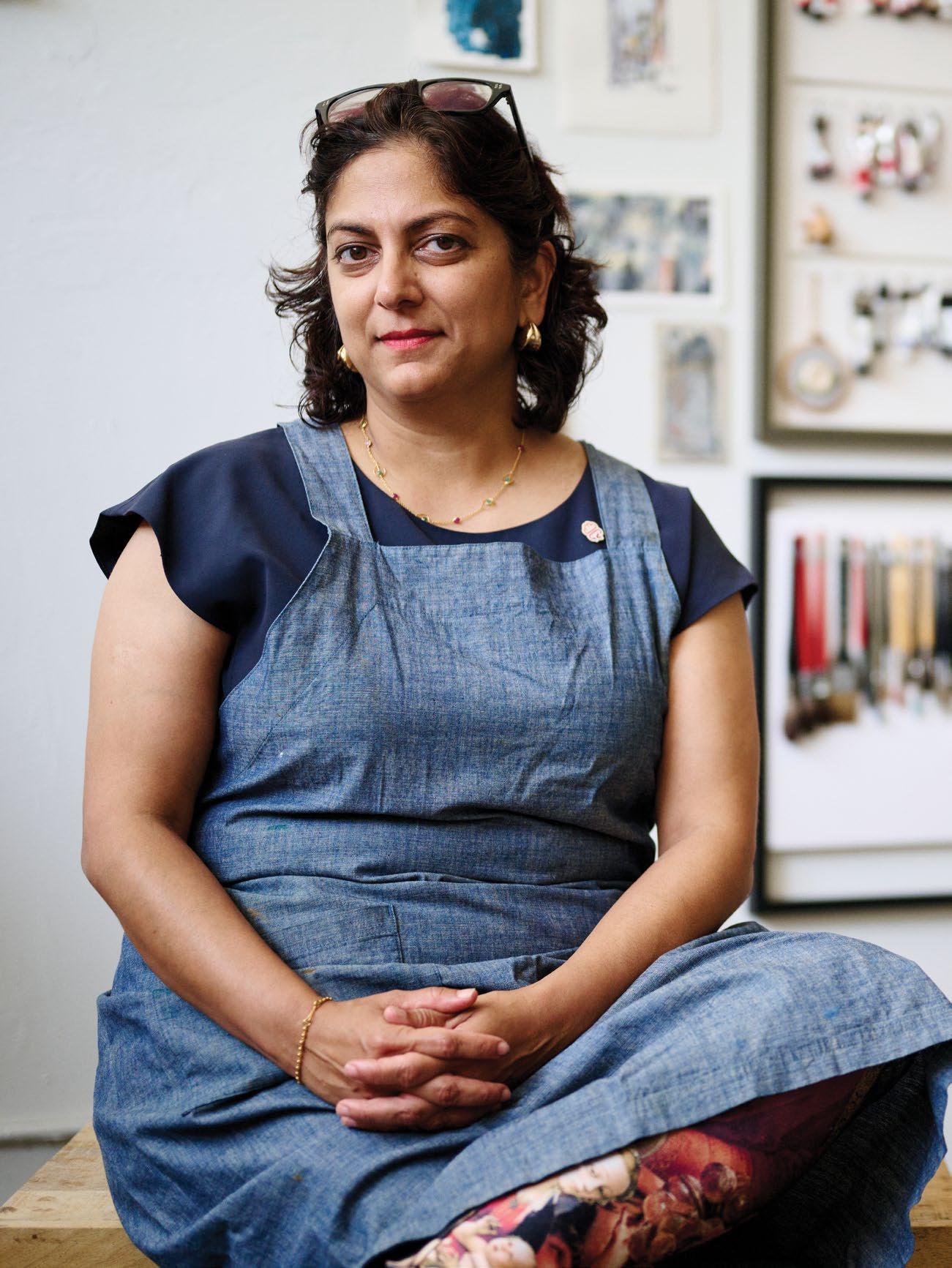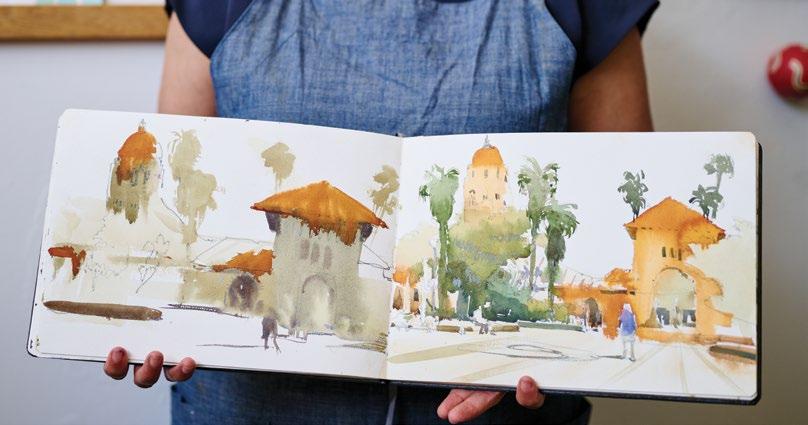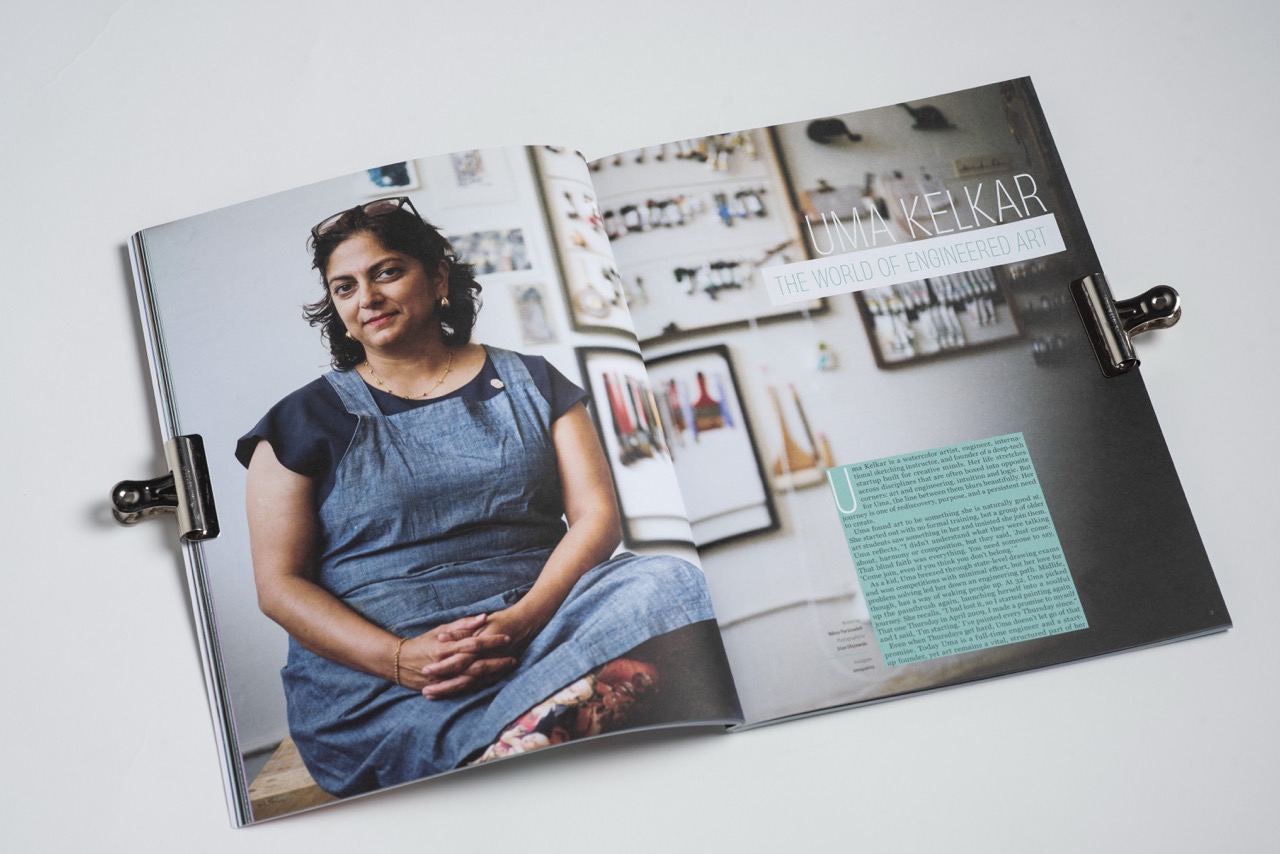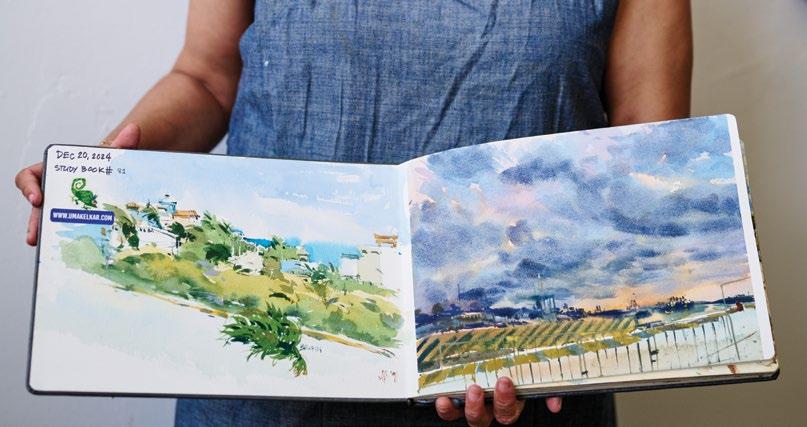
Uma Kelkar is a watercolor artist, engineer, international sketching instructor, and founder of a deep-tech startup built for creative minds. Her life stretches across disciplines that are often boxed into opposite corners: art and engineering, intuition and logic. But for Uma, the line between them blurs beautifully. Her journey is one of rediscovery, purpose, and a persistent need to create.
Uma found art to be something she is naturally good at. She started out with no formal training, but a group of older art students saw something in her and insisted she join them. Uma reflects, “I didn’t understand what they were talking about, harmony or composition, but they said, ‘Just come.’ That blind faith was everything. You need someone to say, ‘Come join, even if you think you don’t belong.’ ”
As a kid, Uma breezed through state-level drawing exams and won competitions with minimal effort, but her love for problem-solving led her down an engineering path. Midlife, though, has a way of waking people up. At 32, Uma picked up the paintbrush again, launching herself into a soulful journey. She recalls, “I had lost it, so I started painting again. That one Thursday in April 2009, I made a promise to myself, and I said, ‘I’m starting.’ I’ve painted every Thursday since.” Even when Thursdays get hard, Uma doesn’t let go of that promise. Today, Uma is a full-time engineer and a startup founder, yet art remains a vital, structured part of her week.
As she got deeper into painting and began connecting with urban sketchers and other artists, she uncovered a love for teaching. She shares, “Every time someone congratulates you or enjoys your work, you feel energized to do it again. We all believe in ourselves, sure, but there’s something powerful about third-person validation. It fuels the cycle.”
For Uma, art and engineering are not separate; they’re puzzles. In both disciplines—art and science—there’s no finality, just a constant hum of iteration. “You make something really pretty, and ten days later you realize: ‘Oh, I could’ve done this better.’ Or sometimes you imagine something beautiful, but you just can’t make it happen. That challenge of trying and failing and solving is everything,” she explains.
“Every time someone congratulates you or enjoys your work, you feel energized to do it again. We all believe in ourselves, sure, but there’s something powerful about third-person validation. It fuels the cycle.”
When asked how she merges the left and right sides of her brain—math and emotion, logic and intuition—Uma has found good artists dissect problems, not themselves, just like good engineers. She finds inexperienced artists often internalize a bad painting as a personal failure, but seasoned ones, like seasoned engineers, break down the issue into smaller problems dissecting it and tinkering with it. This philosophy of tinkering runs deep for Uma, as this practice builds a repository of solutions for problems that haven’t happened yet and, therefore, builds confidence. It can lead to happy accidents, such as an accidental brushstroke that creates a perfect texture.
In October 2022, Uma shifted again, this time launching a startup at the intersection of art and technology. After years of juggling engineering, teaching, and art, she wanted to scale herself and help others like her do the
same. Her product, Vivify.ai, is a visual-intelligence communication platform for creatives. Much like the cloudbased communication platform Slack, this platform is specifically for the creative industry where designers are no longer describing their visuals with text and instead through images.
Uma describes the traditional design review process—sending multiple PDFs back and forth, endless emails, instant messaging, and Zoom meetings—are the norm to decide on something as simple as the right shade of blue. That kind of miscommunication stretches timelines and blows budgets. Animation projects get delayed 80 percent of the time, interior design, 60 percent. Her tool streamlines that process, using image-based prompts and voice messaging to reduce it by half.
By enabling designers to speak and see the results reflected visually in real time, her platform saves each designer 10 hours a week. More importantly, it gives freelancers and solo creators a way to scale without burnout. Uma explains, “Artists at times do five jobs. They’re architects, animators, teachers, influencers, and makers. Their intelligence is scattered. I want to collect that and make them agents of their own scale.”
Outside of the tech-centric nature of her work, Uma’s artist heart still beats strong. Despite her high-tech business and its staggering impact, her art remains rooted in the most human of things: beauty, presence, and story. She paints landscapes and florals not for show, but because they are accessible in the snippets of life between work and family, and she believes drawing in a crowded street creates a kind of soft intimacy. Urban sketching brings stories to Uma’s mind as she quietly draws strangers as they go about their day. Uma Kelkar walks the tightrope between creation and computation. In her world, art and engineering don’t just coexist, but rather they solve each other and are her puzzle, her story, and her freedom, declaring, “You try to achieve something; you might only get 80 percent there, and the remaining 20 percent keeps you coming back. That’s where the kick is.”