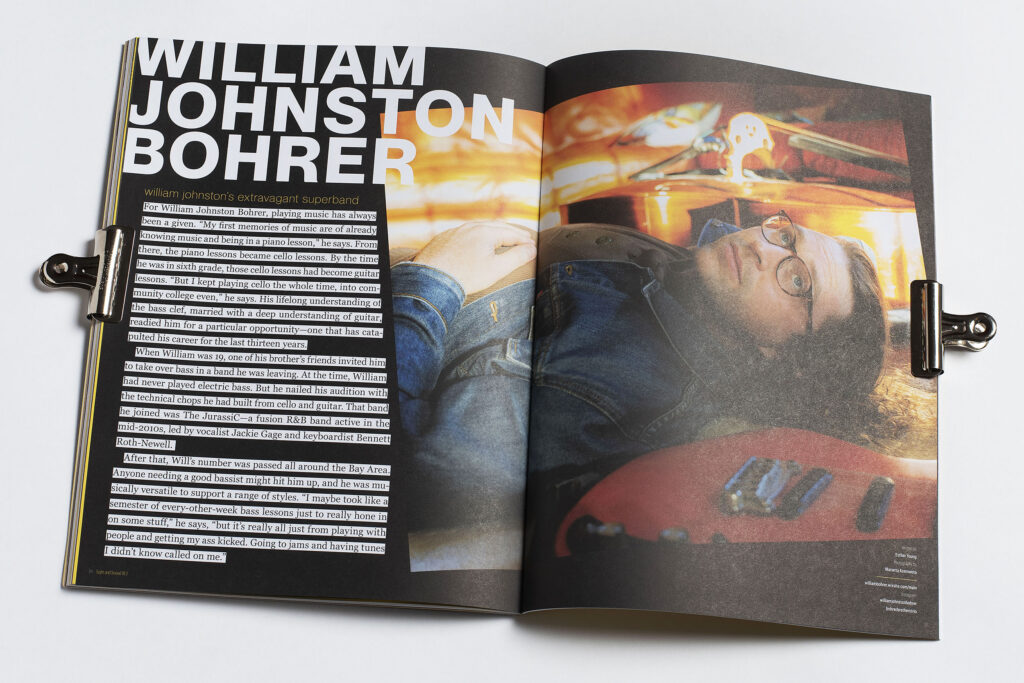
For William Johnston Bohrer, playing music has always been a given. “My first memories of music are of already knowing music and being in a piano lesson,” he says. From there, the piano lessons became cello lessons. By the time he was in sixth grade, those cello lessons had become guitar lessons. “But I kept playing cello the whole time, into community college even,” he says. His lifelong understanding of the bass clef, married with a deep understanding of guitar, readied him for a particular opportunity—one that has catapulted his career for the last thirteen years.
When William was 19, one of his brother’s friends invited him to take over bass in a band he was leaving. At the time, William had never played electric bass. But he nailed his audition with the technical chops he had built from cello and guitar. That band he joined was The JurassiC—a fusion R&B band active in the mid-2010s, led by vocalist Jackie Gage and keyboardist Bennett Roth-Newell.
After that, Will’s number was passed all around the Bay Area. Anyone needing a good bassist might hit him up, and he was musically versatile to support a range of styles. “I maybe took like a semester of every-other-week bass lessons just to really hone in on some stuff,” he says, “but it’s really all just from playing with people and getting my ass kicked. Going to jams and having tunes I didn’t know called on me.”
He met vocalist Ren Geisick at West Valley College and began accompanying her on guitar, forming their duo, the Anachronistics. He also took classes at California Jazz Conservatory. To keep his stylistic toolkit sharp, Will has worked out how to deliver salsa, jazz, reggae, funk, gospel, and country lines on bass. “If I didn’t…I would not be able to support myself,” he says.
But when it comes to his own sound as a bandleader and songwriter, Will leans deep into his passion for ’70s retro soul. He is determined to build on the miraculous achievements of Stevie Wonder on the album Songs in the Key of Life and presents his superband as proof that his vision for ’70s retro soul is possible. Noting the recent wave of retro soul bands as an aesthetic, he says, “All these guys are just recently converted indie-rock guys that never listened to soul a day in their lives.” On the contrary, “I feel like I’m progressing the art form itself.” And William Johnston’s Extravagant Superband is every bit necessary, and marvelous, as a superband.
Three years into playing gospel at church, Will was spellbound by the sound of the Leslie organ. When he plays on stage facing the congregation, his head is right against the speaker cabinet. Inside that old machine, those spinning horns whiz right above his head, slowing and speeding up to create the Doppler effect that is iconic in jazz and gospel.
“I feel like I’m progressing the art form itself.”
Inspired by ’60s funk band The Meters, Will was determined to get the Leslie organ sound alongside that of a clavinet–an instrument similar to an electric harpsichord. “I’m like, I need two keyboard instruments because I need the rhythm guitar space filled, but I just need to do ‘chink, chink,’ then someone else needs to do the Clavinet parts and organs to sustain,” he explains. He continues, “And then I need all the backup vocals because one person can’t sing a separate line by themselves, so I need two people. But they’re locked into their thing, and sometimes I need a third part.”
Combined with the percussion he wants and specific parts for guitar, bass, and saxophone, the recipe may look extravagant, but it’s correct to him as someone who grew up listening to Earth, Wind & Fire (a 17-piece band). “I don’t need it to be anything else other than what it is,” he says. “This is that era—this is that artistic thrust.”
The hurdles created by metropolitan structure and economic paradoxes frustrate his day-to-day balance as a working musician in the South Bay. “People don’t listen to soul music or R&B [here],” he says. Moreover, the high cost of living and scarcity of high-density housing prevent more full-time musicians from calling the South Bay home. “The only people that can afford to live here…Music is just a thing they do on the side,” he adds. The frequent compromise, he notes, is the upkeep of their craft, and their motivation to negotiate market-rate gigs if they make income elsewhere. And for Will, as a professional musician, that hurts his bottom line.
“I should not be here as a musician, with the type of music I make,” he says. “I exist here despite San Jose.” But here, he is accessible to his music students, most of whom are in the Peninsula and the South Bay. He makes it a point to tell his students what they won’t hear from institutions.
With the release of his EP Flesh and Blood, Will plans to take on more roles as a creative producer–advising arrangements, scoring soundtracks, and facilitating the creation of music that inspires him back.
“When I hear authentic blues, that just brings out an emotion… They’re very real and grounded. Anybody in any walk of life can relate to it.” -Aki Kumar
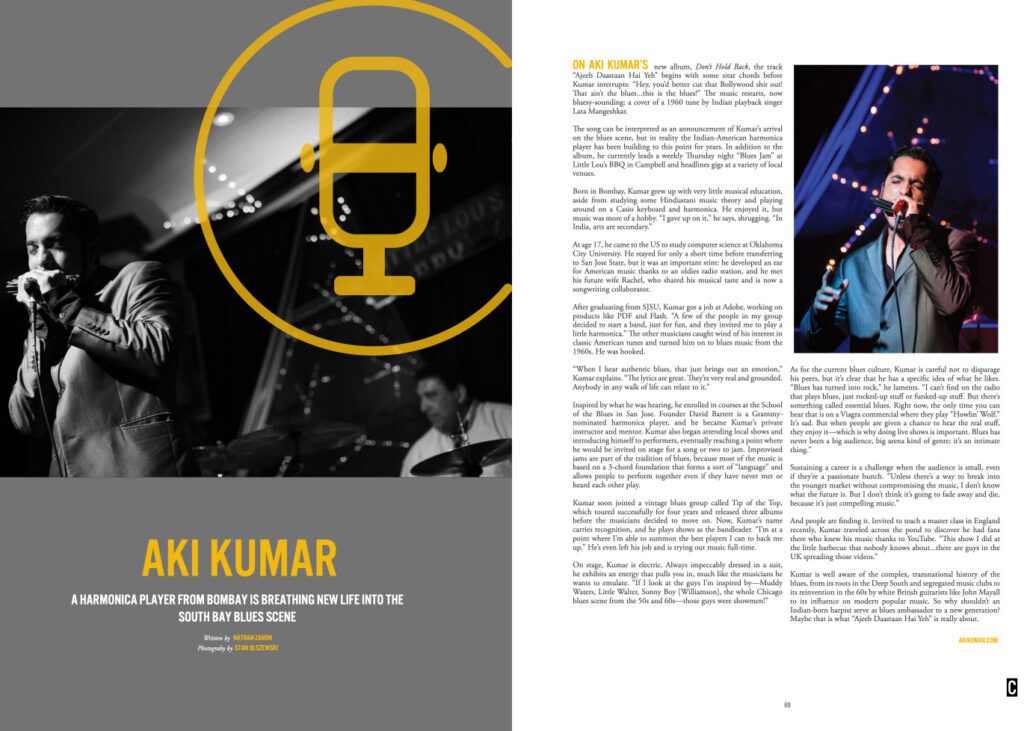
On Aki Kumar’s [2014] album, Don’t Hold Back, the track “Ajeeb Daastaan Hai Yeh” begins with some sitar chords before Kumar interrupts: “Hey, you’d better cut that Bollywood shit out! That ain’t the blues…this is the blues!” The music restarts, now bluesy-sounding: a cover of a 1960 tune by Indian playback singer Lata Mangeshkar.
The song can be interpreted as an announcement of Kumar’s arrival on the blues scene, but in reality this Indian American harmonica player has been building to this point for years. In addition to the album, he currently leads a weekly Thursday night “Blues Jam” at Little Lou’s BBQ in Campbell and headlines gigs at a variety of local venues.
Born in Bombay, Kumar grew up with very little musical education, aside from studying some Hindustani music theory and playing around on a Casio keyboard and harmonica. He enjoyed it, but music was more of a hobby. “I gave up on it,” he says, shrugging. “In India, arts are secondary.”
At age 17, he came to the US to study computer science at Oklahoma City University. He stayed for only a short time before transferring to San Jose State, but it was an important stint: he discovered an ear for American music thanks to an oldies radio station, and he met his future wife Rachel, who shared his musical taste and is now a songwriting collaborator.
After graduating from SJSU, Kumar got a job at Adobe, working on products like PDF and Flash. “A few of the people in my group decided to start a band, just for fun, and they invited me to play a little harmonica.” The other musicians caught wind of his interest in classic American tunes and turned him on to blues music from the 1960s. He was hooked.
“When I hear authentic blues, that just brings out an emotion,” Kumar explains. “The lyrics are great. They’re very real and grounded. Anybody in any walk of life can relate to it.”
Inspired by what he was hearing, he enrolled in courses at the School of the Blues in San Jose. Founder David Barrett is a Grammy-nominated harmonica player, and he became Kumar’s private instructor and mentor. Kumar also began attending local shows and introducing himself to performers, eventually reaching a point where he would be invited on stage for a song or two to jam. Improvised jams are part of the tradition of blues, because most of the music is based on a three-chord foundation that forms a sort of “language” and allows people to perform together even if they have never met or heard each other play.
Kumar soon joined a vintage blues group called Tip of the Top, which toured successfully for four years and released three albums before the musicians decided to move on. Now, Kumar’s name carries recognition, and he plays shows as the bandleader. “I’m at a point where I’m able to summon the best players I can to back me up.” He’s even left his job and is trying out music full-time.
On stage, Kumar is electric. Always impeccably dressed in a suit, he exhibits an energy that pulls you in, much like the musicians he wants to emulate. “If I look at the guys I’m inspired by—Muddy Waters, Little Walter, Sonny Boy [Williamson], the whole Chicago blues scene from the ’50s and ’60s—those guys were showmen!”
As for the current blues culture, Kumar is careful not to disparage his peers, but it’s clear that he has a specific idea of what he likes. “Blues has turned into rock,” he laments. “I can turn on a radio and find nothing that plays blues, or it plays rocked-up stuff or funked-up stuff. But there’s something called essential blues. Right now, the only time you can hear that is on a Viagra commercial where they play “Howlin’ Wolf.” It’s sad. But when people are given a chance to hear the real stuff, they enjoy it—which is why doing live shows is important. Blues has never been a big audience, big arena kind of genre; it’s an intimate thing.”
But sustaining a career is a challenge when the audience is small, even if they’re a passionate bunch. “Unless there’s a way to break into the younger market without compromising the music, I don’t know what the future is. But I don’t think it’s going to fade away and die, because it’s just compelling music.”
And people are finding it. Invited to teach a master class in England recently, Kumar traveled across the pond to discover he had fans there who knew his music thanks to YouTube. “This show I did at the little barbecue that nobody knows about…there are guys in the UK spreading those videos.”
Kumar is well aware of the complex, transnational history of the blues, from its roots in the Deep South and segregated music clubs to its reinvention in the ’60s by white British guitarists like John Mayall to its influence on modern popular music across the spectrum. So why shouldn’t an Indian-born harpist serve as blues ambassador to a new generation? Maybe that is what “Ajeeb Daastaan Hai Yeh” is really about.
Join singer-songwriter Ren Geisick to celebrate the release of her new album on June 21, 2025, at Art Boutiki in San Jose. Her full-length album, The Place I Planned to Go, will be released on June 20, 2025, featuring 14 original songs that showcase her evolution from a jazz vocalist to an Americana songbird, grounded in storytelling, perseverance, and hope. Get Tickets.
Ren was previously featured in Issue 9.4 “Perform” & Episode #33 of the Content Magazine Podcast, where we talk in depth about her roots growing up in Los Gatos, California, her education in Jazz vocal performance, and some early Jazz crossover and funk projects.
Originally from Los Gatos, California, Ren Geisick began singing at a young age. She earned an Ella Fitzgerald Scholarship, studied Jazz vocal performance at California State University, Long Beach, and was named an Outstanding Jazz Vocalist by DownBeat Magazine—but her identity as an Americana Singer-Songwriter has long been in motion. With influences like Willie Nelson, Patsy Cline, and Guy Clark, her latest music draws from the outlaw country tradition—authentic, stripped-down, and emotionally direct. In 2017, she released her debut album, Ren, Love Song, produced by Jesse Harris, marking a significant step toward Americana, which blended folk with jazz sensibilities and showcased her deeply personal songwriting voice. Since then, Ren has leaned fully into Country music. While she doesn’t set out to specifically write country songs, her singing style and focus on honest, lyrical narratives have made Americana a natural fit for her.
The Place I Planned to Go centers on themes of hope and perseverance, especially in the context of being a musician. The album explores the struggles of progressing in life and music, maintaining optimism in the face of challenges, and finding compassion. It includes songs that reflect on the difficulties of the music industry, like the humorous “15 Cents” and more introspective tracks like “Weakness” and “No Mercy at All.” The title track, “The Place I Plan to Go,” was written during the pandemic and reflects on life not turning out exactly as expected yet maintaining hope for the future.
In this conversation, Ren gives us a behind-the-scenes glimpse at the production of this record and collaboration with producer Mikey Ross. Ren opens up about the challenges of sustaining a music career today, her reasons for pushing forward, and her connection to the music she creates.
Follow Ren on Instagram @ren4eva and visit her website, rensings.com, for show dates and updates. Don’t miss her album release show on June 21, 2025, at Art Boutiki in San Jose. Get Tickets.
Content Black Background Performance
“…I would pick up one of my dad’s guitars at home and download tabs from the Internet and try to teach myself Green Day songs.”
Raised on San Jose’s South Side by two social workers, local punk guitarist Mike Huguenor’s upbringing was culturally eclectic. His parents actively encouraged the consumption of all genres of literature, film, and music. If he wanted a particular book, they would purchase it for him. Musically, he was raised listening to the likes of Van Halen and other ’80s “fun rock” groups with his mom, jazz and opera with his dad, and Huey Lewis with both his parents. His dad routinely made mixtapes for him and his brother to listen to. When it came time to choose an instrument for middle school music classes, Huguenor settled on the alto saxophone, an instrument he remembers his father playing. But his excitement for it was no match for his obsession with punk rock. “I was playing sax in the school band, but then I would pick up one of my dad’s guitars at home and download tabs from the internet and try to teach myself Green Day songs.”
Huguenor had discovered the genre through San Jose’s now defunct rock station KOME. It was where he first heard acts like the Offspring and the Bay Area’s own Green Day. Shortly thereafter, a relative of Huguenor introduced him to the Berkeley-based underground band Operation Ivy. “When I heard them, it just opened up everything for me. They were my first real favorite band,” Huguenor says. About 11 years old at the time, he thought it was the best music he ever heard and still thinks their sole, self-titled album is “one of the best punk records ever.”
Huguenor is not alone in that sentiment. Despite the band’s short, three-year tenure, Operation Ivy’s influence on modern punk music—especially the ska subgenre—is difficult to overstate. Dozens of bands, including Goldfinger, Green Day, and Rancid, have released covers of Operation Ivy songs. Most recently, Machine Gun Kelly licensed the hook lyric from their song “Knowledge” for his song “all I know.”
Huguenor was given a starter electric guitar by his ever-supportive parents for his thirteenth birthday. “That’s when I started thinking about it intentionally and started writing hypothetical songs for bands that didn’t really exist.” Huguenor soon formed his first band and took his songwriting from hypothetical to actual. “Let’s just do it,” he recalls saying to a friend. “All these bands are all just people doing it. Let’s start a band.”
That sentiment gave birth to the short-lived punk group, Shooting Blanks. From there, Huguenor experimented with several punk acts throughout high school, but it wasn’t until shortly after graduating in 2002 that he formed his “real, I-actually-want-to-make-a-band, band,” Shinobu. “At the time, I thought it was going to be my not-punk band,” he says. “But in spirit it ended up being so, and that was the community that accepted us.”
After releasing several albums and touring occasionally over the course of six years, Huguenor soon found himself the lone member of Shinobu remaining in California. Another South Bay act, Pteradon, was in a similar situation, having lost their guitarist to the tech industry. Huguenor joined them and formed Hard Girls in 2008. Hard Girls’ songwriting process consisted of simply jamming a riff over and over together until it became a song, as opposed to Huguenor being the primary in Shinobu’s process. Huguenor found the new approach “very freeing.” It got him thinking about music differently, he said. “I was trying to write guitar parts that were interesting and were non-chordal. I was trying to fill out a song with just one guitar and have it sound huge and have it not just be strumming chords.”
Huguenor quickly found that composition wasn’t the only major difference between the two acts. “Shinobu would play San Jose shows and there would be 20 people there. Then Hard Girls would play shows and there would be 150 people there. It seemed like the scene had changed a lot.” Shortly after the formation of Hard Girls, Huguenor received a life-changing phone call. He was told that Jesse Michaels, frontman of aforementioned Operation Ivy, was starting a new musical project and wanted Hard Girls to be a part of it. Michaels had been in the South Bay recording some demos for the new project with Asian Man Records, the same label who had released Hard Girls’ first album. While recording, it was obvious the tracks needed a full band behind them. Mike Park, founder of Asian Man, suggested Hard Girls. The quartet became Classics of Love. “I was just completely blown away at the thought of it and could not believe it,” Huguenor says. “It was a dream situation.”
Hard Girls continued writing and touring at the same time as Classics of Love. Despite consisting mostly of the same members, the type of music differed significantly. “Hard Girls was writing more indie rock music,” Huguenor said. “Jesse was writing straight up ’80s hardcore punk songs. So we were playing way faster, in a totally different harmonic register.”
Over four years, Classics of Love released an EP and a full-length album that spawned tours in both the United States and the United Kingdom. Michaels then relocated to Los Angeles and continues releasing music under the Classics of Love name. Huguenor looks back at the time fondly, having had the opportunity to work so closely with one of his musical heroes. “I don’t really feel a lot of ownership of it. I am just happy to have been a part of it.”
Since then, Huguenor has gone on to record and perform with other acts, both local—such as the Bruce Lee Band and Teens in Trouble— and beyond—such as Dan Andriano in the Emergency Room and Jeff Rosenstock. He currently writes, records, and performs regularly with Rosenstock. In 2020, he also released a solo album of instrumental music in which he plays all the parts on the guitar.
Huguenor’s path has become iconic for many San Jose punk rockers. Ask any musician or fan in the local punk or punk-adjacent music scenes, and they’ll instantly recognize his name. While his stint working with a punk legend may have accelerated that image, Huguenor has now blazed his own reputation that easily stands on its own. “Every year I meet more people who have Shinobu tattoos and who say we inspired them. I really appreciate all their love for the band. It makes me really happy to know that we did connect with people.”
He hopes he can leverage his experiences to help those struggling to find their break. He also wants to see the local music scene grow and thrive. “The punk community has never been able to get a foothold here, and I feel like it needs that. It needs to be allowed to have a permanent space. I need to be involved in some way locally because I need to advocate for the people who are currently teenagers, who have nowhere to play because there’s no room that accommodates major touring bands in San Jose.”
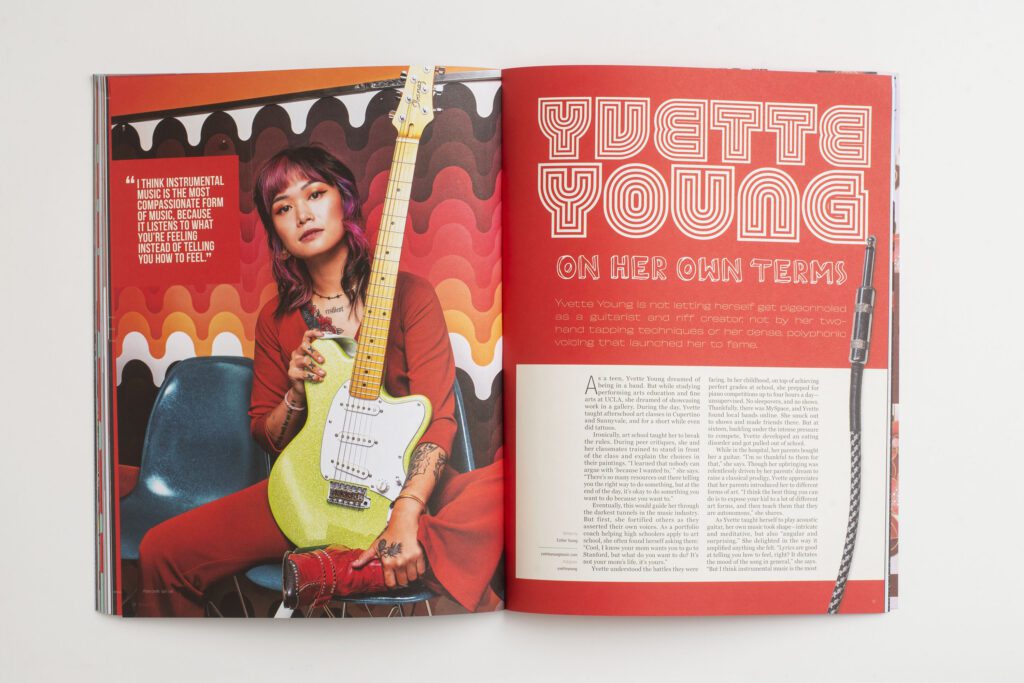
“I think instrumental music is the most compassionate form of music, because it listens to what you’re feeling instead of telling you how to feel.”
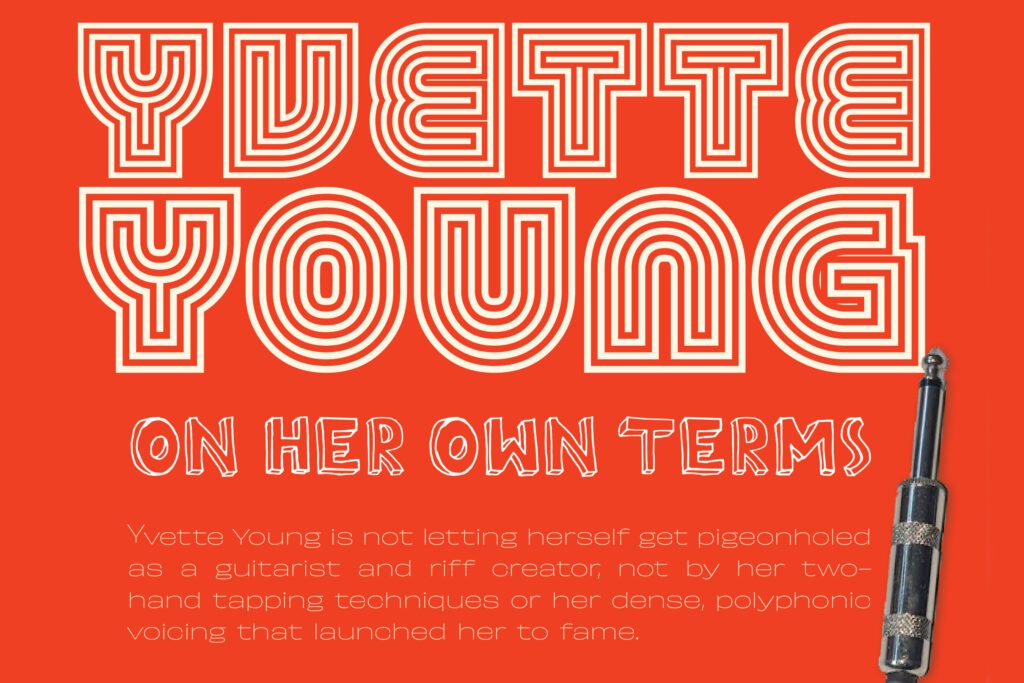
As a teen, Yvette Young dreamed of being in a band. But while studying performing arts education and fine arts at UCLA, she dreamed of showcasing work in a gallery. During the day, Yvette taught afterschool art classes in Cupertino and Sunnyvale, and for a short while even did tattoos.
Ironically, art school taught her to break the rules. During peer critiques, she and her classmates trained to stand in front of the class and explain the choices in their paintings. “I learned that nobody can argue with ‘because I wanted to,’ ” she says. “There’s so many resources out there telling you the right way to do something, but at the end of the day, it’s okay to do something you want to do because you want to.”
Eventually, this would guide her through the darkest tunnels in the music industry. But first, she fortified others as they asserted their own voices. As a portfolio coach helping high schoolers apply to art school, she often found herself asking them: “Cool, I know your mom wants you to go to Stanford, but what do you want to do? It’s not your mom’s life, it’s yours.”
Yvette understood the battles they were facing. In her childhood, on top of achieving perfect grades at school, she prepped for piano competitions up to four hours a day—unsupervised. No sleepovers, and no shows. Thankfully, there was MySpace, and Yvette found local bands online. She snuck out to shows and made friends there. But at sixteen, buckling under the intense pressure to compete, Yvette developed an eating disorder and got pulled out of school.
While in the hospital, her parents bought her a guitar. “I’m so thankful to them for that,” she says. Though her upbringing was relentlessly driven by her parents’ dream to raise a classical prodigy, Yvette appreciates that her parents introduced her to different forms of art. “I think the best thing you can do is to expose your kid to a lot of different art forms, and then teach them that they are autonomous,” she shares.
As Yvette taught herself to play acoustic guitar, her own music took shape—intricate and meditative, but also “angular and surprising.” She delighted in the way it amplified anything she felt. “Lyrics are good at telling you how to feel, right? It dictates the mood of the song in general,” she says. “But I think instrumental music is the most compassionate form of music. It listens to what you’re feeling instead of telling you how to feel.”
She also wanted to subvert stereotypes. “I kind of detested the thought that people would hear my gender through my music.” At the time, witnessing a tendency for women to be written off as singers, Yvette didn’t want to be pocketed into a singer-songwriter genre like “coffee shop core.”
In early 2014, Yvette released her first EP Acoustics. Still an art teacher living in San Jose, she started a band with friends—the first iteration of Covet. With her virtuosic style in the spotlight, Covet grew to prominence in the math rock scene. Two years later, they were on tour. But when one of her bandmate’s behavior became erratic, Yvette had to lean on her closest friends as she navigated the hostile work environment that Covet had become for her.
“I never thought that I would have to devote my energy to a legal battle. I was like, ‘Yo, I just wanna write music.’ ” While playing at Bonnaroo, in Tennessee, she had a breakdown backstage. When she looked up, she was surprised to hear clapping. “They were like, welcome, you’ve passed the rite of passage!” she recalls. Her peers in the guitar community assured her: “Everyone goes through this once in their career. Everyone gets deceived at some point…it’s just how the industry works, unfortunately.”
Yvette took about two years to extricate herself from the situation. Instead of trashing the project, she brought in a new drummer and bassist in 2022 and plans to continue touring with them. “Covet represents a little bit of my past where I still love it to death,” she says. “Guitar riffage? Hell yeah!”
But just as playing guitar for herself—all those years ago—led her to fall back in love with piano and violin, Yvette is following her curiosity towards her present interests. “The key to staying an artist isn’t curating who you are to what people expect of you,” she says. “It’s actually supposed to be the opposite.”
Lately, Yvette’s been falling in love with music production—creating soundscapes with violin, trumpet, or cello. She’s interested in supporting a larger narrative, versus being the front person. “I can work behind the scenes and actually become even more fulfilled artistically,” she says. Between long, lazy drives to her home in the mountains and joyful afternoons creating field recordings, “I’m just trying to figure out how I can stay home more, tour a little less, and just pursue what I actually find really fulfilling.”
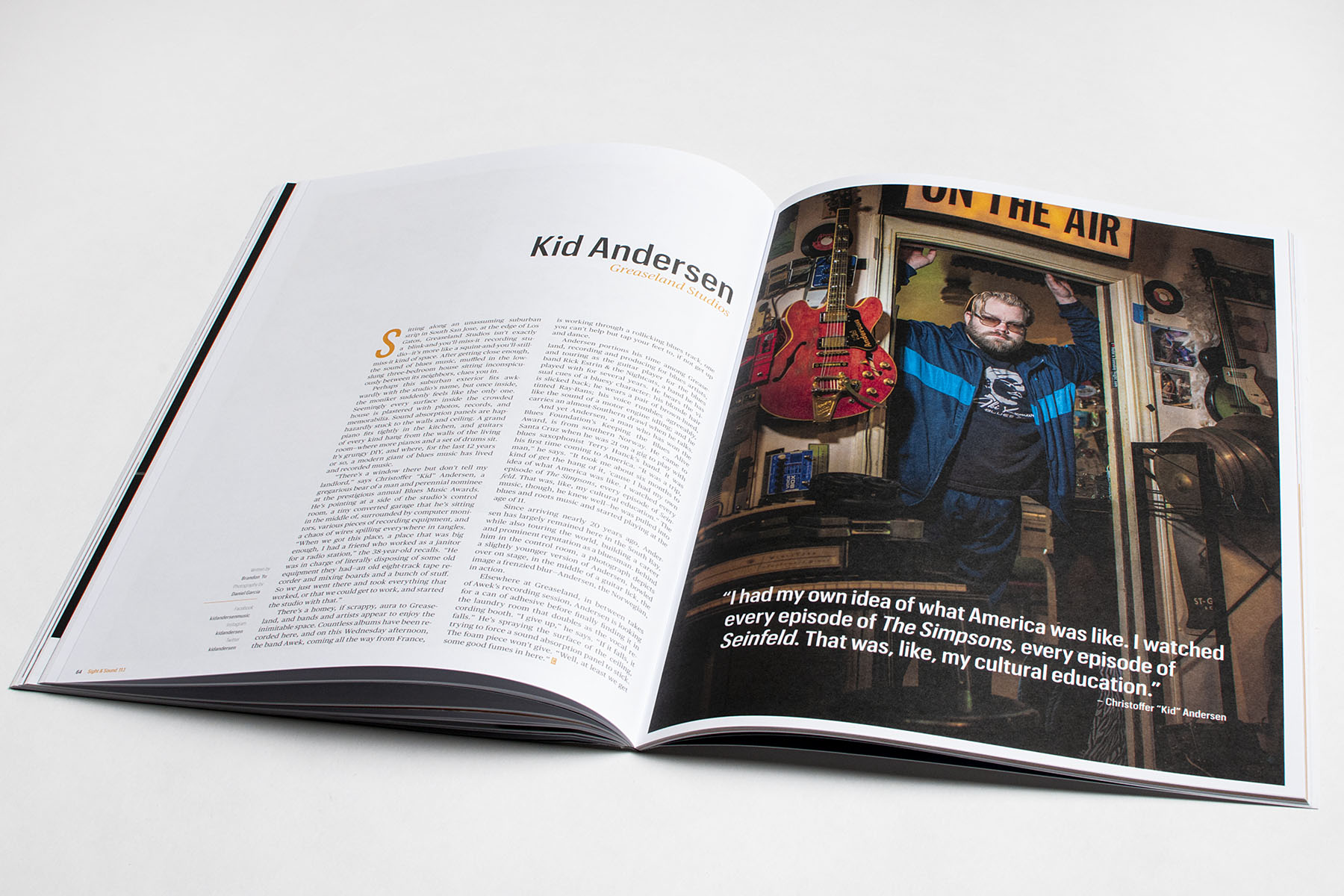
Sitting along an unassuming suburban strip in South San Jose, at the edge of Los Gatos, Greaseland Studios isn’t exactly a blink-and-you’ll-miss-it recording studio—it’s more like a squint-and-you’ll-stillmiss-it kind of space. After getting close enough, the sound of blues music, muffled in the lowslung three-bedroom house sitting inconspicuously between its neighbors, clues you in.
Perhaps this suburban exterior fits awkwardly with the studio’s name, but once inside, the moniker suddenly feels like the only one. Seemingly every surface inside the crowded house is plastered with photos, records, and memorabilia. Sound absorption panels are haphazardly stuck to the walls and ceiling. A grand piano fits tightly in the kitchen, and guitars of every kind hang from the walls of the living room—where more pianos and a set of drums sit. It’s grungy DIY, and where, for the last 12 years or so, a modern giant of blues music has lived and recorded music.
“I had my own idea of what America was like. I watched every episode of The Simpsons, every episode of Seinfeld. That was, like, my cultural education.” – Christoffer “Kid” Andersen
“There’s a window there but don’t tell my landlord,” says Christoffer “Kid” Andersen, a gregarious bear of a man and perennial nominee at the prestigious annual Blues Music Awards. He’s pointing at a side of the studio’s control room, a tiny converted garage that he’s sitting in the middle of, surrounded by computer monitors, various pieces of recording equipment, and a chaos of wires spilling everywhere in tangles. “When we got this place, a place that was big enough, I had a friend who worked as a janitor for a radio station,” the 38-year-old recalls. “He was in charge of literally disposing of some old equipment they had—an old eight-track tape recorder and mixing boards and a bunch of stuff. So we just went there and took everything that worked, or that we could get to work, and started the studio with that.”
There’s a homey, if scrappy, aura to Greaseland, and bands and artists appear to enjoy the inimitable space. Countless albums have been recorded here, and on this Wednesday afternoon, the band Awek, coming all the way from France, is working through a rollicking blues track, one you can’t help but tap your feet to, if not get up and dance.
Andersen portions his time among Greaseland, recording and producing for blues artists, and touring as the guitar player for the blues band Rick Estrin & the Nightcats, a band he has played with for several years. He bears the visual cues of a bluesy character: his blonde hair is slicked back; he wears a pair of brown-hued, tinted Ray-Bans; his voice rumbles agreeably, like the sound of a motor engine idling; and he carries an almost-Southern drawl when he talks.
And yet Andersen, a man who has won the Blues Foundation’s Keeping the Blues Alive Award, is from southern Norway. He came to Santa Cruz when he was 21 on a gig to play with blues saxophonist Terry Hanck’s band. It was his first time coming to America. “It was a trip, man,” he says. “It took me about six months to kind of get the hang of it, ’cause I had my own idea of what America was like. I watched every episode of The Simpsons, every episode of Seinfeld. That was, like, my cultural education.” The music, though, he knew well—he was pulled into blues and roots music and started playing at the age of 11.
Since arriving nearly 20 years ago, Andersen has largely remained here in the South Bay, while also touring the world, building a career and prominent reputation as a bluesman. Behind him in the control room, a photograph depicts a slightly younger version of Andersen, bowled over on stage, in the middle of a guitar lick, the image a frenzied blur—Andersen, the Norwegian, in action.
Elsewhere at Greaseland, in between takes of Awek’s recording session, Andersen is looking for a can of adhesive before finally finding it in the laundry room that doubles as the vocal recording booth. “I give up,” he says. “If it falls, it falls.” He’s spraying the surface of the ceiling, trying to force a sound absorption panel to stick. The foam piece won’t give. “Well, at least we get some good fumes in here.”
My dad brought one home one day, and then one day I just fell in love with it.”
In the world of blues music and beyond, someone to be on the lookout for is Maxx Cabello Jr., a local musician who switches seamlessly between soulfully playing his guitar and rocking out on it. Currently traveling and playing shows with the likes of Earth, Wind, and Fire, Cabello remains true to his Bay Area roots as well, and attendees of the San Jose Jazz Festival may find him onstage.
When did you start playing music? Music’s been in my family since I was born, everybody in my family told me to do it. So I’ll always have that, my early childhood was always surrounded by music. When I was growing up, I listened to a lot of Spanish music, but I was always exposed to rock and roll and things like that. My neighbor actually was a big blues guitar player, he lived right next door to me. Excellent guy, he kind of mentored me, growing up, in the guitar. But I didn’t really play guitar until I was, like, 15 years old. My first instrument was clarinet…and singing, but never guitar. My dad brought one home one day, and then one day I just fell in love with it.
What are you currently working on? I’m traveling quite a bit, but right now my main focus is really trying to finish up my album and get my production together for this show I wanna put together.
Is this your first album? I would say my first real, real, done-right album, because albums before were always rushed and always short, with a small little budget…whatever I could work with. But now it’s like all the years of trying to do something, you know, woodshedding and all that, it kinda makes sense now because this album just has a level, a whole other level. I’ve been writing stuff for more than seven years, but it just hasn’t made sense until recently. And the way the recordings have been coming out is amazing.
It’s called Love and War, and it was originally longer. Thirty-five songs is a lot of music to release at once. So to get some people to listen to it first, instead of blowing my whole wad at once, and not doing the other songs justice, I decided to cut it down to between 12 and 15.
What genre will it be? Will it be mostly blues as well? It’s not gonna be blues at all. You can hear traces of my style, but this is completely different. I don’t know, it has a lot of Spanish [influence]—it’s like rock and roll and soul. It’s a mixture, a little taste of everything. That’s how I see it. It’s a little different…more defined as well.
Do you often play with the same musicians, whether in shows or in the studio? I’ve always gone by my own name, just because bands always break up. You’ve got two kinds of musicians. There are the ones who love the work, but don’t have the experience. Then you have the type that are amazing musicians, they’re always working but that’s what they do, that’s all they do. They’re hired guns. With this album, I’ve used a lot a great musicians, but when it comes time for a show, it’s probably gonna be a really solid core of musicians just backing me.
Could you tell me some more about the production? With the new album coming out, we’re working on this production of Love and War, which is a show, I mean a full-on show, with two 45-minute sets. One with “Love,” which is really soulful and R&B-ish. And the “War” part is pretty much straight-up rock and roll. We have some other styles too, but I’d rather let the listeners put a label on it than label it myself.
I love the blues. I grew up with the blues and that’s never going to change. But my new style of music is more of a maturing after all these years of being exposed to so many different styles of music. All the musicians that I’ve come across have…well, they mold you.