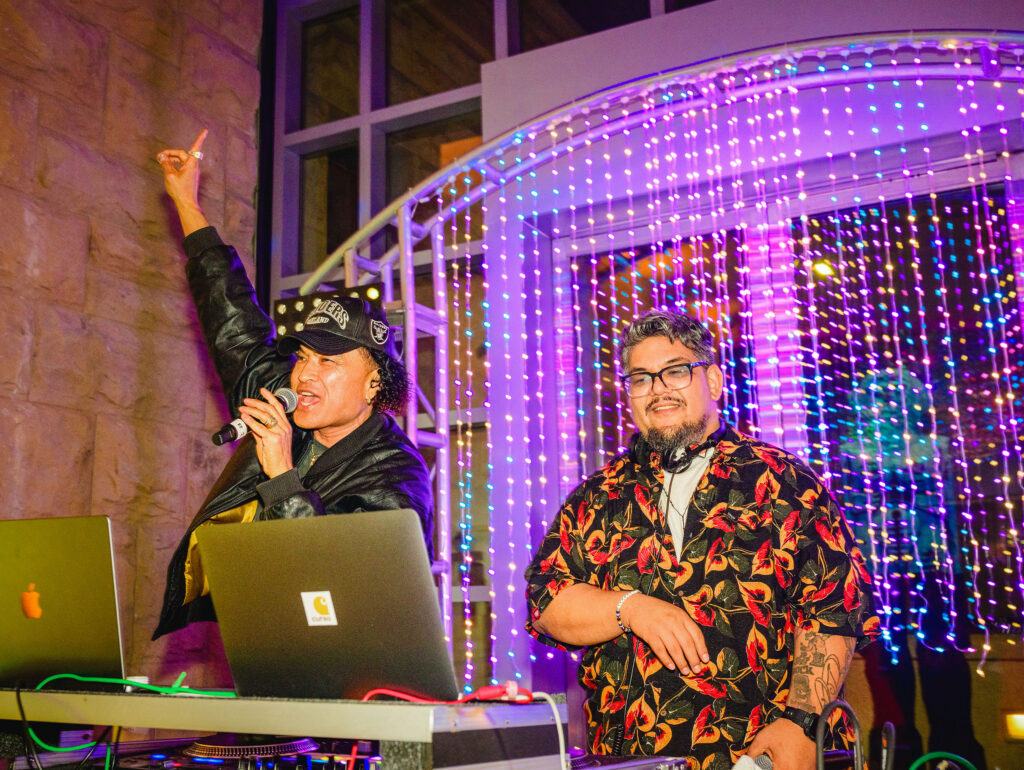
On Saturday, April 25, 2026, downtown San Jose was bustling with energy, as if it were the gateway to an early summer. At the city’s center, the evening began at the circle of palms with the 2026 Gala + Auction, a signature moment where supporters gathered to invest in the creativity and community that define the San Jose Museum of Art (SJMA). This year, the museum honored sculptor Alison Saar with the Artist of Distinction Award and recognized The Adobe Foundation with the SJMA Visionary Award. While the gala sets the foundation for the museum’s mission through an elegant dinner and live auction, the After-Party—presented by Casino M8trix—opens the doors to the broader community, inviting everyone to join the celebration that began earlier.
Walking the purple carpet and seeing members of the arts community dressed in their finest immediately set the tone for a night of shared revelry. Even guests at the gala who seemed to be on their way out at the start of the after-party could be seen second-guessing the decision as the music began to hum. The heart of the party was the dance floor, centered in the museum lobby directly beneath Pae White’s installation, Noisy Blushes, hovering over the crowd like a geometric disco ball landing on Earth. The piece, a meditation on movement and time, material presence, and the elusiveness of form, links the outside with the inside of the museum and serves as a fitting beacon of an evening elevated by the confluence of community. On this night, the lobby was transformed into the classiest nightclub in town, pulsing to live sets by mainstay local DJs and vibe curators DJ Chale Brown and Cutso, with a surprise guest performance by Lyrics Born that electrified the audience.
The vibe on the dance floor was buzzing, a convergence of backgrounds and styles all moving together under the shimmer of White’s work. Between dances, guests enjoyed chef-crafted “light bites” in the Wendel Center from local restaurant partners, including Mezcal Restaurant, The Club on Post, Scott’s Seafood, and Casino M8trix, paired with specialty spirits from 10th St. Distillery. The unique charm of the atmosphere allowed attendees to easily slip away from the music and to the museum’s galleries and experience world-class artwork in a more intimate setting, exploring current exhibitions like Motherboards, ektor garcia: loose ends, and Tending and Dreaming. It was a testament to the power of art and community joy in downtown San Jose.
The Art of Disability Culture — Working Towards Access and Inclusion at the Palo Alto Art Center
SV CREATES’ The Business of Arts and Culture provided an important reminder about the cultural diversity of our community, the unique organizational ecosystem that has built upon it, and continued urgency for social justice, access, and equity in our work. At the Palo Alto Art Center’s recent staff retreat this summer, we used the Museums & Race Report Card tool to assess our progress in supporting equity in governance, funding, representation, responsiveness, resources, and transparency. On average, staff gave us a “C” grade, identifying some gains in the area of representation in programming and transparency, but acknowledging significant work to do in diversifying our staff and in creating a sustainable funding source for equity efforts.
I reflect upon this work as we get ready to launch our fall exhibition, The Art of Disability Culture. As a staff, we have been committed to exploring the “A” for “access” and the “I” for inclusion in our ongoing DEAI (Diversity, Equity, Access, and Inclusivity) work. We saw this exhibition as a chance for us to enhance our organizational capacity for access and inclusion, while bringing creative perspectives from the disability community to the public.
The exhibition will feature the work of 20 artists, all of whom identify as having a disability, in a broad range of media. The show celebrates intersectionality and community, showcasing everything from Anthony Tusler’s documentary photography of the 26-day occupation of the San Francisco Federal Building in 1977 that led to the ADA to the Black Disabled Lives Matter logo designed by Jennifer White-Johnson.
Our goals for the exhibition are lofty:
To introduce audiences to and to create opportunities for celebration around the connectivity, ingenuity, resilience, and creativity of the greater Bay Area disability community.
To encourage audiences to understand the ways that the creative work by people with disabilities has made a positive contribution to our community and world.
To reveal the complexity and diversity of the disability experience.
To promote access to the exhibition for diverse audiences through the use of access features like audio description, Braille, large-print labels, captioned videos, seating, and advance access information.
To achieve these goals, we have relied upon institutional partnerships, with organizations such as AbilityPath, Magical Bridge, Ada’s Cafe in Palo Alto, Creative Growth in Oakland, Creativity Explored in San Francisco, and NIAD Art Center in Richmond. Our outstanding guest curator, Fran Osborne, has created extensive labels for the exhibition that will be available in large-print and Braille. Audio visual descriptions for all the artworks will be available by QR code and on our website. Programs for the exhibition, including Friday Night at the Art Center on September 17 and a Community Day Celebration on October 10, will include live captioning and ASL interpretation, thanks to the assistance of the Midpen Media Center.
This show has demanded that we do more than ever before to support access and inclusion. Funding was necessary to support these activities and we are grateful for the generosity of the Institute of Museum and Library Services, California Humanities, Pamela and David Hornik, and Magical Bridge.
I am also mindful that this exhibition has come at a time when our staff is the smallest it’s been in organizational history. The impact of COVID-19 hit the Palo Alto Art Center dramatically, and like many of our colleagues, we are working to rebuild and recover. While the preparations for this show stretched our team, we have found continued inspiration in the work of the artists, who have been so appreciative for the opportunity to show their work in this community and context.
Circling back to the Museums & Race Report Card, I am also reflecting deeply about how we sustain momentum from this exhibition for deeper institutional change — such as sustainable funding to allow us to provide access features for all of our exhibitions moving forward. I am continually reminded that access and inclusion work is a process. We continue to work toward it, striving to make progress toward a future that we hope to shape, but that remains in many ways uncertain.