An art window into China
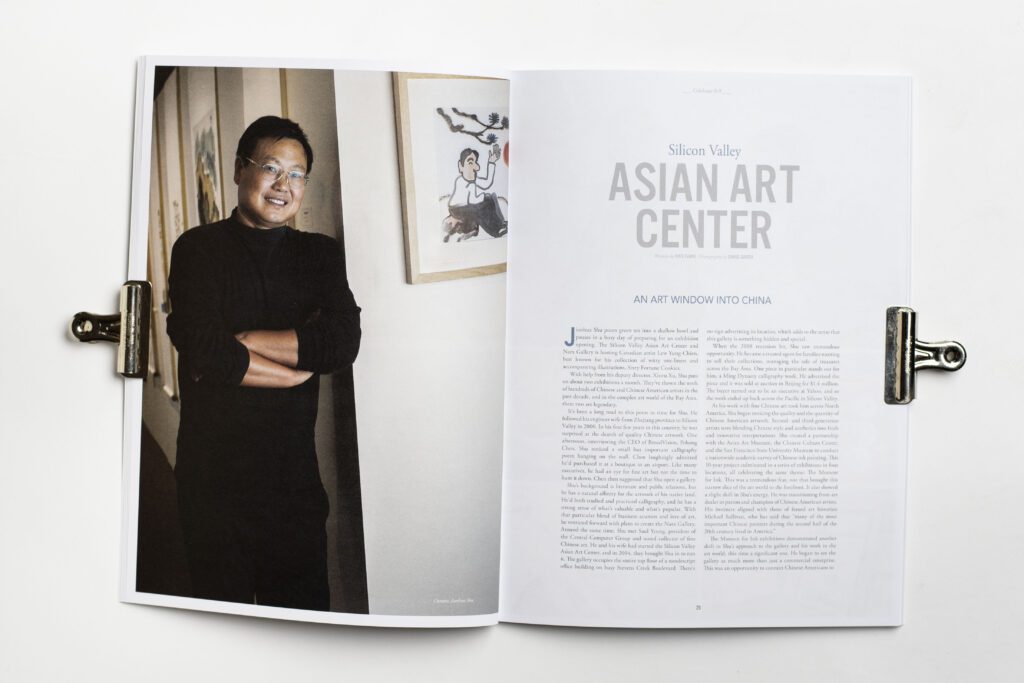
Jianhua Shu pours green tea into a shallow bowl and pauses in a busy day of preparing for an exhibition opening. With help from his deputy director, Xinru Xu, Shu puts on about two exhibitions a month. They’ve shown the work of hundreds of Chinese and Chinese American artists in the past decade, and in the complex art world of the Bay Area, these two are legendary.
Shu has a natural affinity for the artwork of his native land. He has both studied and practiced calligraphy, and he has a strong sense of what’s valuable and what’s popular. With that particular blend of business acumen and love of art, he ventured forward with plans to create the Narx Gallery. Around the same time, Shu met Saul Yeung, president of the Central Computer Group and noted collector of fine Chinese art. He and his wife had started the Silicon Valley Asian Art Center, and in 2004, they brought Shu in to run it. The gallery occupies the entire top floor of a nondescript office building on busy Stevens Creek Boulevard. There’s no sign advertising its location, which adds to the sense that this gallery is something hidden and special.
When the 2008 recession hit, Shu saw tremendous opportunity. He became a trusted agent for families wanting to sell their collections, managing the sale of treasures across the Bay Area. One piece in particular stands out for him: a Ming Dynasty calligraphy work. He advertised the piece, and it was sold at auction in Beijing for $1.4 million. The buyer turned out to be an executive at Yahoo!, and so the work ended up back across the Pacific in Silicon Valley.
As his work with fine Chinese art took him across North America, Shu began noticing the quality and the quantity of Chinese American artwork. Second- and third-generation artists were blending Chinese style and aesthetics into fresh and innovative interpretations. Shu created a partnership with the Asian Art Museum, the Chinese Culture Center, and the San Francisco State University Museum to conduct a nationwide academic survey of Chinese ink painting. This 10-year project culminated in a series of exhibitions in four locations, all celebrating the same theme: “The Moment for Ink.” This was a tremendous feat, one that brought this narrow slice of the art world to the forefront. It also showed a slight shift in Shu’s energy. He was transitioning from art dealer to patron and champion of Chinese American artists.
Through “The Moment for Ink” exhibitions, Shu began to see the gallery as much more than just a commercial enterprise. This was an opportunity to connect Chinese Americans to their culture. One of the best illustrations of this mission is Shu’s uncovering of the cache of artwork from famed Chinese artist Zhang Shuqi. In the 1920s and 1930s, Shuqi studied under Liu Haisu and became well known for his naturalist paintings. In 1942, he moved to the United States, and as his life progressed, his fame faded. Upon his death in 1951, his art was locked away in a storage container. His family had little idea that he was a prominent and beloved artist back home in China.
But Shu knew. Shu was from the same province as Shuqi and knew that he’d settled in the Bay Area, so he started searching for the trove of artwork. Eventually, in 2012, after years of searching for the family, and then convincing them of the art’s worth, he was able to host a large exhibition. Several works were donated, several were sent back to China, and now there are even a few in Stanford University’s collection.
These days, Shu travels back and forth to China four times a year. He acts as a bridge between younger generations of Chinese Americans and the China of today. He tells the story of China’s struggles, its past, and its hopes for the future through art. He hosted an exhibition on the 70th anniversary of the Rape of Nanking. He celebrated the 70th anniversary of China’s victory over Japan. He has plans to mark the 50th anniversary of the Cultural Revolution in May.
Shu holds up a scroll desecrated in 1966 during the Cultural Revolution. Half of the ink characters are almost obliterated by angry strokes of black paint. The older, higher quality of the ink shines through just enough to make out the shapes. Shu is angered by the wholesale and wanton destruction of beautiful art that took place three years before his birth. But today, when he travels back to China, he sees progress. People are happy, open-minded. They have access to more resources.
Xinru Xu, the gallery’s deputy director, explains her philosophy: “Art is a shortcut. It opens a window that is direct and visual.” And through it, people can see Chinese art, history, and culture—and the strong, sustaining bonds between China and California.
SILICON VALLEY ASIAN ART CENTER
facebook: narxgallery
Full article appeared in Issue 9.0 Celebrate
Print Version SOLD OUT