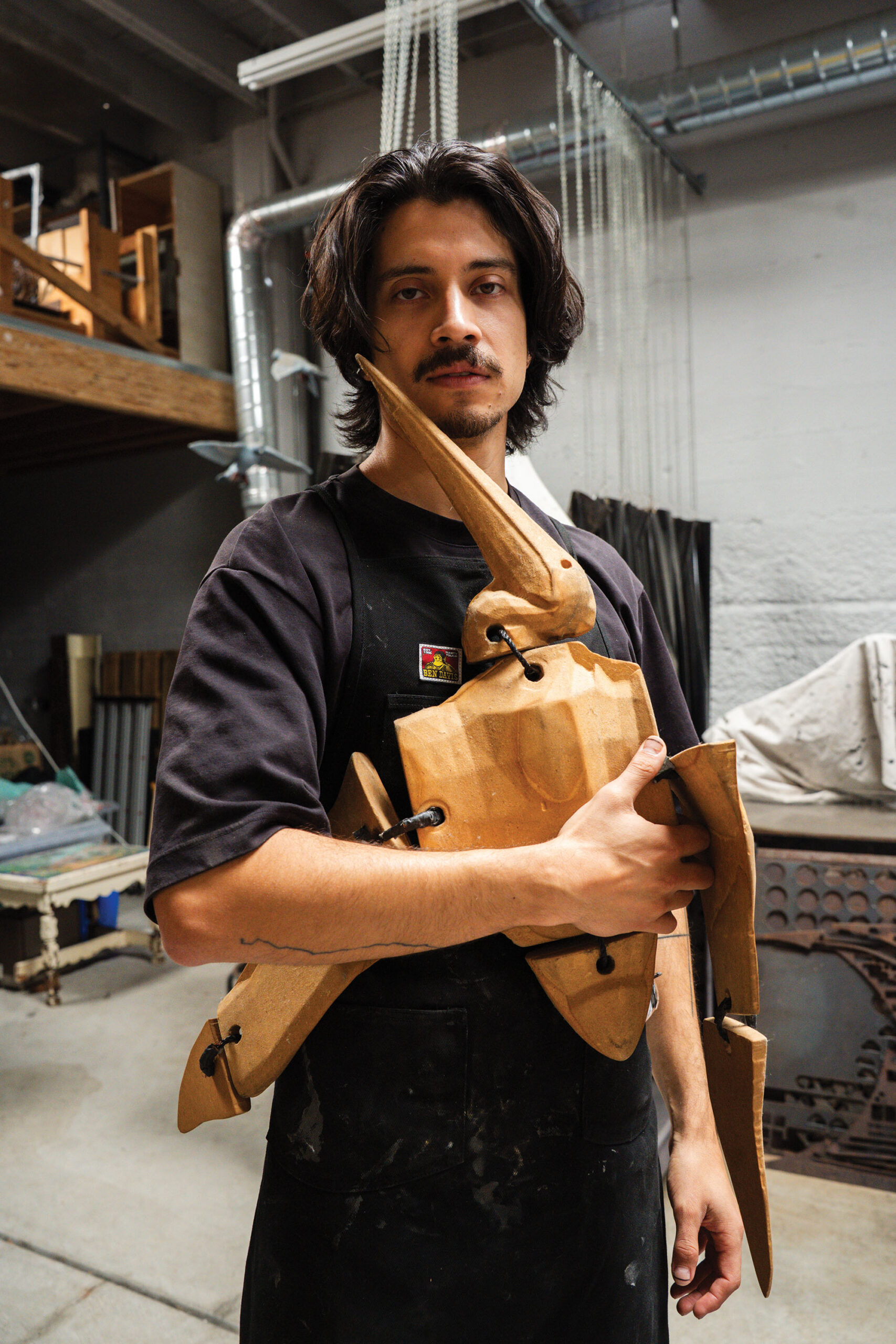
Miguel Novelo sits down at a small table centered within the second-floor kitchenette above the studio he shares with fellow San Francisco Art Institute alumni, Melanie Piech. Pulling a veritable library out of his bag and laying each book out on the table—we’re talking nearly a dozen well-loved paperbacks with titles such as Death, Design, Data and Slow Technology Reader—he declares simply, “Reading is great.”
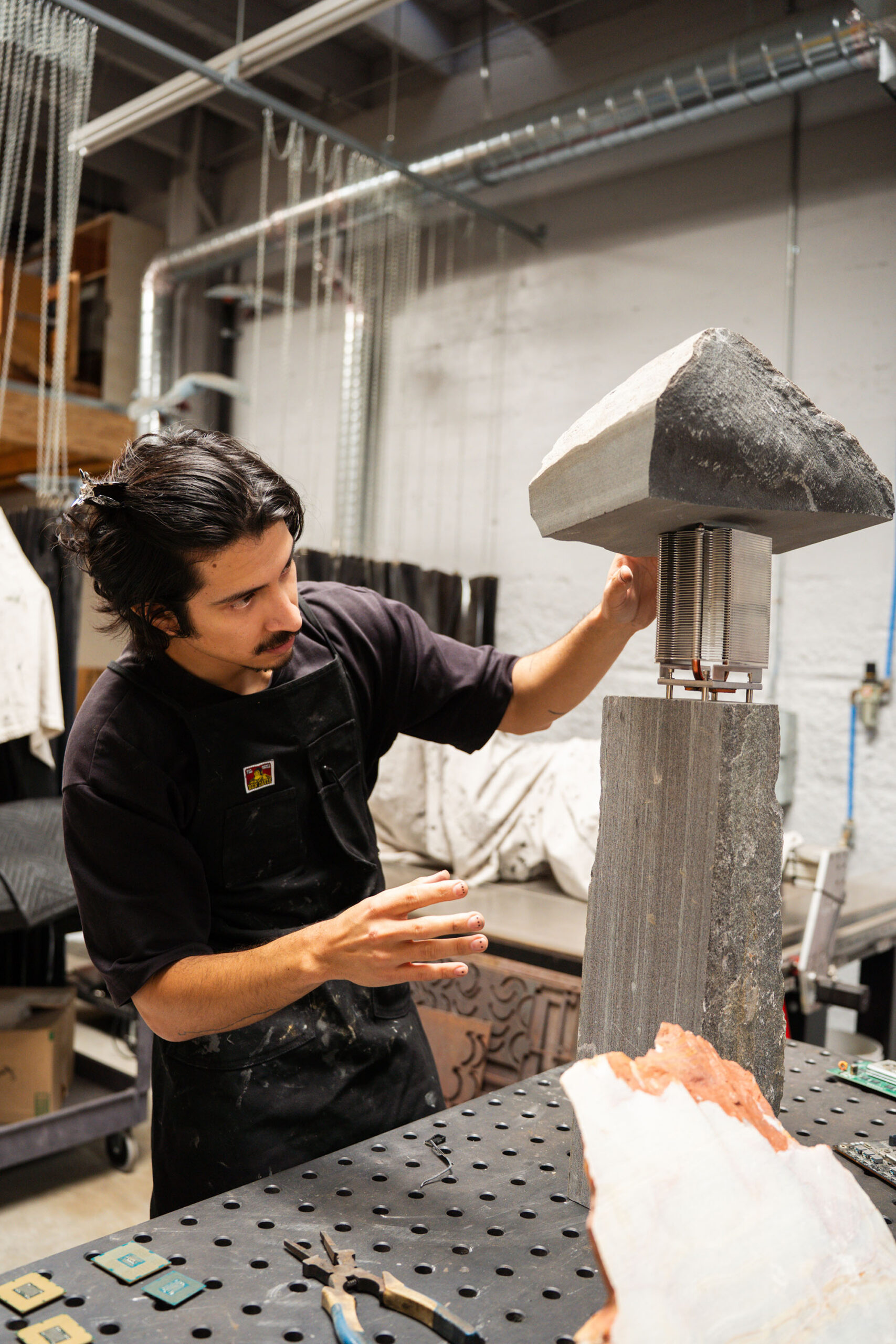
Thinking is just as important to Novelo as the making. Objects, too, have a part to play in the thoughtful, interdisciplinary world-building Novelo engages in. The large studio is stacked with objects, many of them recent additions to an already impressive collection, amassed from his time as a recent artist-in-residence at the Recology San Francisco Artist in Residence (AIR) Program. Old computer monitors, cables, MDF panels, metal-fabrication tools, rocks of varying shapes and sizes, boxes with odds and ends, old drawings—along with an impressive library of books—make up this collection. But as an installation and video-oriented artist, Novelo’s work is about so much more than the objects that appear in his work; it’s about the experiences they can conjure within any given place.
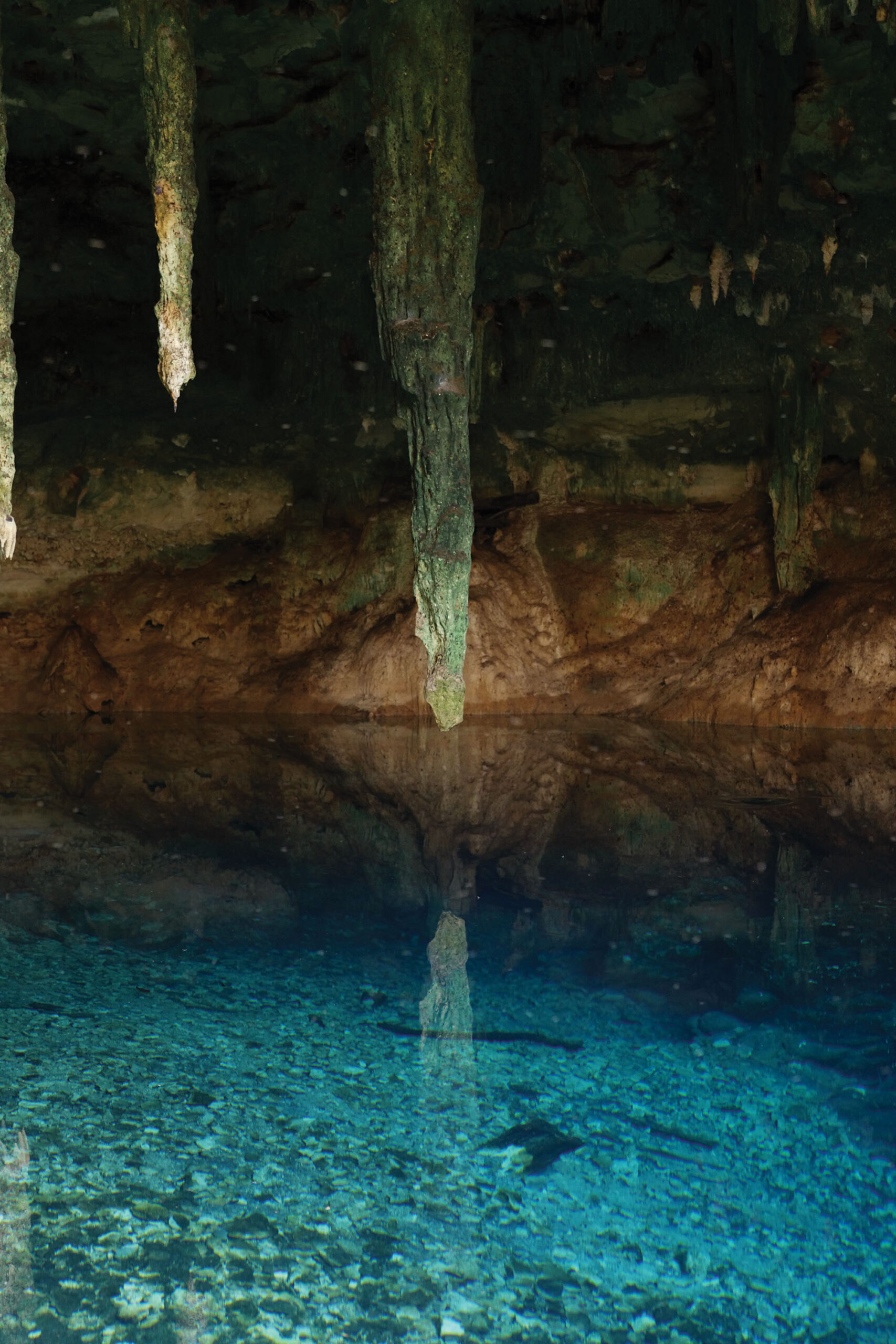
“Most things actually start with a drawing,” Novelo says, his voice measured, almost reverent. “I draw a lot just for me. I research, I find ideas through knowledge, of course, but primarily it starts through the experience [of drawing].” The immersive, genre-bending work that results from these initial drawings presents as anything but strictly visual, making his creative process as an interdisciplinary artist, educator, and researcher all the more intriguing. He describes a piece recently shown as part of SF Art Week, in which multiple speakers, projectors, and lights converted a single room into an immersive soundscape featuring bats emerging from a cave. “If you’re quiet,” he explains, “you can hear the bats…six minutes of them coming up [to the entrance of the cave]. They actually help each other on their way up!”
But you can only hear if you’re quiet. He designed the audio and visual playback to respond to the audience in real time, and if there is sufficient noise and movement to cause sonic disturbance, the video fades to a glowing red and a sub-tone drowns out the bat soundscape. The piece, Vórtice-en-la-zona-
silencio, alludes to ideas of presence, participation, observation, and more overtly, the disruptive impact our human presence can have on the natural world. “I wanted people to understand that their presence matters,” he says, “that listening is an action.” These are the primary considerations that appear to form the core of Novelo’s life and work.
Born and raised in Yucatán, Mexico, Novelo, it seems, was always paying attention to how different systems, environments, and events shape and inform human experience—and vice versa. His father, a veterinarian, often had a young and eager Miguel at his side, observing—and even helping—with animal dissections, for example, which were a completely normalized occurrence. “I’ve always been interested in how things move together,” he says. “People, sound, light, weather, technology. None of it exists alone.” Scientific thinking and an interest in technology, unsurprisingly, came before artmaking for Novelo. After his undergraduate work at the San Francisco Art Institute, he went on to earn an MFA from Stanford University, where he currently lectures. “I’m fascinated by science. I thought Stanford could be a place to really do research and create knowledge. That access to minds is what led me to Stanford.”
Beyond these scientific curiosities, Novelo’s early creative life unfolded through film. As a co-founder of the Campeche Film Festival, along with his sister, Erika, Novelo learned very quickly how films and communal experiences can shift conditionally, how these conditions can be controlled, and to what degree. “It really shaped how I think about media. Control, and the illusion of control, became important to me,” he says. As lead producer, technology director, and programmer for the festival, he was responsible for the entire audience experience, and it was a pivotal moment for him in realizing what he wanted to do next creatively. “That whole experience was media making. I wanted to make things more interactive, to control the full experience. Technology was the way to do that. Who makes technology? Silicon Valley. That’s when I decided to go to San Francisco.”
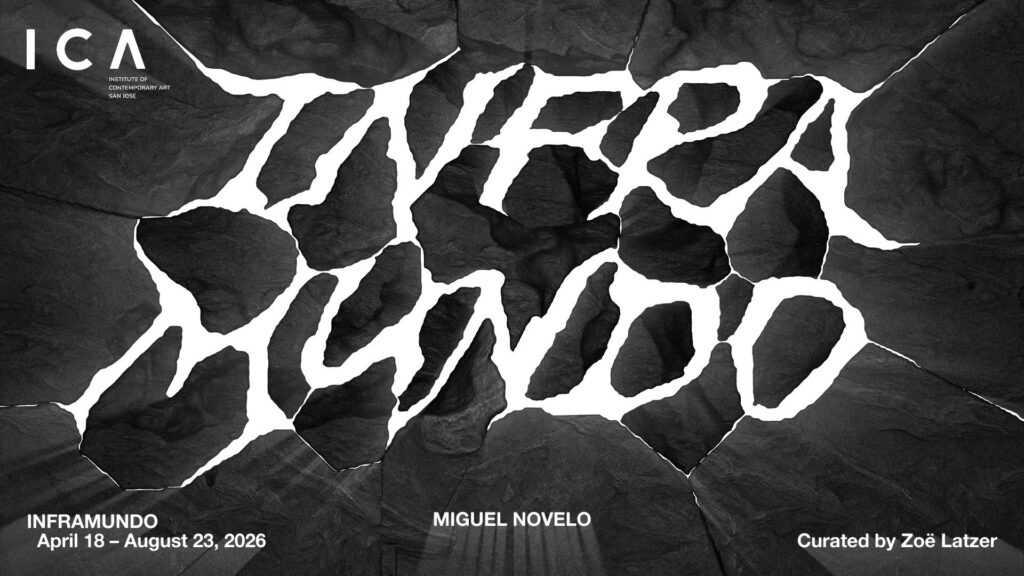
In Novelo’s more recent work, there is a noticeable bent towards full experiential immersion, including several pieces produced at his residency with Recology, where he immersed himself in systems of discard, reuse, and regeneration. But again, materials themselves are secondary. “Technology just allows me to translate something,” he explains. “The experience comes first.” Case in point: For Novelo’s upcoming solo exhibition at the ICA San José, INFRAMUNDO, he’s building out an environment that blends generative visuals and spatialized sound with hammocks and projections that encourage visitors to slow down. “I just tested one of the pieces by projecting it on my ceiling,” he says. “I fell asleep inside of a thunderstorm. I realized, this is it!”
When pressed to describe his body of work in simple terms, he pauses, then laughs. “I usually say I make interactive videos and films,” he says. “Like video games, but more like movies you can talk to.” And many projects certainly do carry a sense of social purpose. He thinks and talks a lot about
accessibility: the how and the why behind audiences entering into the spaces he creates. “Accessibility matters to me. I think about different senses, different attention spans. Someone who spends two seconds with the work. Someone who wants to take it apart and look behind it. I’ve been that person.” He may be working with tools and technologies many can’t understand fully, but he wants his installations to be accessible, to foster connections. “We need to start bridging things, not separating things,” he says, reflecting on both the research-based and creative collaborations he’s had in Russia, Mexico, and the United States. As someone who has only been living and working in the US for a decade, this is personal for him. It is lived experience. Navigating art school and institutions like Stanford University after spending his life in Yucatán, Mexico, he has deftly learned to navigate between two worlds, with the core of both remaining intact in his work. “I am always exploring relationships,” he says, “the ones we have with the environment, with each other, with our histories.”
Novelo clearly grapples with big ideas. Art making seems to be his way of thinking through them. He intelligently, but ever playfully, invites audiences into shared systems of feeling and experience, and in a moment when digital tools often distance us from one another, his installations insist on quite the opposite. Through his work, one has the feeling that just as technology becomes increasingly formidable, it can—if treated with intention—help us feel more attuned to one another and the world around us. His work seems to invite the audience to both notice and feel that which we are already a part of. “It’s about all these little connection points that create the bigger picture,” he says with a shrug. “Maybe that’s what art can do.”
miguelnovelo.com
Instagram: xmiguelnovelo
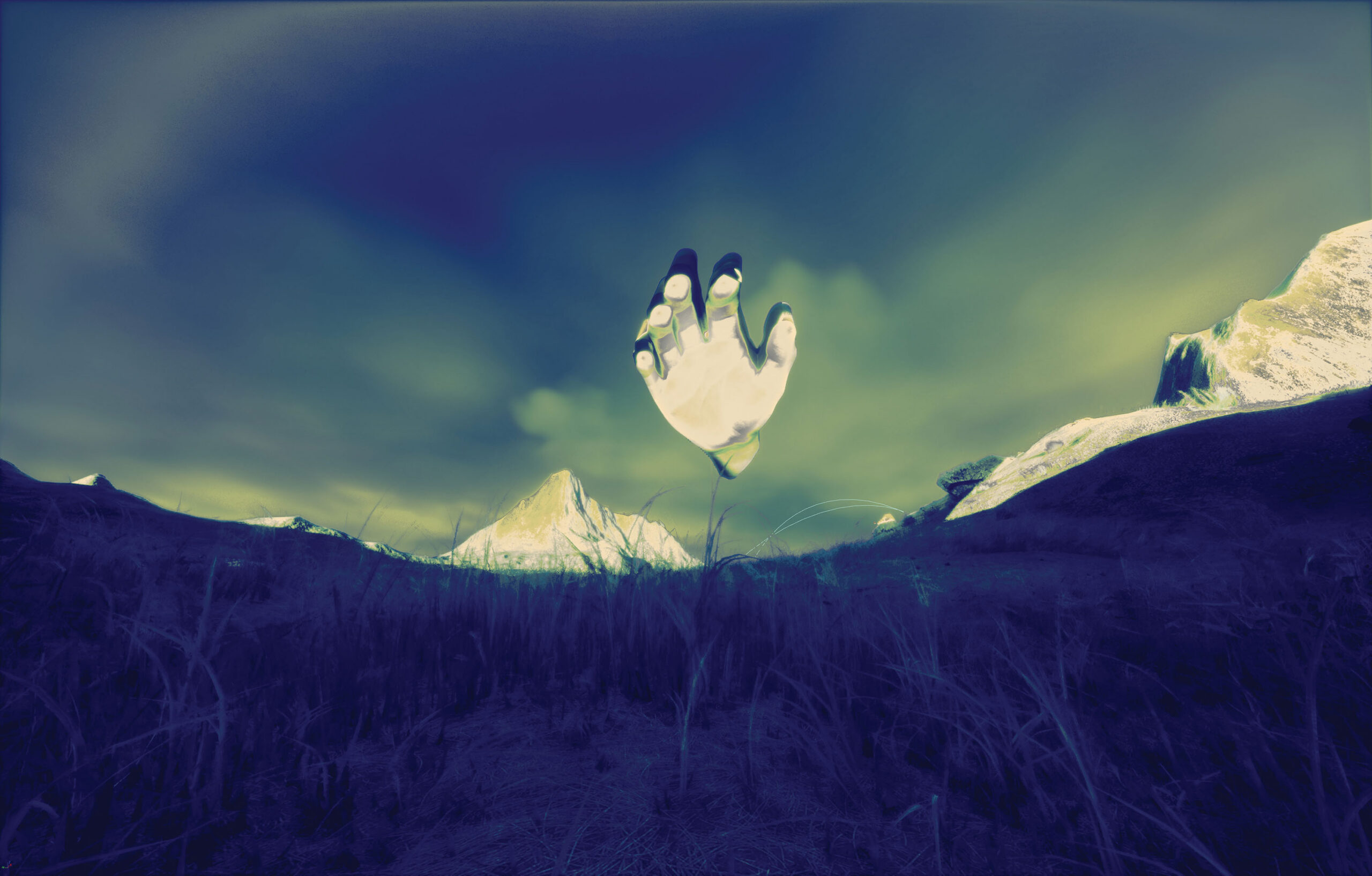
- “Don’t byte da hand that feeds u”, 2022, still image of Unreal Engine game, with motion control Impacto (still), 2022-2026
- CNC MDF carved sculpture, video projection, 2.1 sound, custom software Film is co-produced by Pata de Perro films