Holding Form, Letting Go: Inside Mark Engel’s World of Shifting Figures
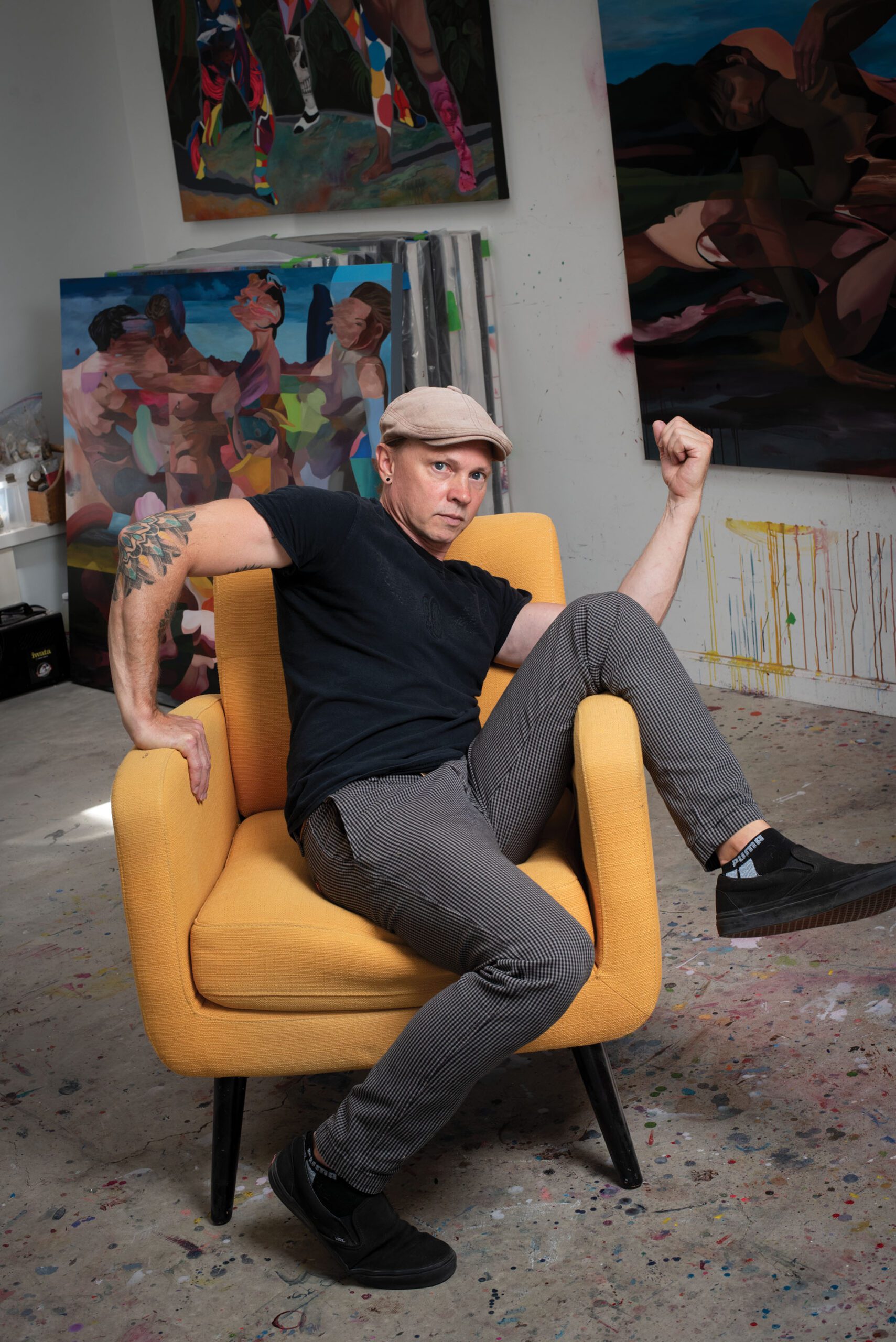
Mark Engel stands in his Walnut Creek studio. Birdsong and the distant hum of a highway blend with the hush of his brush against the canvas. Around him, figures emerge and dissolve: faces freeze mid-expression, limbs smear into strokes of color and shadow. Some figures lean into each other while others yearn to separate.
“There’s sort of this atmospheric pressure trying to push through,” Engel said, glancing at a fresh piece still drying on the wall. “Having this pressure of allowing something bigger than myself to come through, to me, is where the art happens.” As a painter and an educator at Mission College, Engel is a driving force in the Bay Area’s art scene. His figures feel both intimate and unknowable. The forms merge, stretch, and fracture in ways that echo how we relate to each other and ourselves. In Shifting Terrain, his solo exhibition debuting at the Triton Museum in Santa Clara August 2025, Engel will showcase works exploring tensions and transformations within the human form.
Engel followed an unusual path to art. With no family or scholastic exposure to art, he found creativity through skateboarding, which quite literally opened a garage door to his artistic journey. “I had a friend’s house I’d go over to, and his dad had a darkroom that he built in his garage. And so that got me into taking photographs and playing around in the darkroom,” said Engel. “So that was kind of my very first introduction into anything related to art.”
Engel kept returning to photography while working through general education courses at junior college. Everything changed when he transferred to San José State University. There, a drawing class exposed him to a world of creativity that he had not known existed. “When I went there, I met a lot of painters,” said Engel. “I was like, wow, there’s a lot of cool stuff you can do with paint that you really can’t do with photography.”
Engel’s curiosity about figurative art led him to instructor Leroy Parker, who inspired him and became both mentor and close friend. “His approach to the figure and his philosophy on life and on the figure, it just really was inspirational for me,” said Engel. “That really got me into working with the figure and with painting.”
Engel switched his major from photography to the more flexible option of pictorial art, which allowed him to bounce between media and dive headfirst into painting. By the time he returned to San José State to complete his graduate studies, he was firmly hooked on depicting the human figure and its endless possibilities within distortion.
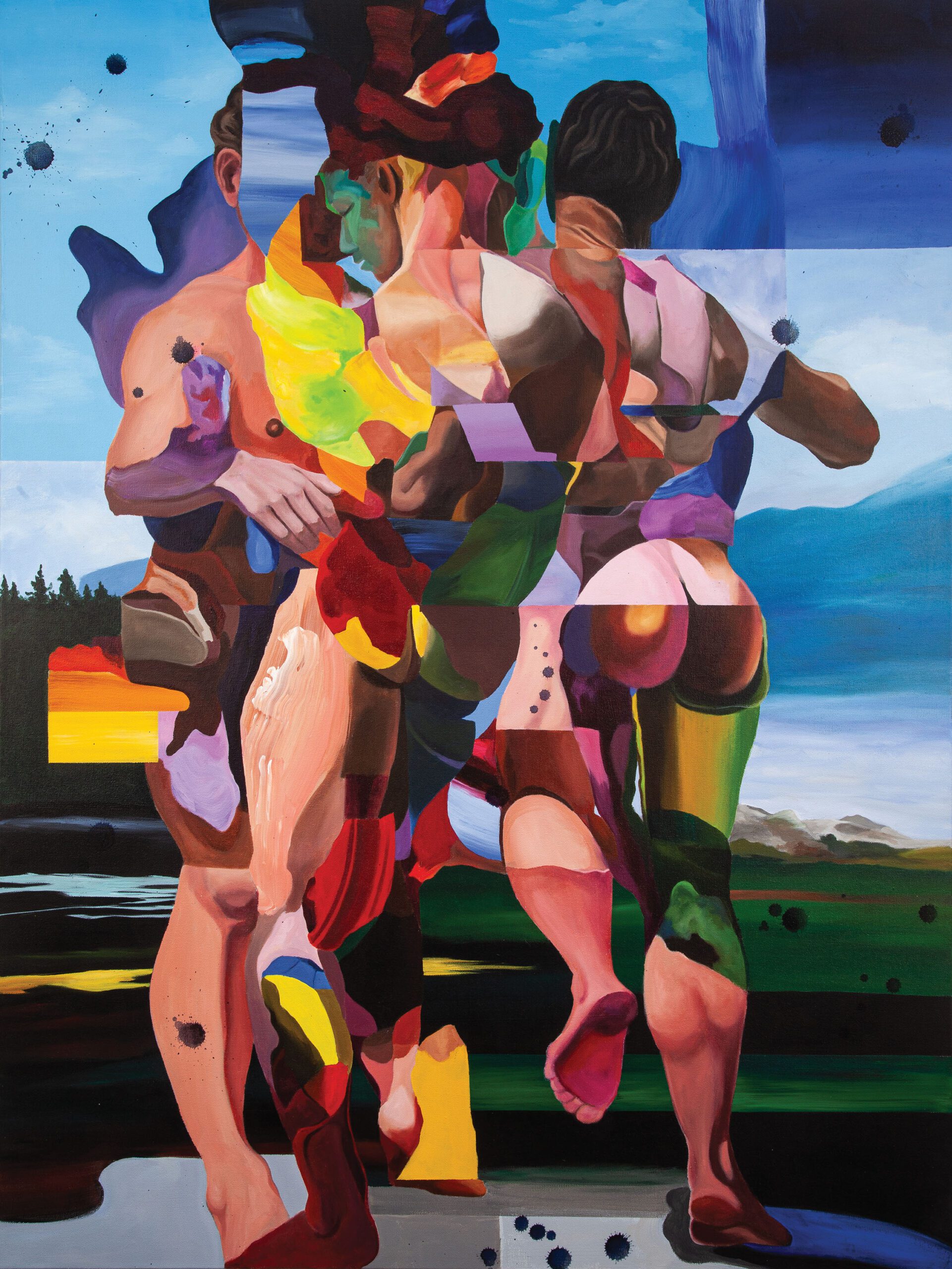
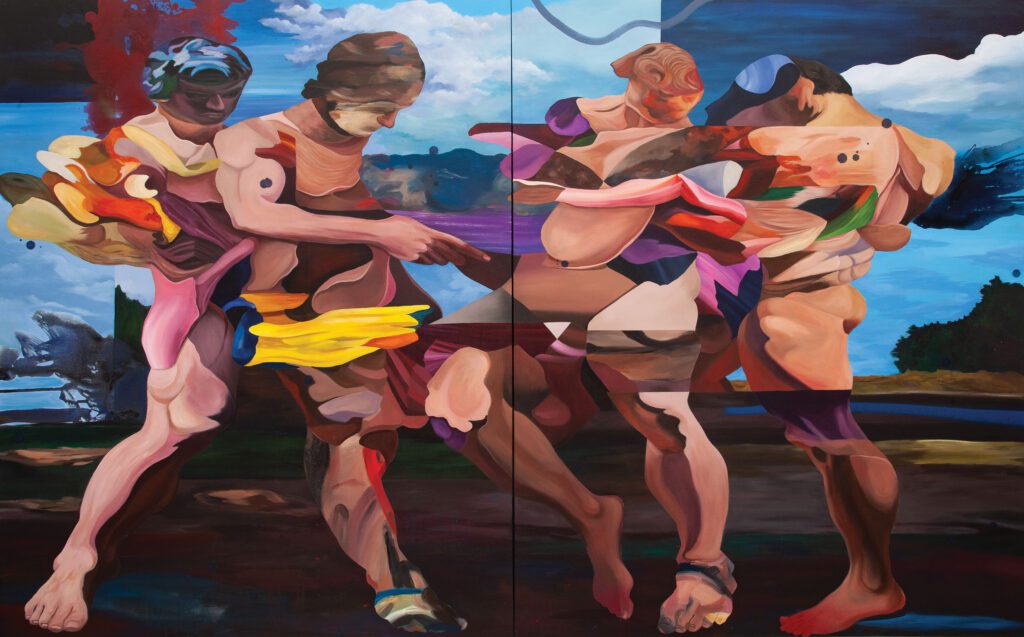
Today, Engel’s process balances structure with freedom. He lays out a loose composition, then lets intuition take over. “I have a starting point. I have sort of a general notion, maybe a loose composition, and then from there, it just kind of happens,” said Engel. “A really important part is to not really know exactly what I’m going to do and to sort of feel my way through it. I really like that idea of spontaneity and of just trying to allow something else to come through where I’m not controlling it as much.” His current works visually echo this mindset. Figures overlap, edges fade into washes of raw color, and shapes stretch and compress like half-remembered dreams. They feel like living organisms growing and stretching beyond his own intentions.
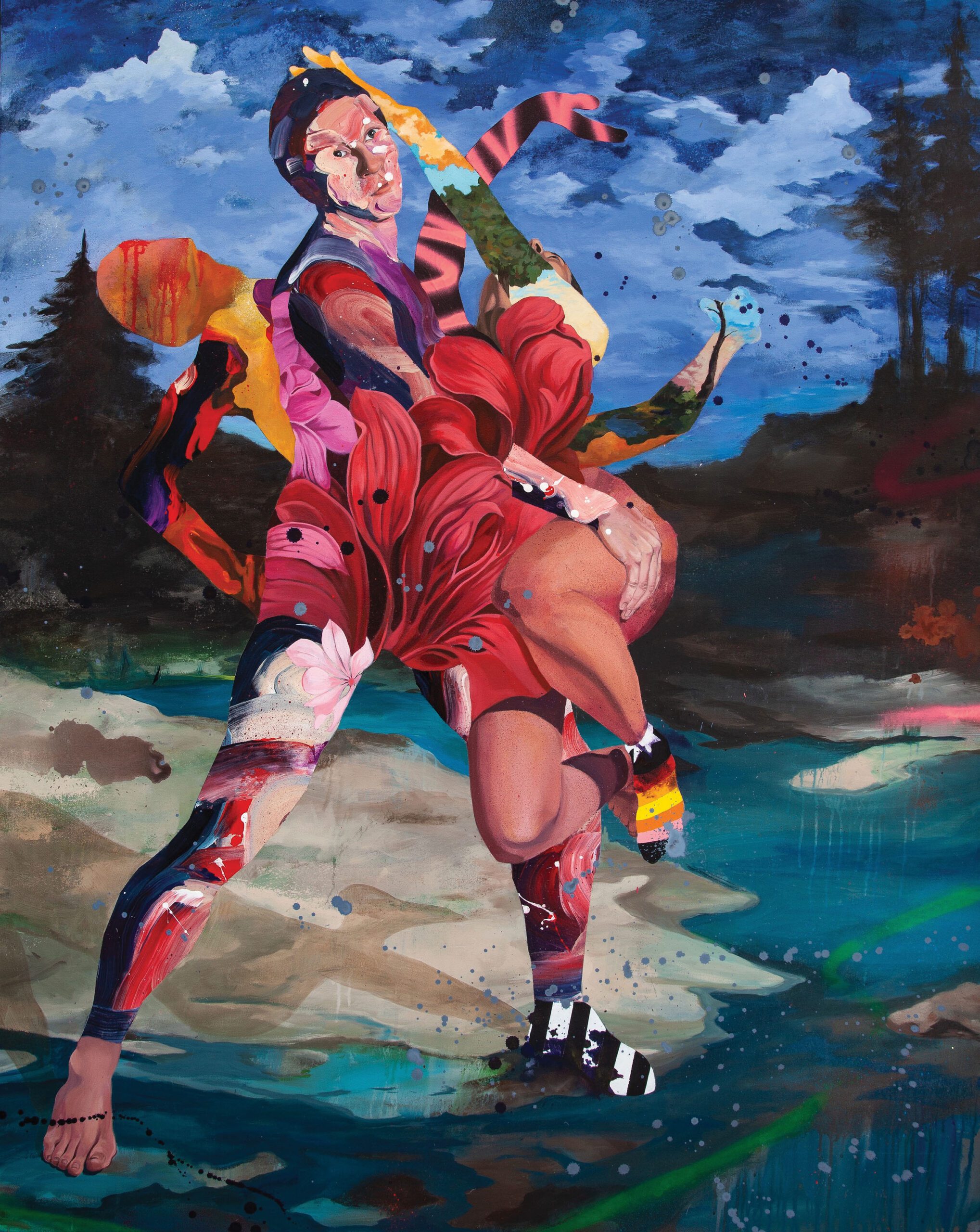
“How do you show transformation? You can’t really see transformation in yourself,” he said. “With my work, I really try to show this sort of fluid space between holding form and dissolving. For me, that’s how you do it.” The theme of transformation lies at the heart of Engel’s work. He traces this interest back to his fascination with psychology, attributing it to Carl Jung’s ideas about self and the fluidity of identity. In Engel’s world, figures and people are never static; they are always on the cusp of becoming something else. His Bloom Series encapsulates this theme: in works like Cross Pollinator and New Skin, humans metamorphose into organic shapes like petals and leaves.
This series draws inspiration from his move from Santa Clara to Walnut Creek in 2020, a shift that drew him away from Silicon Valley’s urban sprawl and closer to nature. “There’s just more nature out here. I think that has a lot of influence as well in my work, just being around plants and trees and flowers and all of that,” Engel said. “It’s kind of creeping into my work. The heads were sort of an extension of heads that I’ve done in the past, but in this case, this metamorphosis of the head shows change and growth and flowering.” Even in his pieces without overt botanical references, the organic feel remains. His newest works tangle human figures or let them drift apart, visual metaphors for how relationships bind and reshape us.
Engel’s painting Drawn Together, Pulled Apart anchors his current exhibition at the Triton Museum, embodying a concept people feel more than speak about. “Drawn Together, Pulled Apart is really about relationships and how we’re affected by other people,” said Engel. “In a relationship, everybody has their own perspective. That interaction with people is really instrumental in how we change and grow individually and as a group.”
For years, Engel focused more on teaching than exhibiting his own work. He has taught art to at-risk youth in alternative schools and juvenile detention centers and has been a college instructor at De Anza College, Mission College, and other Bay Area schools for decades. The students, he says, constantly remind him of how vital it is to feel awkward, even after so many years of creating art. “They’re struggling with it because it’s something new,” Engel said. “It just always reminds me of how I need to be with my own work. If I want to make the work better or different or push it into new territory, I have to be comfortable with that awkwardness.”
Engel has shown work in group exhibitions in New York and Chicago as well as shows closer to home. His recent focus has been on making a name for himself through solo work. During his recent sabbatical, his exhibition Shapeshifters, at Know Future Gallery in Japantown, San Jose, marked a return to the solo stage after so many years of prioritizing the classroom.
With Shifting Terrain, Engel hopes to reach a broader audience and secure gallery representation to help take his work worldwide. “I really want to put my work out there as much as possible and go as far as I can,” said Engel. “The Art Basels or any of the big shows, all of that is definitely what I’m trying to do.” Engel stands on the edge of the next phase of his career, pondering what lies ahead. He lets the brush hush against the canvas once more, capturing what most can feel but rarely see: every form we hold is always shifting, always becoming something new.
“You can’t really separate the work from yourself,” said Engel. “Anything you do is really about yourself.”
markengelart.com
Instagram: markengelart