Threads woven together tell stories about history, culture, and identity
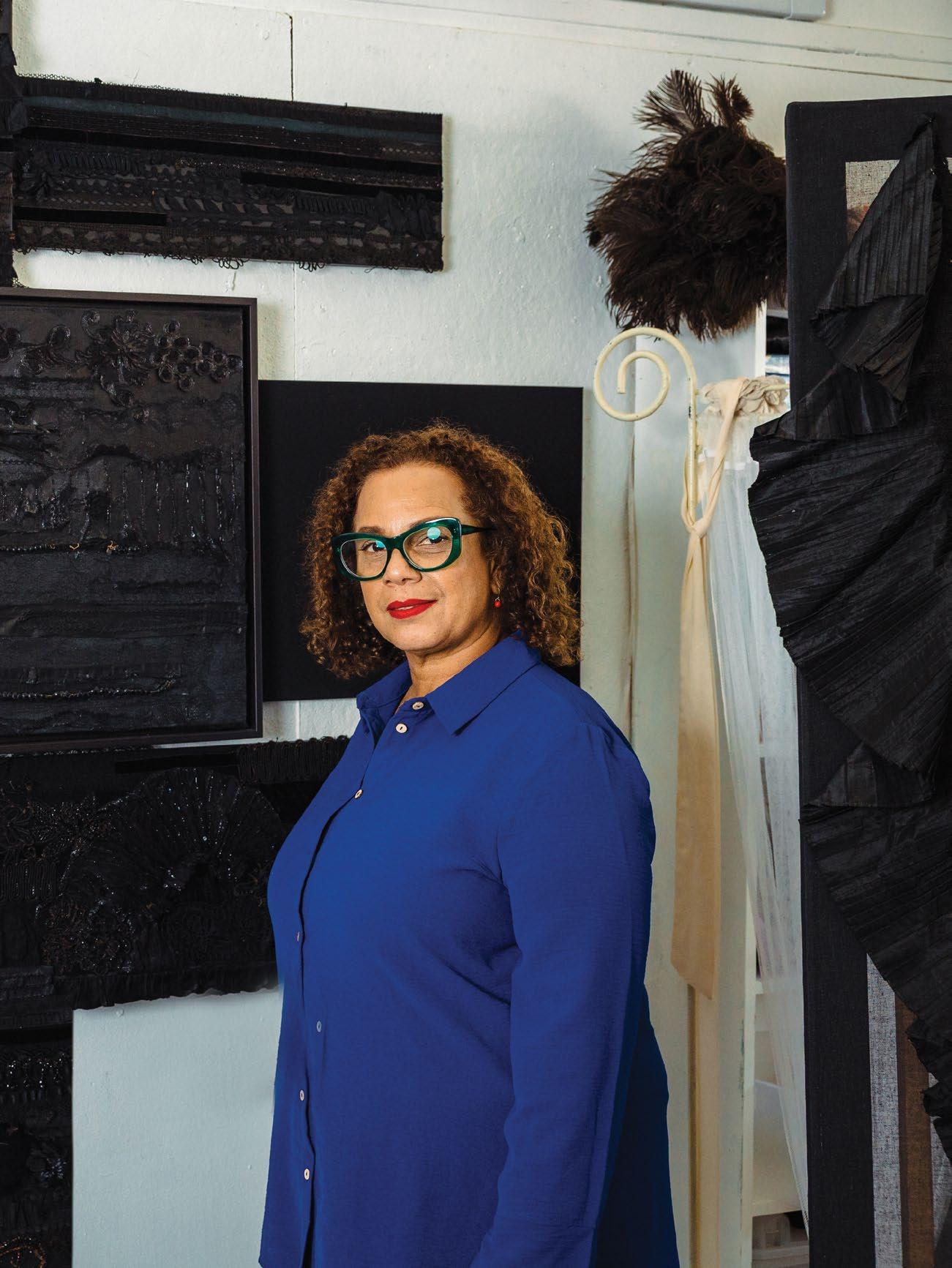
Cynthia Brannvall enjoys making Swedish meatballs with turkey and kale and still calls them Swedish meatballs. Building on her grandma’s original recipe, she regularly cooks this special fusion dish for her family. As a California native who contains multitudes—American, African, and European roots—blending, transforming, and carrying on aspects of different cultures feels natural to her. It has become a central theme in her life and work.
Cynthia is an interdisciplinary multimedia artist, a community college professor, and the current Cubberely Artist in Residence, whose work explores identity, culture, history, and how to move forward in a world of conflict and uncertainty. She was raised primarily by her grandmother, a seamstress who not only taught her recipes but also introduced her to textiles at a young age.
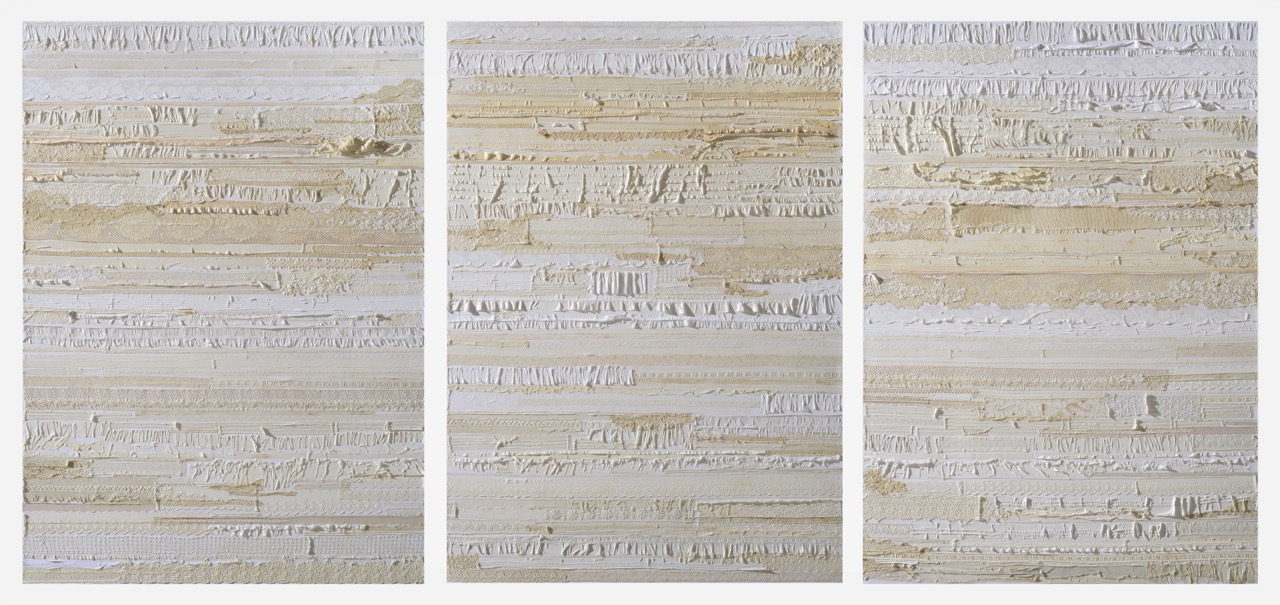
One of her most important works, Continents, is a large three-panel textile painting consisting of off-white strips of linen, cotton, and lace that depicts themes of genomics and geology.“ These patterns represent sediment or histories, landscapes, and various patterns crossing from one panel to the next, like DNA traits passing from one ancestor to another,” she said. Her work also incorporates vintage and recycled textiles, such as blouses from the 1920s, which play into intergenerational themes in her paintings.
While sourcing materials, Cynthia was drawn to working with white textiles, which were never a crisp white. Many of her materials are thrifted, sourced from antiques purveyors or acquired through special collections such as those at Lacis Museum of Lace and Textiles in Berkeley. The fabric scraps she chooses naturally vary in color and come frayed, fragmented, and stained—yet enduring, which only adds more depth and meaning to her art. In another piece, titled The Threads That Bind a Divided Nation, she used off-white and beige colored antique textiles to construct a divided map of the United States. The states are disconnected at the MasonDixon line, which historically divided free and slave states.
While Cynthia was studying art history at UC Berkeley, she witnessed many conversations where artists used the color black, and people concluded that the artwork must be sending a message about race. However, that was never applied to works that were made in white. “It was kind of a defiant move. Like, I dare you to ask me, as a Black artist, why I’m working with the color white so much,” she said. But people rarely ask her that question.
In the past few years, Cynthia has built a new arm of her work, focused on black textiles. She aimed to push back on the obvious connotations of the color black, associated with darkness and mourning. To contrast those feelings, she adds flecks of mica, beads, and sequins to allude to a sense of whimsy and magic. She is currently creating a large black textile painting that will include at least a dozen panels. The use of black was inspired by dark matter and black holes that catalyzed the beginning of the universe, but they are also metaphors for the Black experience. “In my lifetime, I was not born into slavery. But as a Black person, I feel the gravitational pull of that,” she explained.
In addition to textile paintings, Cynthia also creates sculptures in a genre of works she calls “surreal textiles.” In her process, she takes clothing fragments or whole pieces of clothing and molds them into shapes that are often disorienting and thought-provoking. In her piece titled Roar, she molded a thrifted 1950s pink dress in resin to create a sculpture reminiscent of a target or a screaming mouth. She created the piece in 2022 and it helped her access and process her feelings that followed the overturning of Roe v. Wade that summer. Usually, Cynthia mattifies her resin pieces for a satin finish, but for Roar, she wanted a wet look. “It looks wet, so there is this erotic element. It’s clearly a dress, but I think it also evokes the body. It could be a screaming mouth or a vaginal opening. But it also has that sweetness to it because it’s pink,” she said. The juxtaposition of the ruffled pink dress and the way it is opened up evokes uncanny feelings and depicts psychological tensions.
As Cynthia’s past works have conjured questions about history, culture, and identity, she continues to ponder unanswered questions every day. One motivator for her in working with abstraction is that it allows people to come up with different questions and answers when viewing her artwork. Currently, she hopes her artwork can help people think about how to bridge cultural and political divides. She explained, “We live in a polarized time. What would it look like for us to belong somewhere together—whether we agree or not, whether we have hurt each other or not? Is that possible? And what would it look like?”
Image 1: Continents, 2014-2016 vintage and antique cotton textiles painted on stretched crinoline, 3 panels 48”x68”
Image 2: Not Quite Tame, 2024, vintage birdcage, globe, sea fans, vintage and antique trim, lace, and crocheted doilies and trim, 19”x36”x12”
Image 3: Shadow Work #2 A Pickaninny World, 2024, 19th century dress, vintage silk and velvet ribbon, vintage seam binding tape, polyester ribbon, acrylic paint and globe
Follow Cynthia on Instagram at cynthiabrannvall and on the web at cynthiabrannvall.com