William Johnston’s Extravagant Superband
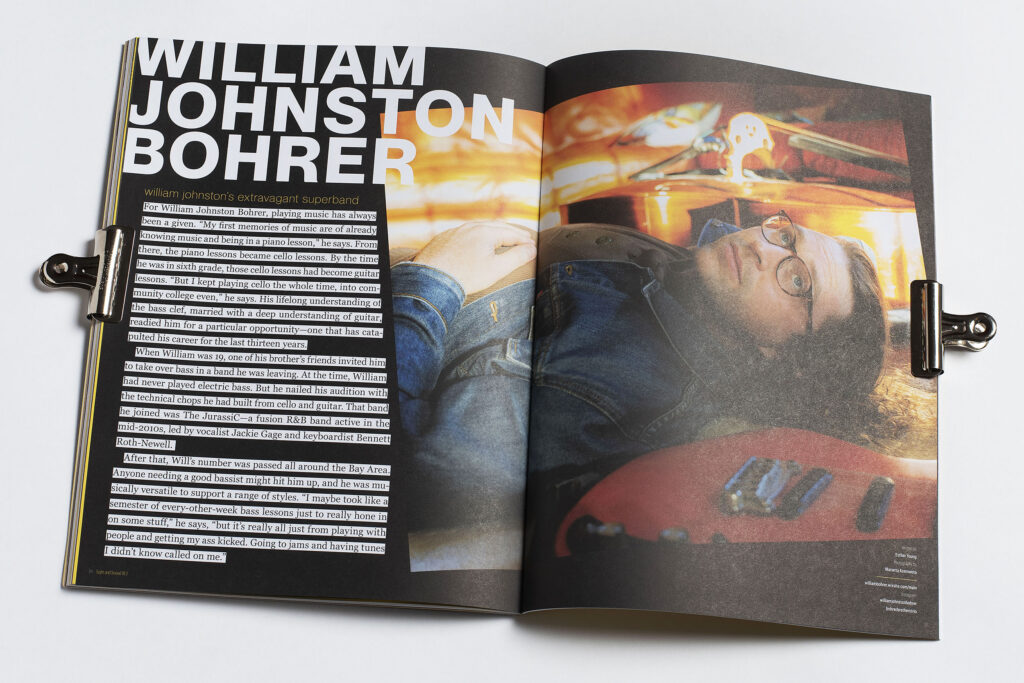
For William Johnston Bohrer, playing music has always been a given. “My first memories of music are of already knowing music and being in a piano lesson,” he says. From there, the piano lessons became cello lessons. By the time he was in sixth grade, those cello lessons had become guitar lessons. “But I kept playing cello the whole time, into community college even,” he says. His lifelong understanding of the bass clef, married with a deep understanding of guitar, readied him for a particular opportunity—one that has catapulted his career for the last thirteen years.
When William was 19, one of his brother’s friends invited him to take over bass in a band he was leaving. At the time, William had never played electric bass. But he nailed his audition with the technical chops he had built from cello and guitar. That band he joined was The JurassiC—a fusion R&B band active in the mid-2010s, led by vocalist Jackie Gage and keyboardist Bennett Roth-Newell.
After that, Will’s number was passed all around the Bay Area. Anyone needing a good bassist might hit him up, and he was musically versatile to support a range of styles. “I maybe took like a semester of every-other-week bass lessons just to really hone in on some stuff,” he says, “but it’s really all just from playing with people and getting my ass kicked. Going to jams and having tunes I didn’t know called on me.”
He met vocalist Ren Geisick at West Valley College and began accompanying her on guitar, forming their duo, the Anachronistics. He also took classes at California Jazz Conservatory. To keep his stylistic toolkit sharp, Will has worked out how to deliver salsa, jazz, reggae, funk, gospel, and country lines on bass. “If I didn’t…I would not be able to support myself,” he says.
But when it comes to his own sound as a bandleader and songwriter, Will leans deep into his passion for ’70s retro soul. He is determined to build on the miraculous achievements of Stevie Wonder on the album Songs in the Key of Life and presents his superband as proof that his vision for ’70s retro soul is possible. Noting the recent wave of retro soul bands as an aesthetic, he says, “All these guys are just recently converted indie-rock guys that never listened to soul a day in their lives.” On the contrary, “I feel like I’m progressing the art form itself.” And William Johnston’s Extravagant Superband is every bit necessary, and marvelous, as a superband.
Three years into playing gospel at church, Will was spellbound by the sound of the Leslie organ. When he plays on stage facing the congregation, his head is right against the speaker cabinet. Inside that old machine, those spinning horns whiz right above his head, slowing and speeding up to create the Doppler effect that is iconic in jazz and gospel.
“I feel like I’m progressing the art form itself.”
Inspired by ’60s funk band The Meters, Will was determined to get the Leslie organ sound alongside that of a clavinet–an instrument similar to an electric harpsichord. “I’m like, I need two keyboard instruments because I need the rhythm guitar space filled, but I just need to do ‘chink, chink,’ then someone else needs to do the Clavinet parts and organs to sustain,” he explains. He continues, “And then I need all the backup vocals because one person can’t sing a separate line by themselves, so I need two people. But they’re locked into their thing, and sometimes I need a third part.”
Combined with the percussion he wants and specific parts for guitar, bass, and saxophone, the recipe may look extravagant, but it’s correct to him as someone who grew up listening to Earth, Wind & Fire (a 17-piece band). “I don’t need it to be anything else other than what it is,” he says. “This is that era—this is that artistic thrust.”
The hurdles created by metropolitan structure and economic paradoxes frustrate his day-to-day balance as a working musician in the South Bay. “People don’t listen to soul music or R&B [here],” he says. Moreover, the high cost of living and scarcity of high-density housing prevent more full-time musicians from calling the South Bay home. “The only people that can afford to live here…Music is just a thing they do on the side,” he adds. The frequent compromise, he notes, is the upkeep of their craft, and their motivation to negotiate market-rate gigs if they make income elsewhere. And for Will, as a professional musician, that hurts his bottom line.
“I should not be here as a musician, with the type of music I make,” he says. “I exist here despite San Jose.” But here, he is accessible to his music students, most of whom are in the Peninsula and the South Bay. He makes it a point to tell his students what they won’t hear from institutions.
With the release of his EP Flesh and Blood, Will plans to take on more roles as a creative producer–advising arrangements, scoring soundtracks, and facilitating the creation of music that inspires him back.
williambohrer.wixsite.com/main
Instagram: williamjohnstonbohrer | bohrerbrotherstrio