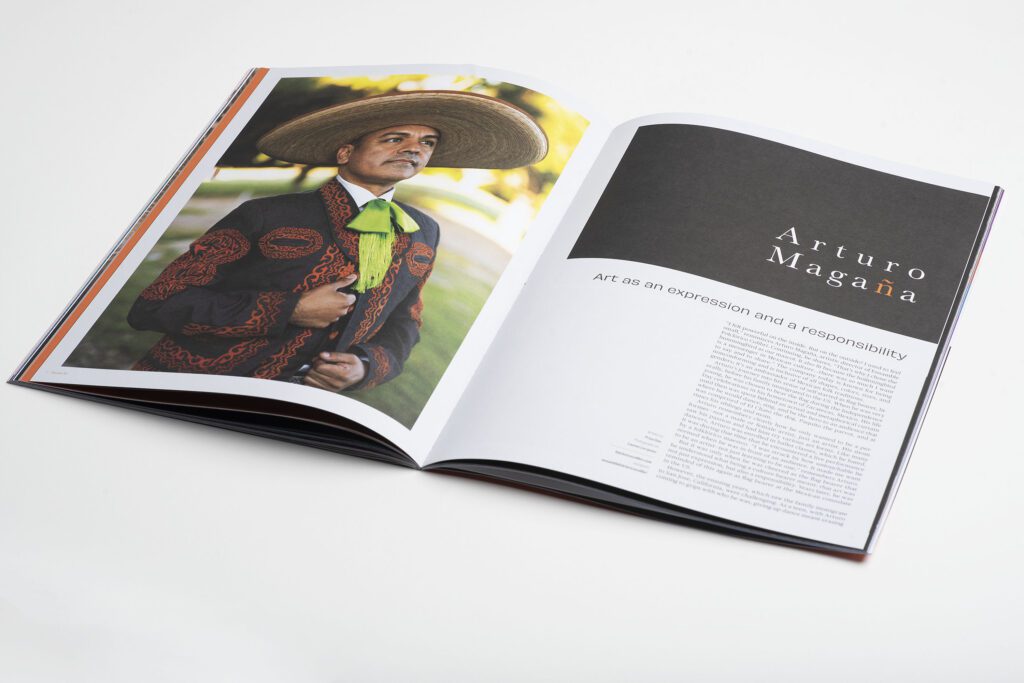
“I felt powerful on the inside. But on the outside? I used to feel small,” reminisces Arturo Magaña, artistic director of Ensamble Folclórico Colibrí. Continuing, he shares, “That’s why I chose the hummingbird as our mascot. It also fit because the hummingbird is a messenger in Mexican culture…there was so much I want to say and to share.” The company today is known for being nonconforming and is inclusive of all shapes, colors, sizes, and genders; it’s an ambassador of Mexican folk traditions.
Arturo’s journey into his sense of self started as flag bearer, literally, before his family immigrated to the US. When he was very young, he was chosen to bear the flag during the Independence Day celebrations in his hometown of Zacatecas, Mexico. His life until then was spent behind an actual and metaphorical curtain where he would dance, sing, and be the hero to an audience that was comprised of El Chato the dog, Paquito the parrot, and at times his siblings and mom.
Arturo remembers clearly how he only wanted to be a performer—not a male or female artist, just an artist. His mom saw his passion and had him try various art forms. Like many dancers, Arturo was enrolled in ballet classes, which he hated. It was during that time that he encountered a live performance by a folklórico maestro. “I was struck by how untouchable he seemed when he was in front of an audience. It made me want to be an artist—not just learning to be one,” remembers Arturo.
But it was only when he was cheered as the flag bearer that he understood what being a culture-bearer meant: that art was not just expression, but also a responsibility. Years later, he was reminded of this again as flag bearer at the Mexican consulate in the US.
However, the ensuing years, which saw the family immigrate to San Jose, California, were challenging. As a teen, with Arturo coming to grips with who he was, giving up dance meant erasing himself. He found himself following the path of priesthood in a country that did not seem to have a place for his art or for him.
It was a strange twist in his destiny that had him on the road a few months later, when he asked for the car to be stopped so he could use the restroom at a club, and while walking out, he saw a flier inviting people to experience folklórico at the Billy DeFrank LGBTQ+ Community Center. For the first time in the US, he felt like he was looking in the mirror and liking what he saw—people he could identify with, performing what he loved.
“Owning one identity gave courage to own the other, to my own self. I came out to my mom when I got back in the car,” shares Arturo fondly, continuing, “Of course, she was not surprised.”
He signed up with ProLatino and later Los Lupeños as their lead dancer. He then stayed on as one of the company’s artistic directors for several years. In 2013, Colectivo ALA, a social and support group for non-hetero-conforming Latinos and Latinas, invited Arturo to present folklórico at their anniversary event; this catalyzed the idea of forming his own organization.
Today, Colibrí has an academy, welcoming youth to embrace who they are while getting rooted in Mexican culture. “I am humbled that we are now on the mainstage, not just LatinX or LGBTQ+ stages. Colibrí is part of Pride parades, of course, and recently was invited to the SF Symphony and San Francisco Opera,” remarks Arturo. He continues, sharing that Mosaic America embraced them as part of Silicon Valley’s mosaic from the start. He says, “When we share our culture at their event, we are part of the broader community we are helping to build. I believe in their process that ensures that we need to only show up as ourselves to be American. After all, that is how I, and therefore Colibrí, came to be, by just being brave enough to be our whole selves.”
In times when bravery is not easily summoned, he channels his mother’s poem that reminds him to stay strong:
Recuerda que eres tan fuerte Como una delicada lirio Que aunque sea plantada en el desierto Se mantiene firme y ni el viento más fuerte la puede arrancar Pues sus raíces son su fortaleza.
Remember that you are as strong as a tender and delicate lily And even if it was planted in the desert, It remains firm and strong, not even a strong wind can yank it out of the ground, for its roots are its fortitude.
Since 1991, the SVLaureate program has awarded more than 150 of the finest artists the South Bay has to offer with honors, recognition, and a cash prize to assist them in pursuing their craft. This year, awards were given in several different categories: Off Stage (an artist working offstage, backstage, or pre-performance), On Stage (a performing artist), On the Wall (a visual artist working in traditional or mixed media), Off the Wall (a visual artist working in sculpture), and Emerging Artist (a young artist in any medium who shows promise for continued growth and excellence). This year the program added a new award, the SVNexus Award, honoring an artist who uses technology to fuel their creative work.
These artists are chosen based on the work they have created and their commitment to their communities. Through their work as teachers, artists, and performers, each of the SVLaureates has shown a devotion to their craft that includes mentorship, service, and forging new cultural understanding.
Kimberly Mohne Hill: Off Stage Recipient
Kimberly Mohne Hill grew up in the small Northern California town of Kelseyville. At age nine, she saw her first play—a high school production of Annie Get Your Gun—and was immediately hooked on the possibilities of live theater. After studying acting at UC San Diego, San Jose State, and A.C.T. in San Francisco, she performed in a number of productions around the Bay Area. A natural teacher, with an ability to empathize with both characters and actors, Hill eventually shifted gears to directing as she helmed The Seafarer for the San Jose Stage Company in 2009. She has had continued success with productions of In the Next Room, Venus in Fur, and others.
“I have always had a vivid, deeply empathetic imagination. When I read a novel, I believe in the circumstances of the characters so easily and fully…the stage is a place where that kind of active empathy has a home; I am able to live inside the stories I read for an extended time. Theater is the place where I feel normal, like my way of looking at the world isn’t weird, but required.
“I’m inspired in different ways by different people for different reasons. My daughters inspire me to seek out stories that encourage and uplift women. My husband inspires me to do work that is worthy of taking my time away from him and our family. As I age and our kids get older, I realize that time is precious and I want to spend it on quality experiences, quality art, and quality time with quality people. I feel very blessed to get to do what I do; if this award opens doors for me to help advance the arts and cultural landscape in San Jose, then that would be the best part about receiving this honor.”
This article originally appeared in Issue 10.3 “Profiles”
What led you to pursue a career in theater? I totally fell into theater by accident. I wanted to go to school to be a surgeon, but during my senior year of high school, I was bribed to choreograph for a musical. I was already a part of the marching band, a dance team, and color guard. The drama teacher approached me and said, “You’re a really strong dancer, you come highly recommended and we just lost a choreographer. Would you be interested in choreographing for a musical?” And I said, “I’m sorry. Theater’s not really my thing. I’m not interested.” And he said, “Well, I’ll pay you.”
And I go, “Okay. I’ll do it.” I had watched performances and opera singers, but I had never thought I’d be into theater for some reason. I had never sung a note in my life! Even though I come from a very musical family, I never thought it would be the road I would follow. But sure enough, it has turned into a dream that I have pursued into reality.
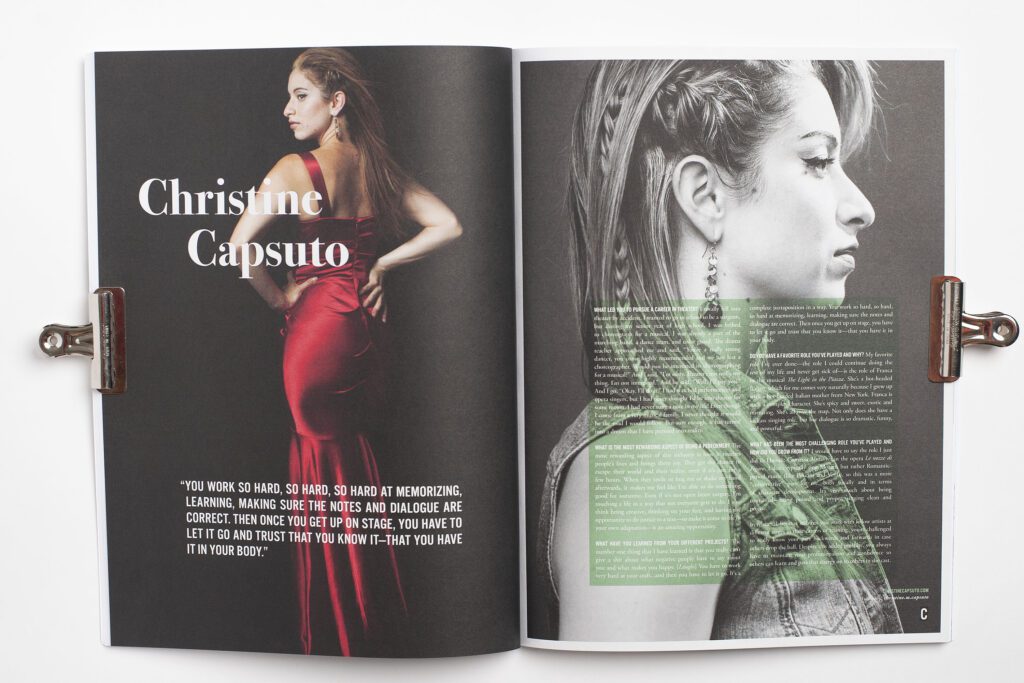
“You work so hard, so hard, so hard at memorizing, learning, making sure the notes and dialogue are correct. Then once you get up on stage, you have to let it go and trust that you know it—that you have it in your body.”
What is the most rewarding aspect of being a performer? The most rewarding aspect of this industry is how it touches people’s lives and brings them joy. They get the chance to escape their world and their reality, even if it’s just for a few hours. When they smile or hug me or shake my hand afterwards, it makes me feel like I’m able to do something good for someone. Even if it’s not open heart surgery, I’m touching a life in a way that not everyone gets to do. I also think being creative, thinking on your feet, and having the opportunity to do justice to a text—to make it come to life in your own adaptation—is an amazing opportunity.
What have you learned from your different projects? The number one thing that I have learned is that you really can’t give a shit about what negative people have to say about you and what makes you happy. [Laughs] You have to work very hard at your craft…and then you have to let it go. It’s a
complete juxtaposition in a way. You work so hard, so hard, so hard at memorizing, learning, making sure the notes and dialogue are correct. Then once you get up on stage, you have to let it go and trust that you know it—that you have it in your body.
Do you have a favorite role you’ve played and why? My favorite role I’ve ever done—the role I could continue doing the rest of my life and never get sick of—is the role of Franca in the musical The Light in the Piazza. She’s a hot-headed Italian, which for me comes very naturally because I grew up with a hot-headed Italian mother from New York. Franca is such a complex character. She’s spicy and sweet, exotic and nurturing. She’s all over the map. Not only does she have a kickass singing role, but her dialogue is so dramatic, funny, and powerful.
What has been the most challenging role you’ve played and how did you grow from it? I would have to say the role I just did in Hawaii: Contessa Almaviva in the opera Le nozze di Figaro. I don’t typically sing Mozart, but rather Romantic period music (like Puccini and Verdi), so this was a more “conservative” part for me, both vocally and in terms of character development. It’s very much about being contained—being poised and proper, singing clean and precise.
In rehearsal, because so often you work with fellow artists at different stages in their careers or training, you’re challenged to really know your part backwards and forwards in case others drop the ball. Despite this added pressure, you always have to maintain your professionalism and confidence so others can learn and pass that energy on to others in the cast.