Enigma’s 17 tracks certainly live up to the title, with Dox serving up a number of musical moods alongside a series of varying flows. Some are cool and laid back, while others are delivered in rapid-fire double time. The boom bap spirit remains at its core. Quick shot scorcher “Juggernauts” has Dox proclaiming, “Bringing light to darker times / We as bright as it gets.” “Dynamite,” featuring vocalist Ricky on the hook, carries an uplifting, summertime feel. Just as the title promises, “Soultro” is a slow-burning, soulful instrumental with a spoken word send-off, imploring listeners to build toward their greater purpose.
He points to artists like the late Gift of Gab, Tech N9ne, and the Hieroglyphics crew as inspirations for his dense lyricism and studied flow, but adds that he doesn’t emulate them. Rising out of the far-reaching, ever-creative proving ground of 90s hip-hop, he maintains a sharp focus on incessantly being himself, adding that “I’ve always tried to deviate and be an individual. That’s all stemmed from the Bay Area and early hip-hop.”
Speaking on his developmental years as a teen, he shares of carefree days and nights when he and others used whatever tools they had available to piece together formative beats. A gifted four-track recorder pushed him to create sounds in unique ways.
“When I started getting into hip-hop, it was a bunch of friends messing around in a friend’s garage and me,” Dox recalled. “Because I had limited access to instruments at that time, I was making snares with two bottles in hand, just being creative with it. That really got me on the path of creating music myself as an emcee and producer,” he shared.
After high school, Dox moved to Honolulu for college, where he made inroads into the Hawaiian hip-hop scene and saw a more introspective side to lyricism. He’s also gained insight and inspiration during stints in Las Vegas and New York.
His knack for embracing change has certainly fueled him. It’s also likely at the core of why, despite the length of his career, he’s not short on answers for what keeps his creative flow going. His response is multi-faceted and studied, much like his music. He speaks of incremental change, brick by brick. He wants to refine his on-stage performance to better connect with his audience, continue to build on the possibility of performing with his band, the Aquanauts, tour the globe, and appear with larger acts.
“I think it’s the ability to do things I haven’t done,” he said. “There are sounds I haven’t created. I’m not looking to start singing or anything, but for me, I definitely feel there are areas of my music that I have yet to tap into,” Dox shared.
For an artist with this much time in the game, that might just be the true gift: his continued desire to wade into the waters of the unknown.
“When I hear authentic blues, that just brings out an emotion… They’re very real and grounded. Anybody in any walk of life can relate to it.” -Aki Kumar
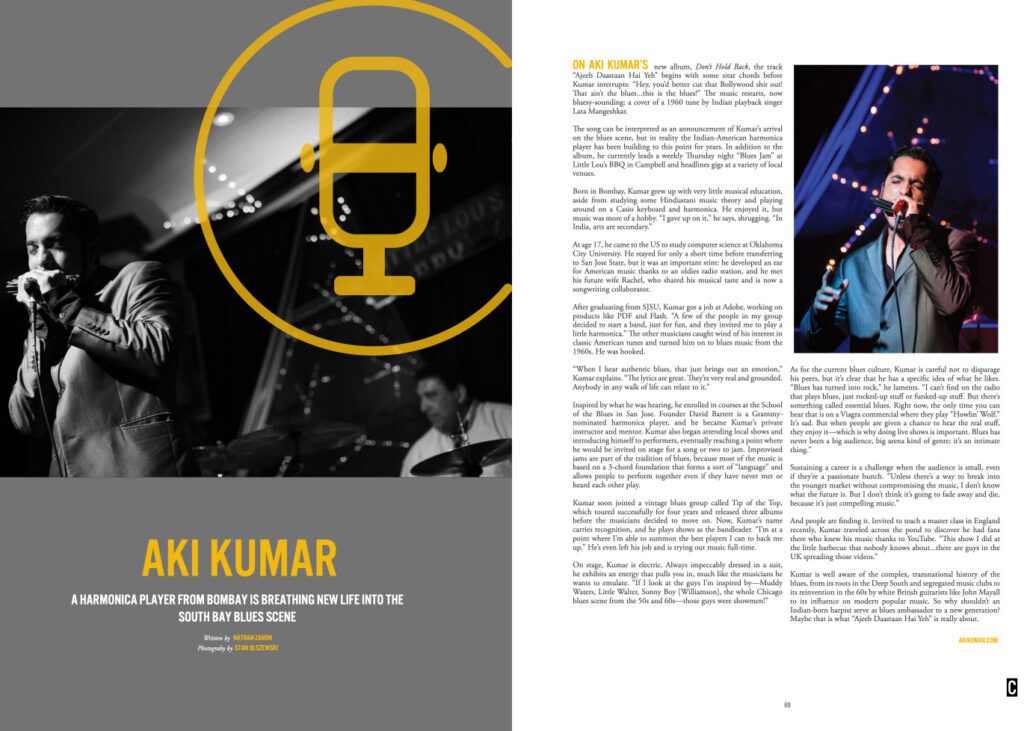
On Aki Kumar’s [2014] album, Don’t Hold Back, the track “Ajeeb Daastaan Hai Yeh” begins with some sitar chords before Kumar interrupts: “Hey, you’d better cut that Bollywood shit out! That ain’t the blues…this is the blues!” The music restarts, now bluesy-sounding: a cover of a 1960 tune by Indian playback singer Lata Mangeshkar.
The song can be interpreted as an announcement of Kumar’s arrival on the blues scene, but in reality this Indian American harmonica player has been building to this point for years. In addition to the album, he currently leads a weekly Thursday night “Blues Jam” at Little Lou’s BBQ in Campbell and headlines gigs at a variety of local venues.
Born in Bombay, Kumar grew up with very little musical education, aside from studying some Hindustani music theory and playing around on a Casio keyboard and harmonica. He enjoyed it, but music was more of a hobby. “I gave up on it,” he says, shrugging. “In India, arts are secondary.”
At age 17, he came to the US to study computer science at Oklahoma City University. He stayed for only a short time before transferring to San Jose State, but it was an important stint: he discovered an ear for American music thanks to an oldies radio station, and he met his future wife Rachel, who shared his musical taste and is now a songwriting collaborator.
After graduating from SJSU, Kumar got a job at Adobe, working on products like PDF and Flash. “A few of the people in my group decided to start a band, just for fun, and they invited me to play a little harmonica.” The other musicians caught wind of his interest in classic American tunes and turned him on to blues music from the 1960s. He was hooked.
“When I hear authentic blues, that just brings out an emotion,” Kumar explains. “The lyrics are great. They’re very real and grounded. Anybody in any walk of life can relate to it.”
Inspired by what he was hearing, he enrolled in courses at the School of the Blues in San Jose. Founder David Barrett is a Grammy-nominated harmonica player, and he became Kumar’s private instructor and mentor. Kumar also began attending local shows and introducing himself to performers, eventually reaching a point where he would be invited on stage for a song or two to jam. Improvised jams are part of the tradition of blues, because most of the music is based on a three-chord foundation that forms a sort of “language” and allows people to perform together even if they have never met or heard each other play.
Kumar soon joined a vintage blues group called Tip of the Top, which toured successfully for four years and released three albums before the musicians decided to move on. Now, Kumar’s name carries recognition, and he plays shows as the bandleader. “I’m at a point where I’m able to summon the best players I can to back me up.” He’s even left his job and is trying out music full-time.
On stage, Kumar is electric. Always impeccably dressed in a suit, he exhibits an energy that pulls you in, much like the musicians he wants to emulate. “If I look at the guys I’m inspired by—Muddy Waters, Little Walter, Sonny Boy [Williamson], the whole Chicago blues scene from the ’50s and ’60s—those guys were showmen!”
As for the current blues culture, Kumar is careful not to disparage his peers, but it’s clear that he has a specific idea of what he likes. “Blues has turned into rock,” he laments. “I can turn on a radio and find nothing that plays blues, or it plays rocked-up stuff or funked-up stuff. But there’s something called essential blues. Right now, the only time you can hear that is on a Viagra commercial where they play “Howlin’ Wolf.” It’s sad. But when people are given a chance to hear the real stuff, they enjoy it—which is why doing live shows is important. Blues has never been a big audience, big arena kind of genre; it’s an intimate thing.”
But sustaining a career is a challenge when the audience is small, even if they’re a passionate bunch. “Unless there’s a way to break into the younger market without compromising the music, I don’t know what the future is. But I don’t think it’s going to fade away and die, because it’s just compelling music.”
And people are finding it. Invited to teach a master class in England recently, Kumar traveled across the pond to discover he had fans there who knew his music thanks to YouTube. “This show I did at the little barbecue that nobody knows about…there are guys in the UK spreading those videos.”
Kumar is well aware of the complex, transnational history of the blues, from its roots in the Deep South and segregated music clubs to its reinvention in the ’60s by white British guitarists like John Mayall to its influence on modern popular music across the spectrum. So why shouldn’t an Indian-born harpist serve as blues ambassador to a new generation? Maybe that is what “Ajeeb Daastaan Hai Yeh” is really about.
We have to be able to do something musically that speaks to people that don’t speak the same language. –Jason Eckl
Every year, the San Jose Jazz Summer Fest pushes musical boundaries by booking diverse acts that break the mold of what listeners know as jazz music. The 2016 lineup is no exception. Soul, blues, and hip-hop artists add variety to a lengthy list of heavyweight jazz performers and rising stars. In spite of the seemingly vast genre gap between some of the artists, the San Francisco Bay Area’s own Dirty Cello is proof that all performers at the Summer Fest share a common respect for the jazz tradition.
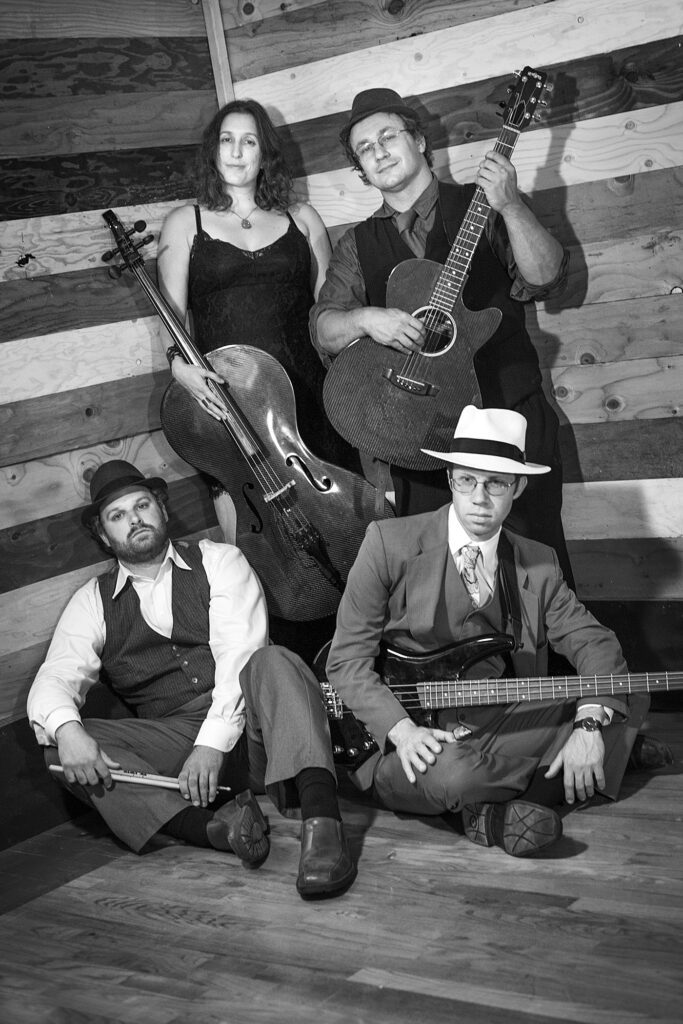
Founding members Rebecca Roudman, cello, and Jason Eckl, guitar, have both established themselves as accomplished classical musicians in the Bay Area, playing and writing for the Santa Rosa and Oakland symphonies. As proficient as they are with classical music, the couple’s true passion lies in American folk and blues traditions. In 2011, they decided to channel their creative unrest into an experimental collaboration.
“We played around with all sorts of ideas,” Eckl recalls, “but now we’ve happened upon this whole mix of blues, jazz, a little bit of bluegrass—all featuring lead cello. Hence the name Dirty Cello.”
In addition to cello and guitar, Dirty Cello features Colin Williams on bass and Anthony Petrocchi on drums. The band, however, isn’t always limited to the quartet. Following the jazz and blues tradition, the couple believes in handpicking local players to supplement the quartet’s live shows. Whether these musical mercenaries consist of a few horn players or an entire orchestra, the couple makes sure they find people who “aren’t only great players, but nice people.”
Five years after Dirty Cello’s inception, the band has traveled as far as Europe and China. After experiencing a language barrier between the audience and the stage in other countries, Eckl learned, “We have to be able to do something musically that speaks to people that don’t speak the same language.” The band members’ expressive body language and the universality of the blues help them connect with both international and American audiences.
As Bay Area natives, the band has already graced multiple San Jose music hubs, including Café Stritch and the SoFA Festival. “We feel like we owe a lot to the Bay Area,” Eckl reflects. “There are still new horizons and new things to do.”
One way Dirty Cello gives back to their audience is their sensitive approach to their set list. At the drop of a dime, they can change their set based on audience response. “It’s not about us; it’s about sharing [the experience] with the audience,” says Roudman, who recognizes the need to adapt on the fly. This concept of a “flexible set list” will be put to the test during their August 14 performance at the Jade Leaf Lounge.
Their set promises to embrace the familiar sounds of blues and folk with an unfamiliar instrumentation. Listeners will leave saying, “I didn’t know a cello could do that!”
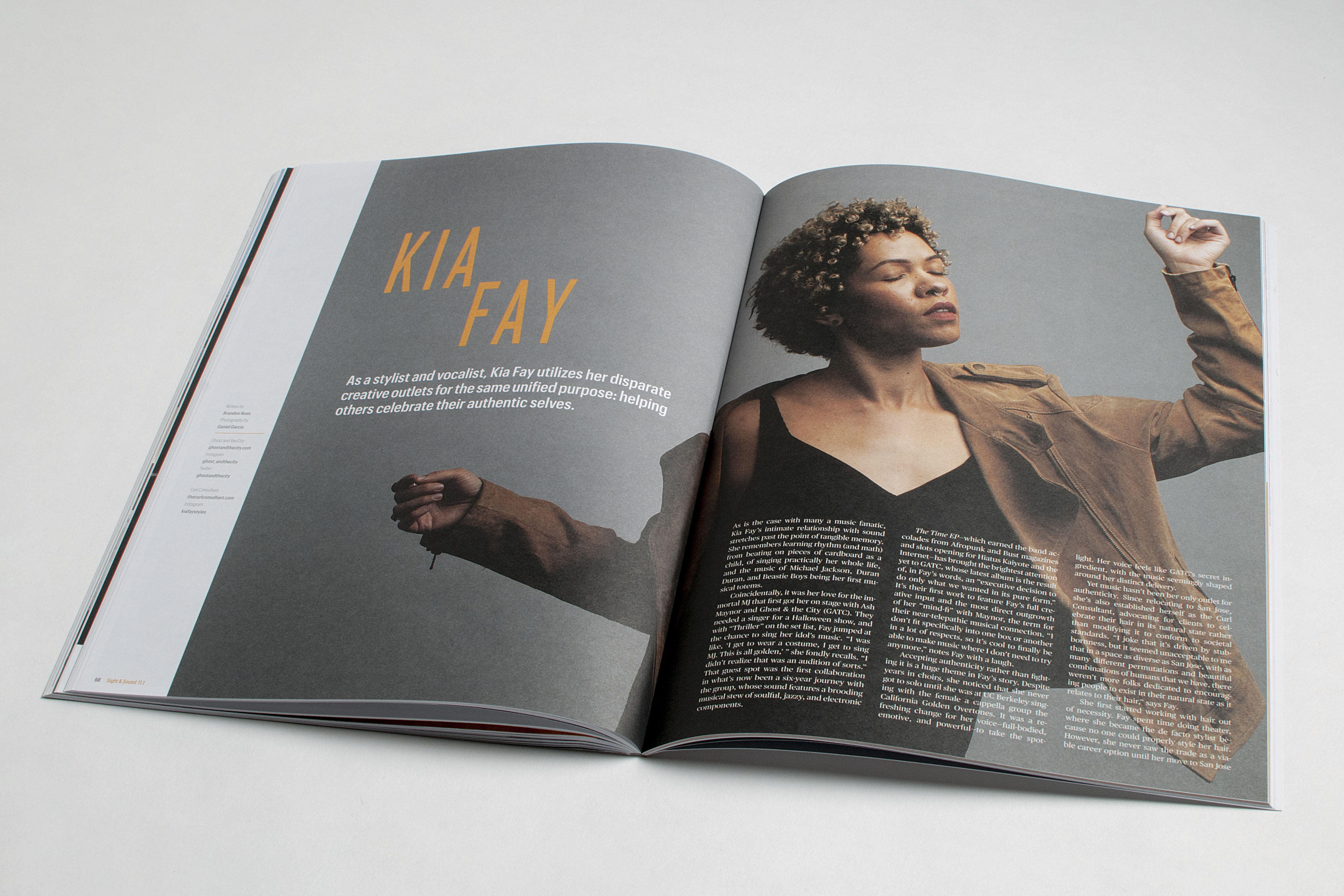
As is the case with many a music fanatic, Kia Fay’s intimate relationship with sound stretches past the point of tangible memory. She remembers learning rhythm (and math) from beating on pieces of cardboard as a child, of singing practically her whole life, and the music of Michael Jackson, Duran Duran, and Beastie Boys being her first musical totems.
Coincidentally, it was her love for the immortal MJ that first got her on stage with Ash Maynor and Ghost & the City (GATC). They needed a singer for a Halloween show, and with “Thriller” on the set list, Fay jumped at the chance to sing her idol’s music. “I was like, ‘I get to wear a costume, I get to sing MJ. This is all golden,’ ” she fondly recalls. “I didn’t realize that was an audition of sorts.” That guest spot was the first collaboration in what’s now been a six-year journey with the group, whose sound features a brooding musical stew of soulful, jazzy, and electronic components.
The Time EP—which earned the band accolades from Afropunk and Bust magazines and slots opening for Hiatus Kaiyote and the Internet, has brought the brightest attention yet to GATC, whose latest album is the result of, in Fay’s words, an “executive decision to do only what we wanted in its pure form.” It’s their first work to feature Fay’s full creative input and the most direct outgrowth of her “mind-fi” with Maynor, the term for their near-telepathic musical connection. “I don’t fit specifically into one box or another in a lot of respects, so it’s cool to finally be able to make music where I don’t need to try to anymore,” notes Fay with a laugh.
Accepting authenticity rather than fighting it is a huge theme in Fay’s story. Despite years in choirs, she noticed that she never got to solo until she was at UC Berkeley singing with the female a cappella group the California Golden Overtones. It was a refreshing change for her voice—full-bodied, emotive, and powerful—to take the spotlight. Her voice feels like GATC’s secret ingredient, with the music seemingly shaped around her distinct delivery.
Yet music hasn’t been her only outlet for authenticity. Since relocating to San Jose, she’s also established herself as the Curl Consultant, advocating for clients to celebrate their hair in its natural state rather than modifying it to conform to societal standards. “I joke that it’s driven by stubbornness, but it seemed unacceptable to me that in a space as diverse as San Jose, with as many different permutations and beautiful combinations of humans that we have, there weren’t more folks dedicated to encouraging people to exist in their natural state as it relates to their hair,” says Fay.
“I don’t fit specifically into one box or another in a lot of respects, so it’s cool to finally be able to make music where I don’t need to try to anymore.”
She first started working with hair out of necessity. Fay spent time doing theater, where she became the de facto stylist because no one could properly style her hair. However, she never saw the trade as a viable career option until her move to San Jose propelled her to be the change and to establish a space the city desperately needed. “The bulk of the feedback I’ve received has been that the work I do is liberating,” admits Fay. “That’s the best-case scenario for me: freeing anybody from a restriction they thought they had that was only an artificial restriction. Hopefully I can plant that seed for other folks, and they in turn will stand as beacons wherever they are.”
As a person of mixed descent who struggled over the years with where she fit in, Fay’s now using her two creative pursuits to help others recognize and celebrate their own unique tastes and identities through communion and connection. “We have to stop being so wedded to [the idea that] ‘This is what beauty looks like. This is what music looks like,’ and just accept beauty when we see it and hopefully foster what comes naturally to people and stop encouraging them to resist their more authentic selves, in any capacity,” she says.