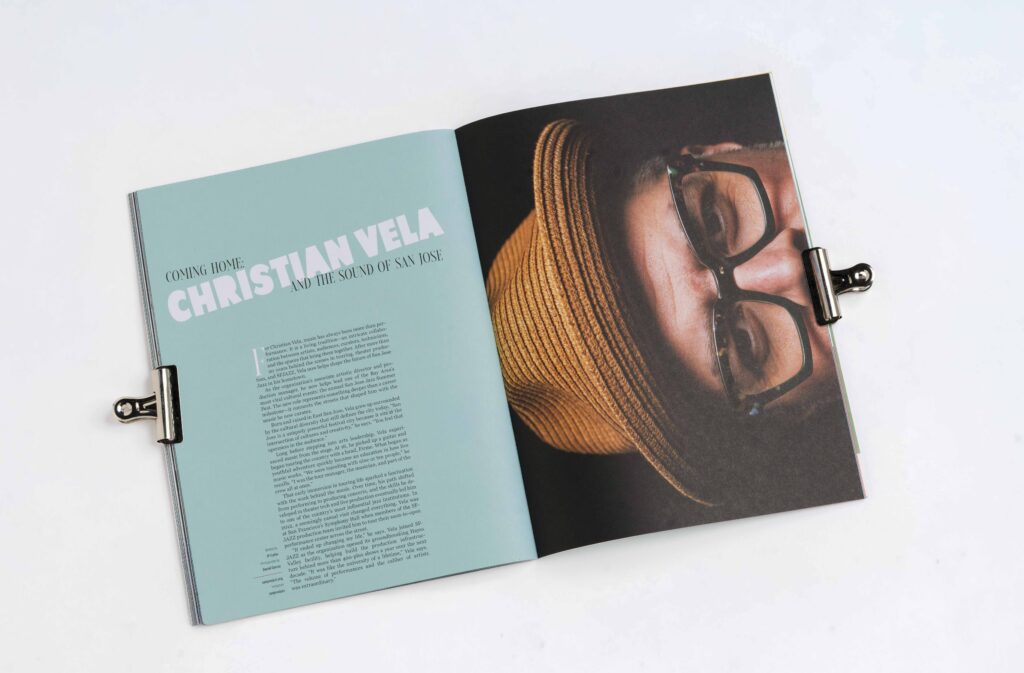
For Christian Vela, music has always been more than performance. It is a living tradition—an intricate collaboration between artists, audiences, curators, technicians, and the spaces that bring them together. After more than 20 years behind the scenes in touring, theater production, and SFJAZZ, Vela now helps shape the future of San Jose Jazz in his hometown.
As the organization’s associate artistic director and production manager, he now helps lead one of the Bay Area’s most vital cultural events: the annual San Jose Jazz Summer Fest. The new role represents something deeper than a career milestone—it connects the streets that shaped him with the music he now curates.
Born and raised in East San Jose, Vela grew up surrounded by the cultural diversity that still defines the city today. “San Jose is a uniquely powerful festival city because it sits at the intersection of cultures and creativity,” he says. “You feel that openness in the audience.”
Long before stepping into arts leadership, Vela experienced music from the stage. At 16, he picked up a guitar and began touring the country with a band, Firme. What began as youthful adventure quickly became an education in how live music works. “We were traveling with nine or ten people,” he recalls. “I was the tour manager, the musician, and part of the crew all at once.”
That early immersion in touring life sparked a fascination with the work behind the music. Over time, his path shifted from performing to producing concerts, and the skills he developed in theater tech and live production eventually led him to one of the country’s most influential jazz institutions. In 2012, a seemingly casual visit changed everything. Vela was at San Francisco’s Symphony Hall when members of the SFJAZZ production team invited him to tour their soon-to-open performance center across the street.
“It ended up changing my life,” he says. Vela joined SFJAZZ as the organization opened its groundbreaking Hayes Valley facility, helping build the production infrastructure behind more than 400-plus shows a year over the next decade. “It was like the university of a lifetime,” Vela says. “The volume of performances and the caliber of artists was extraordinary.”
The residency format at SFJAZZ created an environment where artists stayed for multiple nights. “You’re spending a week with each artist—rehearsals, sound checks, performances,” he explains. “You get to know the musicians, their families, their kids. Those relationships become incredibly meaningful.” During those years, Vela worked with artists across the global spectrum of jazz and soul—from acclaimed Cuban piano master Chucho Valdés and Mexican singer Lila Downs to funk and soul icons Lee Fields, Chicano Batman, and Fishbone.
He also helped produce large-scale institutional events, including the SFJAZZ Gala. “I love big production values,” Vela says. “I thrive with the challenge of bringing ambitious artistic ideas to life on stage.” Even as his career expanded across the Bay Area’s cultural landscape, including a stint as COO of Presidio Theatre, San Jose Jazz remained a familiar presence in his heart.
For the past four years, Vela has come to serve as production manager for San Jose Jazz Summer Fest, coordinating technical operations across the festival’s many stages. Summer Fest itself reflects the cultural rhythm of the city. Audiences can take in a Latin tropical dance set plus a show in the SJZ Break Room before witnessing an A-list headliner on the main stage. “That range mirrors the way people here live and listen,” Vela says. “Globally influenced, locally grounded, and very community oriented.”
Now stepping into a larger leadership role, Vela is helping guide the artistic vision of the festival while continuing to oversee the technical precision that makes it possible. His curatorial philosophy embraces jazz as both heritage and evolution. Vela often points to saxophonist Joshua Redman’s description of music as “tradition in transition.”
“That idea really resonates with me,” he says. “Jazz is a gift that America gave to the world. And now the world is giving us the next evolution of jazz.” As he enters his expanded role, Vela remains deeply mindful of the legacy built by longtime Artistic and Festival Director Bruce Labadie and the San Jose Jazz team. “I’m standing on the shoulders of giants,” he says. “Bruce built something really special here.”
But if Vela’s career has taught him anything, it is that the magic of music rarely happens in isolation. It is built through collaboration—between artists, crews, curators, and communities who gather around a shared experience. “This isn’t a festival people just attend,” Vela says. “It’s one they feel incredibly connected to.”
For a musician who has long called San Jose home, returning now feels natural. The stages may be bigger, but the mission remains the same: bringing people together through music.
Nestled on the corner of South First and San Carlos, at the edge of San Jose’s SoFA arts district, is a fairly ordinary office building that transforms when the clock strikes five. Entering the office on weekdays, you will see the staples of a nonprofit workplace: overhead fluorescent lighting, cubicles, filing cabinets, and a water cooler. Any time after 5pm, the hum of the water cooler is replaced with sound checks, the fluorescent lights are replaced with projections and mood lighting, and the front desk is converted into a bar. This office-turned jazz-lounge is the San Jose Jazz (SJZ) Break Room, a 100-person music venue designed and operated by San Jose Jazz that was established in 2020 through a grant from the Knight Foundation.
Early COVID-era live streams from SJZ Break Room featured small, socially distanced crowds wearing masks. Today, it is common to be a full house, but the team has continued producing live streams available on the San Jose Jazz YouTube page and projected during the show on the 20foot windows facing San Carlos Street. The brainchild of Special Projects Manager Scott Fulton, SJZ Break Room was designed as an intimate setting for audiences to enjoy a variety of jazz-adjacent performances by emerging and established musicians. Recalling his initial vision for the space, Fulton shares, “San Jose Jazz was a 30-year-old organization that never had its own venue.”
“I know how hard it is to pursue music; I’ve been on the front lines of that, so any little thing that I can do to help young people not give up on that dream and to pursue it with every fiber in their bodies is really exciting, humbling, and my favorite thing to do.”
Born and raised in the South Bay, Scott Fulton has long been interested in music. He recalls seeing a video of Les Claypool, bassist for Bay Area progressive rock group Primus performing at Woodstock ’94, launching his practice as a bass player. Later in life, Fulton pursued music industry studies at California State University, Northridge, while playing bass in a cover band called Seduction and an original project called Balance and the Traveling Sounds. He recalls, “My main source of income was the two bands, but I also had really crappy jobs to just get the rent paid. Balance and the Traveling Sounds’ best and worst year was 2013. We played at the Java Jazz Fest in Indonesia, were paid for our recording sessions, and then the band completely capitulated. It was serendipitous, though, because my wife got into grad school at San Jose State University right around that time. I was ready to be out of there, but I fondly remember that time.”
After returning to San Jose, Fulton retired from performing. He took a job with San Jose Jazz, managing transportation logistics for Summer Fest and working with the youth program. He later took on initiatives such as the San Jose Jazz Boombox truck, a mobile stage providing pop-up concerts. After experiencing the crowded and cutthroat music scene in Los Angeles, Fulton recalls, “Getting back to San Jose felt like a breath of fresh air because this arts community wants to prop each other up.”
Fulton pitched the initial layout, sound, and lighting design concepts for SJZ Break Room. His dream of designing a venue stems back to his youth. “As a teenager, I was a projectionist for landmark theaters. I always thought of movie theaters as perfect music venues. I would draw pictures of my ideal venue and include technical elements.” The intimate design of the space, including the absence of a stage, was inspired by Fulton’s time as a musician. “My favorite gigs to play were always house parties. They felt loose, like people could express themselves freely. That was a big part of why there’s no stage, no barriers. You feel like a part of the show when there’s no stage.”
When asked about the importance of venues, Fulton shares, “I can’t even stress how important they are. There’s so much talent and creativity in the San Jose music scene, but those people leave to go to New York, Los Angeles, or places where there’s greater opportunity, or they give up, and that’s really sad for me to see. That’s a huge reason we wanted our own venue; it’s just a little way to create one more space.”
For 2024, SJZ Break Room has a new mural painted by San Jose’s own Brush House that marks it as a landmark right at the gateway to the SoFA arts district. The venue is also hosting several Summer Fest performances, including acts such as Nikara Warren, Huney Knuckles, Baycoin Beats, Jay Sticks, Nico Segal, and The JuJu Exchange. On his time with San Jose Jazz, Fulton shares, “I just really appreciate that I’ve been given the opportunity to basically live the dream, just the fact that I have this time period in my life where I get to do audio production and raise up the local music scene. I know how hard it is to pursue music; I’ve been on the front lines of that, so any little thing that I can do to help young people not give up on that dream and to pursue it with every fiber in their bodies is really exciting, humbling, and my favorite thing to do.”