The benefit of loving your hometown is that if you close your eyes, you can see it in any season. It imprints itself onto you. Artist Rubén Darío Villa can see his hometown of Gilroy clear as day. Through his art he speaks of his culture, his home, and the history he lives with. His art tells the story of growing up in the Bay Area as a first-generation Chicano.
Like a lot of designers, Villa reached the pinnacle of success early in his career. His first major job out of Santa Clara University was as a designer at Apple. Years later, he transitioned to a similar position at Google. After a decade-plus tenure in tech, Villa was let go during the pandemic. As a husband and father of two, Villa recounted, “It had, for me, a beautiful awakening of what I called my year of cleanse and curate. Let go of things. You begin to be very particular about what you bring back into your life. It started with the four of us, my family. What else could make this better? The beauty of the yin and yang of the pandemic.”
During his time at Google, Villa took on the volunteer role of global brand lead for Google’s Latinx employee resource group, HOLA. Inspired by his experience there, Villa curated the event Sin Miedo (fearless), Google’s first all-Latinx art exhibit. Villa scheduled the event to coincide with Hispanic Heritage Month, with the intent of highlighting the ocean of Latinx talent tucked away in the Googleplex.
This was in 2017, at the dawn of Trump’s presidency, when his harsh rhetoric towards Mexico was at its zenith. Talking heads across the media landscape were occupied with fact checking and proselytizing the then-president’s accusations that Mexico was sending criminals, rapists, and drugs into the country. Sin Miedo would let the Latinx community voice their truth and experience. To further the concept, Villa constructed an outdoor gallery of fences, explaining, “There’s a good neighbor fence and a bad neighbor fence. And the bad neighbor fence is the one where the other neighbor doesn’t want to pitch in to build a new fence between your properties. The one that pays for the fence puts the wood planks on their side so it’s beautiful. You don’t see the post and then you leave the other side completely open. That’s the bad neighbor fence. If you help pay for it together, both sides look nice. We’re being a bad neighbor to Mexico right now.”
The exhibit also acted as the unveiling of Villa’s personal art piece, Frida 4587. The unveiling of the portrait—crafted from 4,587 pieces of candy-covered Chiclet gum—coincided with Frida Kahlo’s 110th birthday. The piece made the rounds across social media and was lauded by major outlets like HuffPost, Pop Sugar, and Yahoo! News.
Villa was a ceaseless voice for the Latinx community while ensconced in the tech world—but that is an industry he has no plans on returning to. “I learned all the lessons God needed me to learn,” Villa goes on to explain, “The culture at Apple had me thinking that there was something wrong with me. I thought that the way Apple did things was the norm. It was my first big job after college. I just thought, ‘This is how it has to be.’ What I realize now is that I’m a big picture person, and I just didn’t fit the secretive, need-to-know work environment. And although I found a better home at Google years later, I don’t think I would ever go back to tech.” Once free of the constraints inherent in multinational conglomerates, Villa went on to fully represent that community that means so much to him in his art and his line of Mexican-themed air fresheners, Fúchila Fresheners.
Fúchila, slang for “smelly” in Spanish, takes the novelty car air freshener and instills it with a collective history, the nostalgia found in the Latinx community. Villa opened shop on Fúchila Fresheners in 2015 with six original designs: Frida Kahlo, Pancho Villa, Blue Demon, Cantinflas, Selena Quintanilla, and a sugar skull. Over the years, there have been over 100 different designs, with Villa dipping further into the iconography and nostalgia of his youth. Villa named this pool of inspiration “Chicanostalgia,” the experience of Western pop culture as lived by the Chicano community.
In the background of all this, Villa was also a board member at youth services organization Digital NEST, an advisor on the San Jose Public Arts Advisory Council, and was recently elected commissioner on Gilroy’s Arts and Culture Commission. These roles are as vital as the design and branding work. In March of 2023, Villa opened the doors on his latest venture, Fúchilandia. Based out of the non-profit 6th Street Studios and Art Center in downtown Gilroy, Fúchilandia will not only be Villa’s home base for design work but will act as the final resting place of Fúchila Fresheners, which is slowly being phased out. “Fúchila Fresheners was never really about air fresheners. It was about feeling seen in even the smallest of products, about honing my craft, about inviting other artists to join me, and about activating the community in ways that amplify our humanity. The fact that the air freshener production has slowed is only an indicator of my cleanse and curate ethos,” he says.
As the final stock of Fúchila Fresheners runs out, Fúchilandia is just getting started. Joining Villa on his new project hangs Frida 4587 , his visual signpost looking to the future from the past.
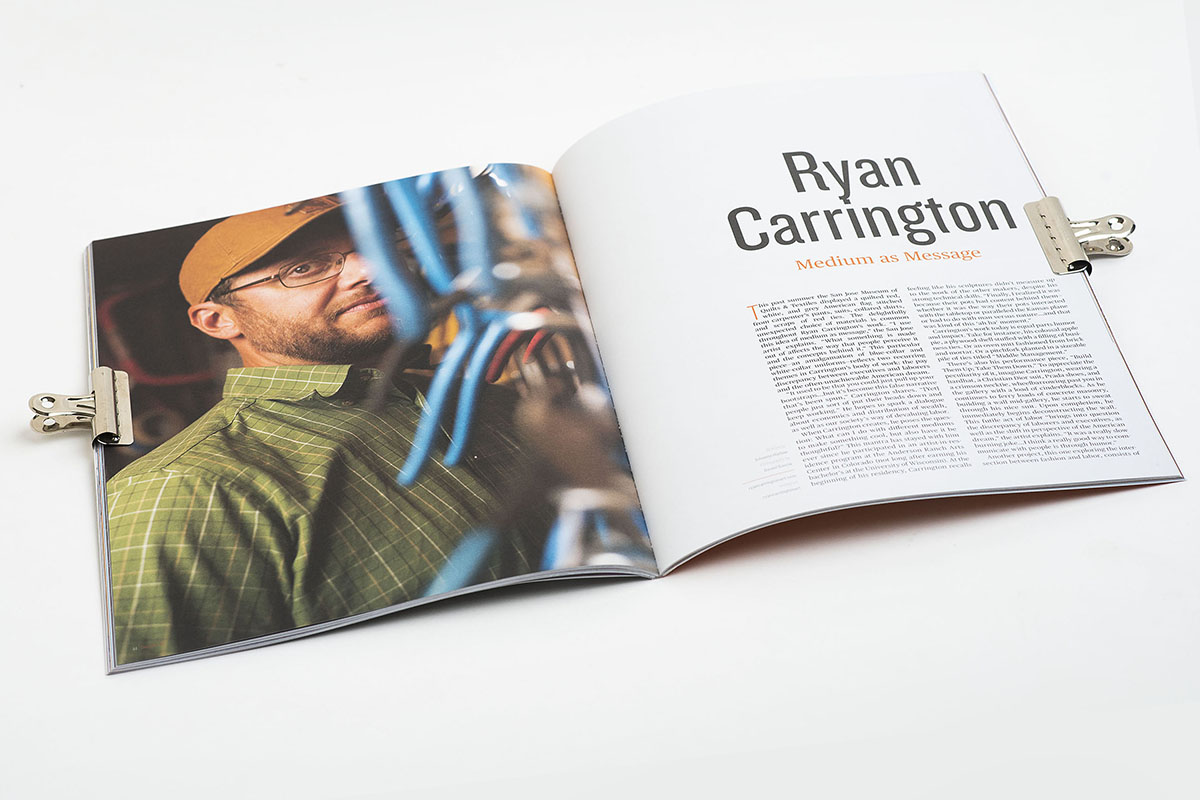
This past summer the San Jose Museum of Quilts & Textiles displayed a quilted red, white, and grey American flag stitched from carpenter’s pants, suits, collared shirts, and scraps of red ties. The delightfully unexpected choice of materials is common throughout Ryan Carrington’s work. “I use this idea of medium as message,” the San Jose artist explains. “What something is made out of affects the way that people perceive it and the concepts behind it.” This particular piece—an amalgamation of blue-collar and white-collar uniforms—reflects two recurring themes in Carrington’s body of work: the pay discrepancy between executives and laborers and the often-unachievable American dream.
“It used to be that you could just pull up your bootstraps…but it’s become this false narrative that’s been spun,” Carrington shares. “[Yet] people just sort of put their heads down and keep working.” He hopes to spark a dialogue about economics and distribution of wealth, as well as our society’s way of devaluing labor.
When Carrington creates, he poses the question: What can I do with different mediums to make something cool, but also have it be thoughtful?” This mantra has stayed with him ever since he participated in an artist-in-residence program at the Anderson Ranch Arts Center in Colorado (not long after earning his bachelor’s at the University of Wisconsin). At the beginning of his residency, Carrington recalls feeling like his sculptures didn’t measure up to the work of the other makers, despite his strong technical skills. “Finally, I realized it was because their pots had content behind them—whether it was the way their pots interacted with the tabletop or paralleled the Kansas plane or had to do with man versus nature…and that was kind of this ‘ah ha’ moment.”
Carrington’s work today is equal parts humor and impact. Take for instance, his colossal apple pie, a plywood shell stuffed with a filling of business ties. Or an oven mitt fashioned from brick and mortar. Or a pitchfork planted in a sizeable pile of ties titled “Middle Management.”
There’s also his performance piece, “Build Them Up; Take Them Down.” To appreciate the peculiarity of it, imagine Carrington, wearing a hardhat, a Christian Dior suit, Prada shoes, and a crimson necktie, wheelbarrowing past you in the gallery with a load of cinderblocks. As he continues to ferry loads of concrete masonry, building a wall mid-gallery, he starts to sweat through his nice suit. Upon completion, he immediately begins deconstructing the wall. This futile act of labor “brings into question the discrepancy of laborers and executives, as well as the shift in perspective of the American dream,” the artist explains. “It was a really slow burning joke…I think a really good way to communicate with people is through humor.”
Another project, this one exploring the intersection between fashion and labor, consists of plaid patterns he made with colored nails (aptly named “Screw Relief”). The idea came from one of his frequent trips to Home Depot. “I have to go alone, my wife won’t go with me. She’s like, ‘You’re just going to stand there and stare at materials,’ ” he laughs. “[But] she’s very supportive! She’s like, ‘You can have your alone time with that. I’m going to go take care of some business.’ ”
While wandering the aisles, Carrington came across bins of screws and realized they were the exact colors of a plaid Burberry design. “This is hilarious, I must make Burberry,” Carrington recalls thinking to himself. “A lot of luxury companies have sort of appropriated plaid,” he goes on to explain. “Plaid is something that’s gone lowbrow (like grunge rock) all the way up through high-end Burberry, like Ralph Lauren.” It took him a good handful of weeks to develop the right design, a practice he fondly refers to as “failing through the process.” Then he began the arduous task of fixing hundreds of screws into place.
“When people find out I’m an artist, they imagine me up on some bluff with some oils, you know? And it’s like, ‘No, I’m just, like, firing screws or staples into a board,’ and just trying over and over and over and over to make something remotely good-looking,” he laughs.
This sort of labor-intensive detail can be found throughout Carrington’s work. His quilted flags take him 40 to 50 hours to complete. And that’s after all the quilting classes at Eddie’s Quilting Bee alongside a group of venerable ladies (who got quite the kick out of this young man’s interest in their craft). “I make work about work. So, it should take work,” Carrington says, pointing out the parallel between his process and the way laborers perform the same task over and over again.
When Carrington isn’t creating, he’s teaching. “In sixth grade, I joined Future Teachers Club. You know, I just knew that was my calling.” He admits that for the longest time he intended to teach biology but had a change of heart after his college ceramics class. “I was enjoying the studio more than the lab,” he recalls. “I fell in love with artmaking through the potter’s wheel…the repetition and the craftsmanship and homing in on the technical skills.”
Today, he teaches at Santa Clara University, instructing students on the topics of sculpture, 3D design, site-specific land art, and professional practice. “So I got into this game as an educator and developed an art habit, I suppose,” he chuckles.
Carrington’s exhibit at the San Jose Museum of Quilts & Textiles has wrapped up, but keep an eye out for his upcoming projects. As he continues to educate others on the blue-and-white-collar divide, the integration of craftsmanship, humor, and depth in his future artwork is sure to be seamless.