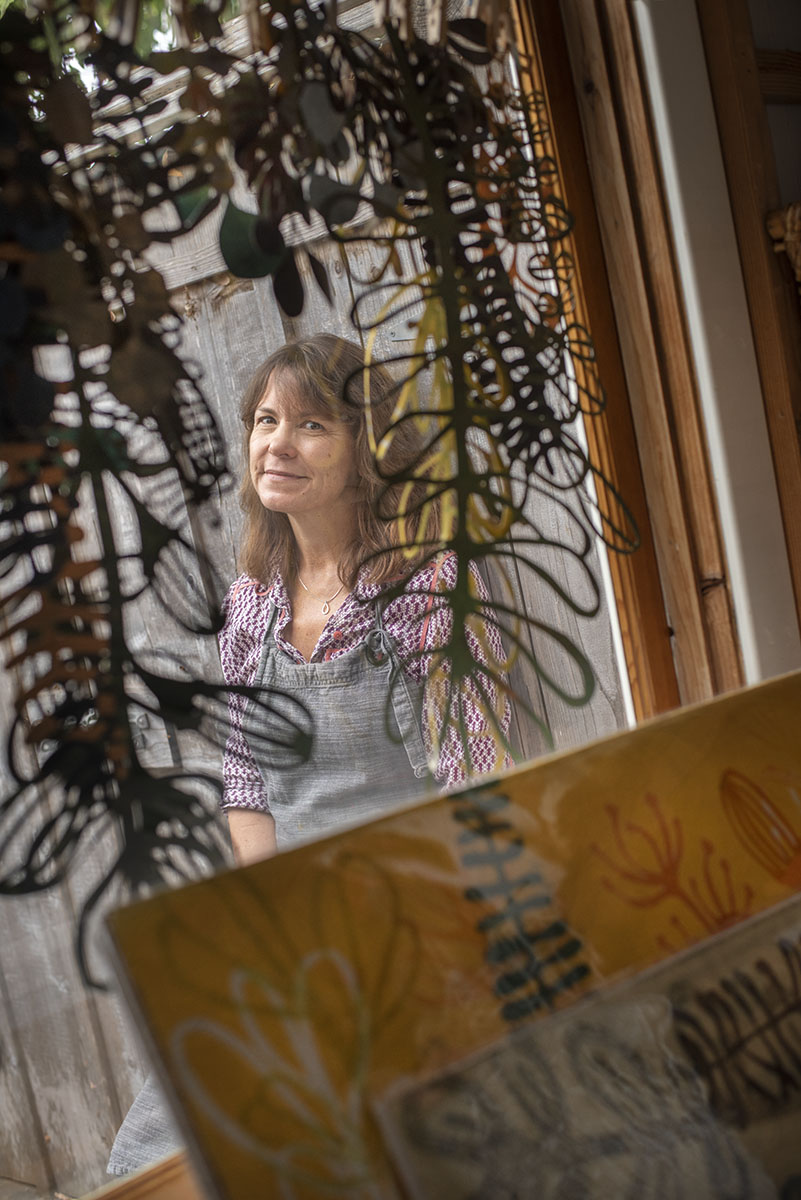
Santa Cruz artist Sarah Bianco’s work can be found at the intersection of fine and commercial art. As the owner of Painting by Bianco, her contract work includes interior painting and color consultations involving work from rolling paint and plaster to fine detail and murals. Her current studio practice at the Tannery Arts Center is quite literally built from her commercial practice, where she uses old drop cloths from her painting business as the foundation for her fine art. The cloth material retains a canvas-like texture and incidental marks, which Bianco views as abstract landscapes, guide her compositions.
Bianco views her studio process as meditative. She approaches the work intuitively, playing with color and imagination to develop ethereal worlds, allowing the paint and canvas to lead. Bianco describes, “I’m essentially trying to get out of my own way and allow what the painting wants to be shown to me”. She often combines open acrylics for fluid movement with oil-based paint bars to add a distinct, chunky texture to her pieces.
Bianco’s process often results in airy dreamscapes, some of which depict floating figures, jumping, and suspended in space. In many ways, this motif represents her artistic approach, taking risks and leaping into the unknown. That liminal space, the moment between when you jump and when you land, is also echoed in the ‘in-between” concept of Apricity, for which she named her gallery, which means the warmth of the sun in winter. She holds that once a piece is created, the magic is in its own relationship with everyone who sees it.
Bianco will be featured along with over 340 Santa Cruz County artists in the 2025 40th annual Santa Cruz County Open Studios Art Tour.
Featured in Content Magazine Issue 18.1, “Discover”
Artwork 1. Her Flowers Still Bloom, mixed media on wood, 18“x18“ 2. Feel, oil on used painters tarp, 30“x39.75“ 3. Respect What You Love, mixed media on wood panel, 32.75“x24.5“
All these comments and likes boosting our self-esteem
That instant gratification is poisoning our dreams
Social media pulling the plug on real time
I’m just trying to stay above it when it flatlines.
– Amplified, “Lovie”
IIn an age when many bank on virality, Andrew Vicente—“Amplified” to his fans—has been following the old model for building a fan base: touring as much as possible, making fans out of strangers, and selling music and merch hand-to-hand himself, one person at a time. Some might call his approach dated, but it might also help explain how, 10 years deep and still under 30, he’s already had fans tattoo his lyrics to their skin.
Over coffee at Forager in downtown San Jose, Vicente relates the time when his friend Gabe shared some lyrics by rapping over a beat he played through a karaoke machine. That moment in eighth grade was the exchange that inspired Vicente to pick up a pen and start writing his own rhymes. “I knew this is how I can really share who I am and not feel like this depressed little kid that can’t connect with other people. Everything clicked for me when I did that,” he recalls. “I’ve been obsessed. This is all I think about.”
“I knew this is how I can really share who I am and not feel like this depressed little kid that can’t connect with other people. Everything clicked for me.”-Andrew Vicente
Amplified is a two-city rapper in the truest sense, splitting his early years between Santa Cruz and San Jose. Once he transferred over the hill to Gunderson High School, he started sharing his rhymes with a history teacher and rapper named Apocalypse, who hosted a hip-hop open mic at Iguana’s called Lyrical Discipline. He urged the budding lyricist, whose ears were tuned to the complex lyricism of Immortal Technique and Minneapolis’s Rhymesayers crew, to take part; through connections he made on the scene, Vicente hit the road with the Vans Warped Tour in 2013.
That initial Warped Tour experience proved both inspiring and sobering. He and fellow support acts set up and dismantled their stage for every date of the tour. His limited stage time came while larger adjacent stages were doing changeovers, forcing him to immediately engage listeners or risk losing a crowd. In those make-or-break circumstances, Vincente learned how to perform. He headed out again in 2014, making waves as a duo act with singer-songwriter Brandon Scott and grinding out space in 2016 alongside fellow South Bay rapper Andrew Bigs.
In 2017, he encountered an offer he couldn’t refuse: Santa Cruz reggae rock heroes the Expendables asked him to handle work for their upcoming tour, with the chance to be an opening act. It’s a partnership that’s already taken him across the country twice. “I’m probably at the best position in my career I’ve ever been,” he notes, 48 hours removed from a tour stop in Bend, Oregon. “Even though I’ve been doing this for 10 years, I’m really going all out now.”
His recent single “I Am” earned a re-tweet from none other than Boy George. Follow-up “Illusions” provides the soundtrack to his first full-length music video. Both came in advance of his debut EP, Not Quite There Yet. The album’s a surprising listen, one that challenges listener expectations. There’s lyrical rapping, reggae vibes—he says his Santa Cruz roots made him destined to embrace the sound—and even a ballad sung in Spanish. The title alludes to the fact that these were all half-finished ideas he finally completed; it also suggests that, if the songs are a stretch for listeners, they might not be fully aware of the breadth of his talent just yet.
“It all started from me trying to find myself. Now I’m seeing my words and the music I wrote help [listeners] find themselves.”_Andrew Vicente
Adding to that conversation is Catch Lightning, his duo with San Jose stalwart Rey Res. It’s a project that defies listener expectations on both sides. For Res, it’s a showcase of his lush, evocative production ability; for Vicente, it’s been a chance to create freely with a musical partner—a new experience for a man used to piecing songs together in his bedroom.
When talking about what’s next, his restless mind is already scheming how to get back out on tour to retain the fans he just cultivated while touring with the Expendables. There’s a new project in the works. But even if it all stopped today, he knows he’s already made a lasting impact. “It all started from me trying to find myself. Now I’m seeing my words and the music I wrote help [listeners] find themselves,” he says. “If I never make another song again, it’s [still] mission accomplished.”
Bree Karpavage and Ann Hazels are breathing new life into the Santa Cruz art scene.
First Friday Santa Cruz is celebrating its 20th anniversary in 2024. As part of the celebration, First Friday Santa Cruz and Radius Gallery, also celebrating their 10th anniversary this year, have teamed up to host an exhibition entitled “Changing Spaces,” opening on the First Friday in June. “Changing Spaces” features the work of 39 artists and is an homage to this monthly event that presents both emerging and established artists showing in small businesses, galleries, and art spaces across the county.
Radius Gallery was founded in 2014 by Ann Hazels to create a space for contemporary art with an edge. As a commercial gallery, Radius partners with other regional arts organizations while maintaining its vision for curation and creating a platform for local artists. A practicing artist herself, Hazels believes in the power of art to change the world and works hard to create shows at Radius that resonate with visitors, knowing artists are working just as hard to make the same things happen.
Bree Karpavage, the new face of First Friday Santa Cruz since 2020, has injected fresh energy into the organization. Her focus has been on uplifting venues and artists, all while fostering a sense of community. Karpavage’s vision for First Friday Santa Cruz extends beyond downtown or traditional art galleries. She envisions it as a platform that showcases the artistic talent of the entire region. First Friday Santa Cruz is a bridge that connects the community to art and small businesses, firmly believing in the transformative potential of art experiences.
In this conversation, Ann and Bree discuss the business of art, their own art practices, advice for emerging artists, and what they hope audiences take away from their work.
Be sure to attend First Friday Santa Cruz on June 7 and check out the opening of “Changing Spaces” at Radius Gallery. This exhibition celebrates 20 years of First Friday and features the work of 39 artists. It is an homage to this monthly event, which presents both emerging and established artists showing in small businesses, galleries, and art spaces across the county.
Trevor Jones is a family man, building designer, and co-owner of Minnow Arts Gallery in Santa Cruz, California. Trevor was born and raised in Cupertino before studying economics and international studies during his undergrad and earning a master’s in architecture from the University of Oregon. Trevor describes the 15 years he lived in Portland, Oregon, as the “cauldron of his life as a creative person.” Inspired by Portland’s DIY art, design, music, and skateboarding scene, he imbued collaborative and process-oriented principles into SpaceCamp Studio, his design-build practice where he works as principal designer and general contractor.
Trevor moved to Santa Cruz in the early 2010s to continue his work at SpaceCamp, raise his family, and, as a surfer, live a coastal lifestyle. He met Minnow Arts Co-Owner Christie Jarvis through a mutual friend and artist, Jeremy Borgeson. Christie, a landscape architect, ceramicist, and filmmaker, was looking for office space, and Trevor had an office in the barrel aging warehouse of Humble Sea Brewing. It didn’t work out for them there, but it led Trevor and Christie to look for an office together. They eventually found and leased the space that became the Minnow Arts Gallery.
Trevor and Christie began hosting exhibitions that featured work from friends and artists they were connected with. Since then, Minnow Arts has been working to create an inclusive and supportive gallery focused on supporting the local art scene in Santa Cruz and giving opportunities to local and regional artists. Rather than having a strict mission statement, Minnow Arts stays true to its DIY roots and takes a more flexible approach to exploring what the space can be through different shows and events. They also aim to make exhibiting art more approachable and demystified for artists. Trevor sees his role as a “companion” to artists.
In our conversation, Trevor shares his approach to building design, reflections on the journey that led him to co-owning a gallery, and advice for anyone hoping to ‘do it themselves.’
Join Christie and Trevor at Minnow Arts Gallery on Friday, January 5th, for First Friday Santa Cruz as they open a retrospective exhibition featuring artwork from Good Knife Studio Creative Director Juan Llorens, a Buenos Aires-based artist who designs and illustrates work for Humble Sea Brewing’s cans, bottles, and marketing materials. Frank Scott Krueger from Humble Sea Brewing is collaborating with Juan to curate the show.
Stacy Frank is a printmaker based in Santa Cruz. She has been working on paper since 1994. What Stacy loves about printmaking is the process and the technique involved. She did some darkroom photography in college, but after graduating, Stacy learned about printmaking which seemed like a perfect combination of her scientific illustration and photography processing.
“One thing I love the most about printmaking is the big reveal.” -Stacy Frank
Over the last three years, Stacy developed an entirely non-toxic techniques that are fast and get quick results—using a process of cutting out stencil boards and using those stencil boards as masking and printing elements. Stacy then runs them through the press several different times. Using various combinations of inks and layers, she achieves beautiful ghosting and offsetting patterns from the stencils. Though the results can be unexpected, that enhances her love of the “reveal. But that is what gives Stacy joy in her process. “You never know exactly what you’re going to get sometimes; it’s fantastic, sometimes it needs a little work, but it’s always so satisfying.”
See more of Stacy’s work and her workshop at StacyFrank.com
Each October, Stacy participates in Santa Cruz Open Studios, where visitors experience artist workspaces, watch art demonstrations, view and purchase original art.
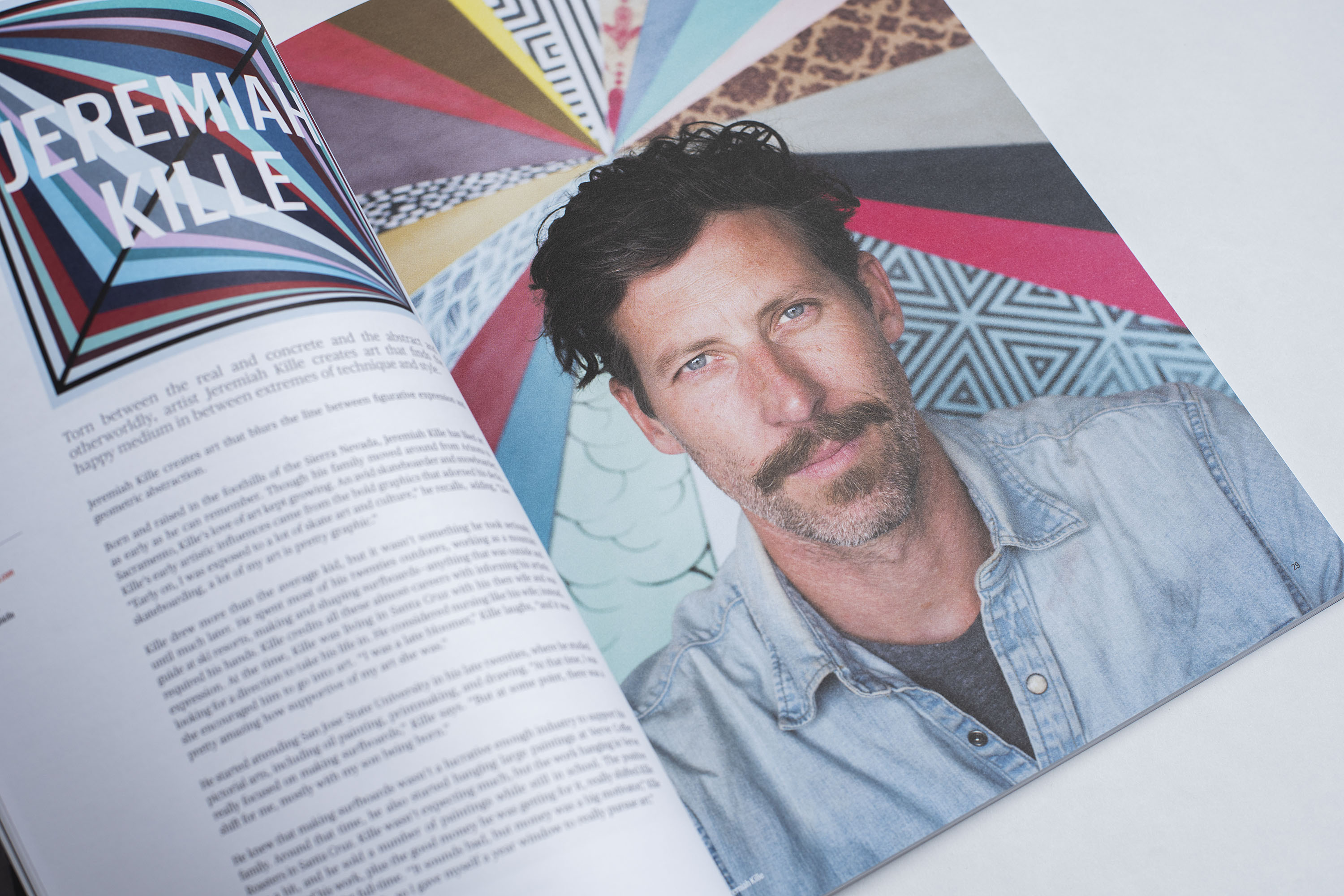
Jeremiah Kille creates art that blurs the line between figurative expression and geometric abstraction.
Born and raised in the foothills of the Sierra Nevada, Jeremiah Kille has liked art as early as he can remember. Though his family moved around from Arizona to Sacramento, Kille’s love of art kept growing. An avid skateboarder and snowboarder, Kille’s early artistic influences came from the bold graphics that adorned his decks. “Early on, I was exposed to a lot of skate art and culture,” he recalls, adding, “Like skateboarding, a lot of my art is pretty graphic.”
Kille drew more than the average kid, but it wasn’t something he took seriously until much later. He spent most of his twenties outdoors, working as a mountain guide at ski resorts, making and shaping surfboards—anything that was outside and required his hands. Kille credits all these almost-careers with informing his artistic expression. At the time, Kille was living in Santa Cruz with his then wife and was looking for a direction to take his life in. He considered nursing like his wife; instead, she encouraged him to go into art. “I was a late bloomer,” Kille laughs, “and it was pretty amazing how supportive of my art she was.”
He started attending San Jose State University in his late twenties, where he studied pictorial arts, including oil painting, printmaking, and drawing. “At that time, I was really focused on making surfboards,” Kille says. “But at some point, there was a shift for me, mostly with my son being born.”
He knew that making surfboards wasn’t a lucrative enough industry to support his family. Around that time, he also started hanging large paintings at Verve Coffee Roasters in Santa Cruz. Kille wasn’t expecting much, but the work hanging in Verve was a hit, and he sold a number of paintings while still in school. The positive reception of his work, plus the good money he was getting for it, really shifted Kille into being an artist full-time. “It sounds bad, but money was a big motivator,” Kille says. “Times were tough, so I gave myself a year window to really pursue art.”
A couple of months into his self-imposed time frame, Kille knew that he wasn’t going to quit art anytime soon. “I was all in,” he recalls, adding, “This is what I want to do for the rest of my life.”
Kille’s art is a bold, explosively toned journey into his subconscious. Much like his juggling of jobs, Kille’s work is a kaleidoscopic expression of the warring sides of his brain, where one day abstraction takes the driver’s seat and on another day figurative composition bleeds in. Focusing often on living, breathing motifs, such as elephants, birds, and matadors, and on the more inanimate, like boats and hot air balloons, Kille transforms this familiar imagery into a vibrant, texture-hopping landscape of metaphysical possibility.
Working mostly in oil and acrylic paint, Kille creates geometric compositions that melt into graphic representations of dreams through the use of loud, wild color. By combining the familiar elements of different styles, Kille creates entirely unique and unfamiliar compositions. “I am drawn to art that has elements of abstraction with moments of realism or recognizable objects,” Kille says. “To me, that combination is provoking. When I look at art like that, I am drawn in by the tensions between the two worlds as well as the balance.”
Through most of his artistic life, Kille has been met with pushback to his desire to jump around between styles and techniques. He understands unifying one’s work and seeing the artist as a brand, but Kille refuses to be tied down to one style or forced into one direction. He says, “If you look at my work, I do a few different things. I think it’s natural for me to not be boxed in creatively.”
As for the future, Kille’s work is going to be featured in an art show in Sacramento, as well as at numerous outdoor festivals, where he hopes to expand his large-scale painting skill. Either way, Jeremiah Kille is going to continue making art on his terms—and sometimes get recognition for it.
It’s tempting to say that Blaise Rosenthal has moved from his professional snowboarding career to being an artist, but it is more accurate to say that Blaise, who has been drawing since childhood, is merely now devoting his creative energies to his paintings.
How would you describe your work? I would say it’s more environmental. My experiences of a certain place during a certain period, and the physicality of that place, it’s very archetypal for me. It’s like, “This is water. This is Earth. This is heat. This is foliage.”
It’s very much like it’s like my own personal Garden of Eden, except not necessarily so serene. It has more adversity than obviously a paradise would have, but it still is my own kind of primal experience, and so in that way, I relate back to that. Then the physicality, all of my work has a certain physicality to it.
There’s a real earthy or elemental aspect to your work. Right. Charcoal is a totally natural material. It’s also one of the first mark-making media that humanity ever probably used—probably charcoal from the fire, boom—on the ground, or on the wall, or on a rock, or whatever.
Is that something that you intentionally did, or is that just a byproduct? I use the charcoal because it was something I was doing a long time ago, and I realized there was another way I was using it. A lot of what I do is that I do something, and I go, “Ooh, that works. Why does it work?” And then I reverse-engineer it. “Why does the geometry work for me? Why does the repetition work for me?” and so it’s like that.
Your earlier work was very colorful. What was the transition to the current work? I was making the underpainting for one of the paintings I was working on. I had just finished a show, and I was starting to work again. I made this piece, and I had all of the underpainting done, and made an outline for what I wanted to do, and when I finished doing that, I saw it, and I was like, “What am I doing? This is what I want to make.”
I had been creating these underpaintings, and then looking at it and going, “That’s really beautiful, but it doesn’t fit the idea I have.” I would complete an idea in a painting to express some concept that I didn’t even necessarily believe in five minutes later. I was trying to have all this conceptual importance in the work, or have some theoretical underpinning to the paintings. But then, I gave in to beauty, and I was like, “Why am I going to cover something that I like up?”
Do you think with that earlier work, then, you were trying to almost prove yourself in a way? I wanted an excuse for the paintings. I wanted to be like, “OK, I’m making the paintings because I need to investigate the meaning of life or whatever.” I kept trying to think about it, and it was a very weak topic. There was nothing else. I see people make paintings about all kinds of things. It seems like a really inefficient medium for that purpose, whereas a documentary or podcast, whatever, you can get a point across.
With painting, I think it’s touching on something that isn’t necessarily explainable. To have a concept before you even start to make the painting, and then adhere to that concept, then it’s the painting to potentiate that concept. Fortunately, I stopped working and paid attention. That has been foundation of everything I’ve made since.
You’ve said you want your paintings to be about nothing, or something like that? I don’t want them to be about nothing at all. I actually want them to be everything all at once, but I just don’t want them to be too specifically something, because that limits their potential to be everything else.
Is that because you want the viewer to bring in more of their own emotion or a feeling, and their thoughts to it, than a “story” you are trying to tell? I would like it to be holistically experiential in the sense that when you see my art, people want to touch it. With my larger pieces, people really respond to the texture of them. To touch them on that sensory level: I want it to stimulate your mind. I just don’t necessarily want to dictate to you what to think, because I think people’s life experiences are so subjective, and the potential is then infinite.
What I try to do is to create a moment of sincerity in regards to my painting, where this painting comes as close to a hundred percent being from a place that I feel is true, and that I have a license to speak from, as far as my experience growing up, my influences in art making. Then I put it there, and people bring whatever they have to the table, and they look at it, and whatever it does for them, I don’t know.
As much as I’m trying to maybe downplay the whole idea of dictating, I at least do think there are universal themes or potentials for human experience. And if I can touch on those, then I’m doing really well. There’s a final kind of singular moment at which the whole becomes greater than the sum of its parts.
Not to focus on your snowboarding life, but are there any similarities in the sense of having a career in snowboarding, and then having a career in painting? What would you say is the connection, what’s the commonality? Snowboarding was something that worked for me because it was an extension of skateboarding, and skateboarding was something that worked for me because it was physical, and yet it also had the potential for expression.
It was performance art, in a way, and it was also satisfying in so many ways. Skateboarding is a pretty highly refined—almost to a fault at times—but a highly refined subculture, where the possibility for meaning through artistic expression is totally inherent in the act.
What color shoelaces you have can be a way of expressing an aspect of personal identity, and I would say that snowboarding is an extension in the same way. The way in which you would do something, the way in which you wouldn’t do something, there were decisions that I made that were definitely calculations not based on athleticism, but based on expressiveness or identity.
In that way, snowboarding and painting are related, because they’re both places where I can be the person that I am. I just seem to be the type of person that has this need to do this thing and share it with other people.
It’s not a song if it was never sung, right? Right. I’m not just entertaining myself. I am, but I’m entertaining myself with a deep-seated hope that someone else is going to be affected by what I’m doing, too, and I’d be lying if I said otherwise, so I love the idea that I am autonomous sometimes, and my work could be autonomously beautiful, but it still needs to be seen.