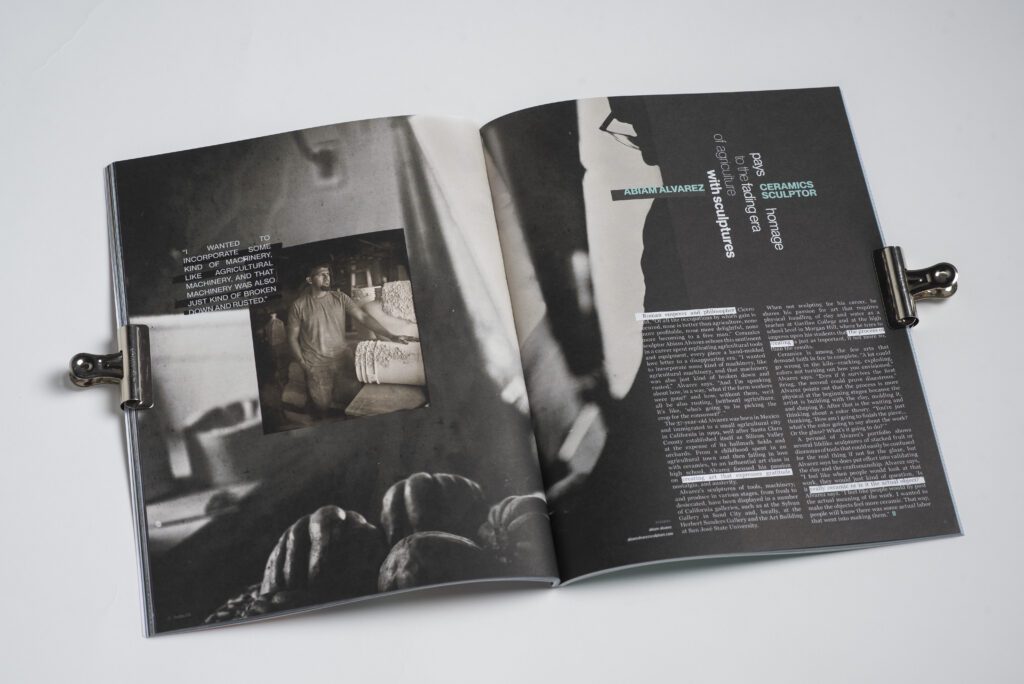
Roman emperor and philosopher Cicero said, “Of all the occupations by which gain is secured, none is better than agriculture, none more profitable, none more delightful, none more becoming to a free man.” Ceramics sculptor Abiam Alvarez echoes this sentiment in a career spent replicating agricultural tools and equipment, every piece a hand-molded love letter to a disappearing era. “I wanted to incorporate some kind of machinery, like agricultural machinery, and that machinery was also just kind of broken down and rusted,” Alvarez says. “And I’m speaking about how, in a way, ‘what if the farm workers were gone?’ and how, without them, we’d all be also rusting, [without] agriculture. It’s like, ‘who’s going to be picking the crop for the consumer?’. ”
The 37-year-old Alvarez was born in Mexico and immigrated to a small agricultural city in California in 1999, well after Santa Clara County established itself as Silicon Valley at the expense of its hallmark fields and orchards. From a childhood spent in an agricultural town and then falling in love with ceramics, to an influential art class in high school, Alvarez focused his passion on creating art that expresses gratitude, nostalgia, and austerity.
Alvarez’s sculptures of tools, machinery, and produce in various stages, from fresh to desiccated, have been displayed in a number of California galleries, such as at the Sylvan Gallery in Sand City and, locally, at the Herbert Sanders Gallery and the Art Building at San José State University.
“I wanted to incorporate some kind of machinery, like agricultural machinery, and that machinery was also just kind of broken down and rusted.”
When not sculpting for his career, he shares his passion for art that requires physical handling of clay and water as a teacher at Gavilan College and at the high school level in Morgan Hill, where he tries to impress upon his students that the process of creating is just as important, if not more so, than the results.
Ceramics is among the few arts that demand faith in fire to complete. “A lot could go wrong in the kiln—cracking, exploding, colors not turning out how you envisioned,” Alvarez says. “Even if it survives the first firing, the second could prove disastrous.” Alvarez points out that the process is more physical at the beginning stages because the artist is building with the clay, molding it, and shaping it. After that is the waiting and thinking about a color theory. “You’re just thinking, ‘How am I going to finish the piece… what’s the color going to say about the work? Or the glaze? What’s it going to do?’ ”
A perusal of Alvarez’s portfolio shows several lifelike sculptures of stacked fruit or dioramas of tools that could easily be confused for the real thing if not for the glaze, but Alvarez says he does put effort into validating the clay and the craftsmanship. Alvarez says, “I feel like when people would look at that work, they would just kind of question, ‘Is it really ceramic or is it the actual object?’ ” Alvarez says. “I feel like people would fly past the actual meaning of the work. I wanted to make the objects feel more ceramic. That way, people will know there was some actual labor that went into making them.”
Follow Abiam’s work on the web at abiamalvarezsculpture.com and on Instagram at abiam.alvarez
Image 3: Watermelon Bin, 2021 Ceramic, acrylic 21 x 40 x 29 inches
Image 4: Honeydew Medallion, 2021 Ceramic 20 x 20 x 7 inches