Nestled on the corner of South First and San Carlos, at the edge of San Jose’s SoFA arts district, is a fairly ordinary office building that transforms when the clock strikes five. Entering the office on weekdays, you will see the staples of a nonprofit workplace: overhead fluorescent lighting, cubicles, filing cabinets, and a water cooler. Any time after 5pm, the hum of the water cooler is replaced with sound checks, the fluorescent lights are replaced with projections and mood lighting, and the front desk is converted into a bar. This office-turned jazz-lounge is the San Jose Jazz (SJZ) Break Room, a 100-person music venue designed and operated by San Jose Jazz that was established in 2020 through a grant from the Knight Foundation.
Early COVID-era live streams from SJZ Break Room featured small, socially distanced crowds wearing masks. Today, it is common to be a full house, but the team has continued producing live streams available on the San Jose Jazz YouTube page and projected during the show on the 20foot windows facing San Carlos Street. The brainchild of Special Projects Manager Scott Fulton, SJZ Break Room was designed as an intimate setting for audiences to enjoy a variety of jazz-adjacent performances by emerging and established musicians. Recalling his initial vision for the space, Fulton shares, “San Jose Jazz was a 30-year-old organization that never had its own venue.”
“I know how hard it is to pursue music; I’ve been on the front lines of that, so any little thing that I can do to help young people not give up on that dream and to pursue it with every fiber in their bodies is really exciting, humbling, and my favorite thing to do.”
Born and raised in the South Bay, Scott Fulton has long been interested in music. He recalls seeing a video of Les Claypool, bassist for Bay Area progressive rock group Primus performing at Woodstock ’94, launching his practice as a bass player. Later in life, Fulton pursued music industry studies at California State University, Northridge, while playing bass in a cover band called Seduction and an original project called Balance and the Traveling Sounds. He recalls, “My main source of income was the two bands, but I also had really crappy jobs to just get the rent paid. Balance and the Traveling Sounds’ best and worst year was 2013. We played at the Java Jazz Fest in Indonesia, were paid for our recording sessions, and then the band completely capitulated. It was serendipitous, though, because my wife got into grad school at San Jose State University right around that time. I was ready to be out of there, but I fondly remember that time.”
After returning to San Jose, Fulton retired from performing. He took a job with San Jose Jazz, managing transportation logistics for Summer Fest and working with the youth program. He later took on initiatives such as the San Jose Jazz Boombox truck, a mobile stage providing pop-up concerts. After experiencing the crowded and cutthroat music scene in Los Angeles, Fulton recalls, “Getting back to San Jose felt like a breath of fresh air because this arts community wants to prop each other up.”
Fulton pitched the initial layout, sound, and lighting design concepts for SJZ Break Room. His dream of designing a venue stems back to his youth. “As a teenager, I was a projectionist for landmark theaters. I always thought of movie theaters as perfect music venues. I would draw pictures of my ideal venue and include technical elements.” The intimate design of the space, including the absence of a stage, was inspired by Fulton’s time as a musician. “My favorite gigs to play were always house parties. They felt loose, like people could express themselves freely. That was a big part of why there’s no stage, no barriers. You feel like a part of the show when there’s no stage.”
When asked about the importance of venues, Fulton shares, “I can’t even stress how important they are. There’s so much talent and creativity in the San Jose music scene, but those people leave to go to New York, Los Angeles, or places where there’s greater opportunity, or they give up, and that’s really sad for me to see. That’s a huge reason we wanted our own venue; it’s just a little way to create one more space.”
For 2024, SJZ Break Room has a new mural painted by San Jose’s own Brush House that marks it as a landmark right at the gateway to the SoFA arts district. The venue is also hosting several Summer Fest performances, including acts such as Nikara Warren, Huney Knuckles, Baycoin Beats, Jay Sticks, Nico Segal, and The JuJu Exchange. On his time with San Jose Jazz, Fulton shares, “I just really appreciate that I’ve been given the opportunity to basically live the dream, just the fact that I have this time period in my life where I get to do audio production and raise up the local music scene. I know how hard it is to pursue music; I’ve been on the front lines of that, so any little thing that I can do to help young people not give up on that dream and to pursue it with every fiber in their bodies is really exciting, humbling, and my favorite thing to do.”
MindFi Performance of “The Many Faces of Men” in Content Black Backdrop at the end of this post.
What happens when a hair salon becomes a stage, a friendship becomes a band, and a guitar and voice create a whole universe of sound?
MindFi is a genre-bending musical duo formed by Kia Fay and Mark Arroyo. Combining their unique talents, they have created something they describe as a wireless mind connection, a performance philosophy, and a creative community rooted in the heart of San Jose’s Japantown.
The name MindFi is a play on “Wi-Fi for your mind,” and that is exactly what their music feels like—tapping into an unseen, deeply intuitive frequency between two artists who listen as much as they play. Born from a long-standing friendship and shared vision for musical purity, the project came to life post-COVID, blending logistical simplicity with artistic depth. With just guitar and vocals, they challenge themselves to make music that feels expansive, spontaneous, and emotionally raw.
MindFi’s core performance takes place on the last Wednesday evening of every month at The Curl Consultant, Kia’s salon-turned-sound-lab on Jackson Street in Japantown. What makes MindFi especially captivating is their intentionality. Every element—from the curated audience and the timing of their Wednesday shows to their strategic approach to growth—is designed to create connection and community. The band values intimate live performances and how each set is never quite the same. Each breath, mistake, and laugh becomes part of the show, immersing listeners in the moment and the music.
Their sound is the product of weekly rehearsals, conversations, active listening, and an ongoing “what if” approach to creation: what if we play this differently? What if we strip it down? What if we rebuild it entirely? Whether covering Depeche Mode with just a guitar and voice or experimenting with chord voicings and layered effects, their goal is always to make the music feel full beyond what most would expect of a duo.
While this collaboration between artists was long in the making, Kia received a 2025 San Jose Jazz Jazz Aid Fund commissioning grant, which acted as an accelerator for the project’s artistic vision. The fund validated their presence in the local arts scene and gave them the resources to launch MindFi with autonomy and intention. They continue to grow the project on their own terms—developing recordings, videos, and plans for future performances—while bypassing the traditional struggle of new bands constantly chasing gigs.
In this conversation, Kia and Mark reveal their approach to music as a creative outlet, a community hub, and a sonic experiment. They discuss their careers making art in other contexts and how MindFi is a place where they decompress, reconnect, and remember why they fell in love with music in the first place.
Experience MindFi’s sound at Pick-Up Party 17.3 on May 16, 2025 at West Valley College. They will be opening the event at 7p. You can also experience their magic at The Curl Consultant every last Wednesday of the month in Japantown. RSVP.
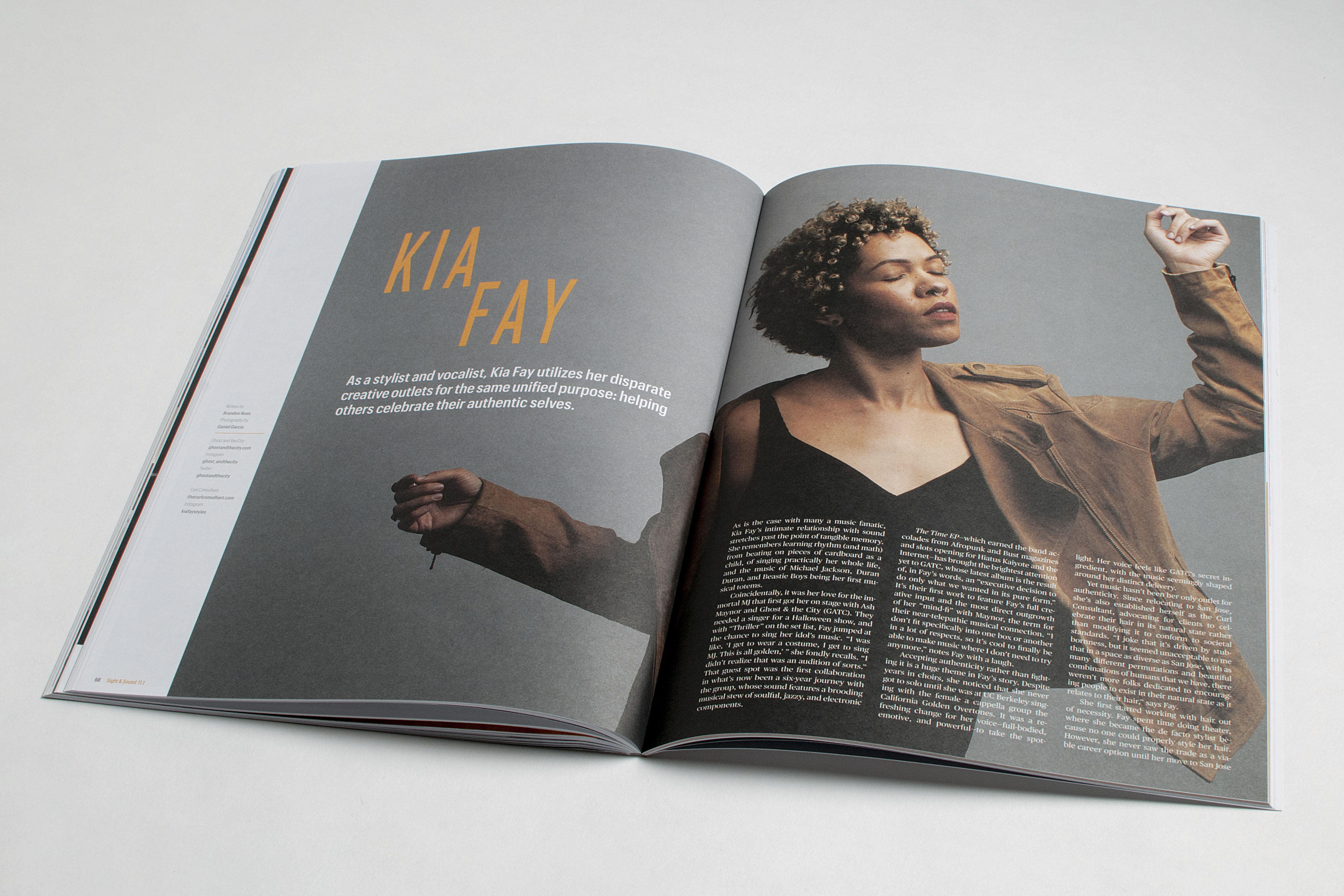
As is the case with many a music fanatic, Kia Fay’s intimate relationship with sound stretches past the point of tangible memory. She remembers learning rhythm (and math) from beating on pieces of cardboard as a child, of singing practically her whole life, and the music of Michael Jackson, Duran Duran, and Beastie Boys being her first musical totems.
Coincidentally, it was her love for the immortal MJ that first got her on stage with Ash Maynor and Ghost & the City (GATC). They needed a singer for a Halloween show, and with “Thriller” on the set list, Fay jumped at the chance to sing her idol’s music. “I was like, ‘I get to wear a costume, I get to sing MJ. This is all golden,’ ” she fondly recalls. “I didn’t realize that was an audition of sorts.” That guest spot was the first collaboration in what’s now been a six-year journey with the group, whose sound features a brooding musical stew of soulful, jazzy, and electronic components.
The Time EP—which earned the band accolades from Afropunk and Bust magazines and slots opening for Hiatus Kaiyote and the Internet, has brought the brightest attention yet to GATC, whose latest album is the result of, in Fay’s words, an “executive decision to do only what we wanted in its pure form.” It’s their first work to feature Fay’s full creative input and the most direct outgrowth of her “mind-fi” with Maynor, the term for their near-telepathic musical connection. “I don’t fit specifically into one box or another in a lot of respects, so it’s cool to finally be able to make music where I don’t need to try to anymore,” notes Fay with a laugh.
Accepting authenticity rather than fighting it is a huge theme in Fay’s story. Despite years in choirs, she noticed that she never got to solo until she was at UC Berkeley singing with the female a cappella group the California Golden Overtones. It was a refreshing change for her voice—full-bodied, emotive, and powerful—to take the spotlight. Her voice feels like GATC’s secret ingredient, with the music seemingly shaped around her distinct delivery.
Yet music hasn’t been her only outlet for authenticity. Since relocating to San Jose, she’s also established herself as the Curl Consultant, advocating for clients to celebrate their hair in its natural state rather than modifying it to conform to societal standards. “I joke that it’s driven by stubbornness, but it seemed unacceptable to me that in a space as diverse as San Jose, with as many different permutations and beautiful combinations of humans that we have, there weren’t more folks dedicated to encouraging people to exist in their natural state as it relates to their hair,” says Fay.
“I don’t fit specifically into one box or another in a lot of respects, so it’s cool to finally be able to make music where I don’t need to try to anymore.”
She first started working with hair out of necessity. Fay spent time doing theater, where she became the de facto stylist because no one could properly style her hair. However, she never saw the trade as a viable career option until her move to San Jose propelled her to be the change and to establish a space the city desperately needed. “The bulk of the feedback I’ve received has been that the work I do is liberating,” admits Fay. “That’s the best-case scenario for me: freeing anybody from a restriction they thought they had that was only an artificial restriction. Hopefully I can plant that seed for other folks, and they in turn will stand as beacons wherever they are.”
As a person of mixed descent who struggled over the years with where she fit in, Fay’s now using her two creative pursuits to help others recognize and celebrate their own unique tastes and identities through communion and connection. “We have to stop being so wedded to [the idea that] ‘This is what beauty looks like. This is what music looks like,’ and just accept beauty when we see it and hopefully foster what comes naturally to people and stop encouraging them to resist their more authentic selves, in any capacity,” she says.