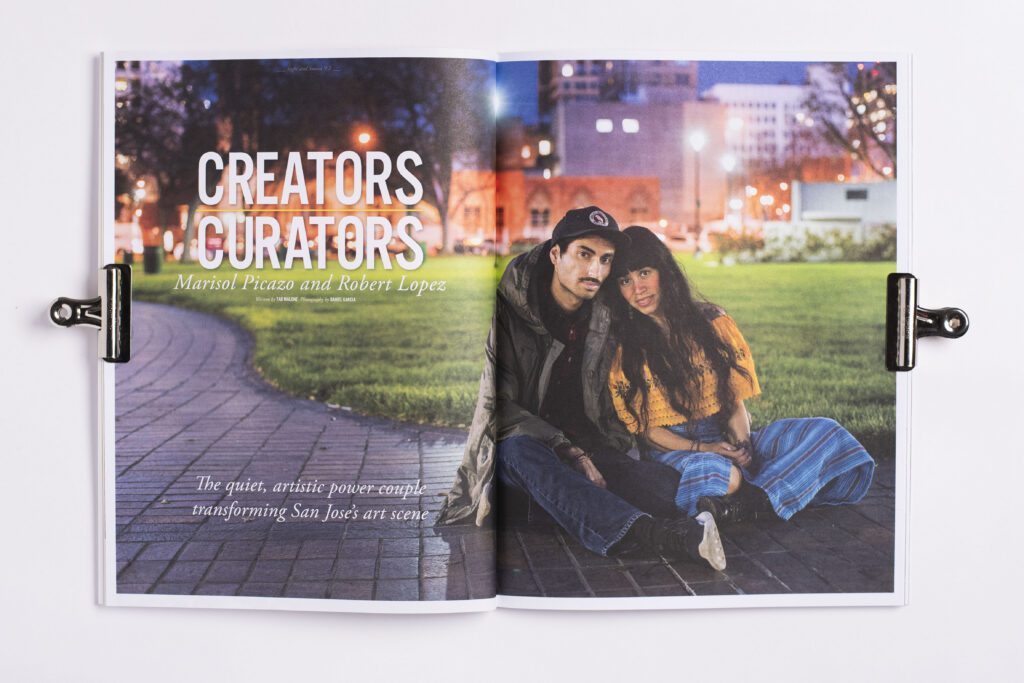
Marisol Picazo and Robert Lopez are the most unassuming power couple you’ll ever meet. From creating zines to curating art shows or featuring their own work in galleries, Marisol and Robert have been quietly establishing a young, ambitious, and deeply positive force in the San Jose art scene.
The pair met through a mutual friend in late 2009. After meeting up to take pictures together in Big Sur, they started hanging out every day. “We always chilled and took photos and fed off each other. I guess we just clicked,” Robert says. Their artistic collaborations began soon after they met, as both of them were bloggers and film documentarians.
As for how they got into art, the process definitely started early for each. “I’ve loved art all my life,” says Robert. “As a kid, I liked to look at pictures and either trace or copy them and make it in my own way.” This life-long infatuation led Robert to enroll in a four-year art program at his high school. It was during this time that he started getting into photography. From there, he went on to San Jose State University, graduating with a BA in design studies. Students could sign up for gallery time, and it was here that Robert got his first taste of curating.
Marisol has also been in touch with her artistic side from a young age. A photographer as well as a writer, Marisol graduated with a degree in creative writing from CSU Monterey Bay. Her personal writing and photography (which focus particularly on Chicano/a identities) have been published in various zines, literary journals, and online publications.
In recent years, they have found themselves becoming increasingly in demand as local curators. Though Robert already had some experience curating shows in the South Bay, it wasn’t until after managing a 52-person show in 2015 for the relatively cozy Chromatic Coffee that the couple’s curatorial work took off. That work caught the attention of the owners of Boba Bar in San Jose, who asked the couple to curate art in their own store. From this project they created Space B, a multimodal art exposition that puts on a show at least every two months. Their most recent show, “Tough Love,” was a blow-out success. For now the couple plans on taking a little breather, but Marisol and Robert will have another show up and running by April.
As for their more textual work, the idea of Paper Memory stemmed from an open-call zine that Marisol and Robert created and released in late 2015. They invited a group of photographers to share intimate portraits from their lives and titled the project Something Personal, a name derived from an old blog Robert and Marisol used to share called Memories on Paper. “When we first started doing it, it was only through our inner circle of friends,” says Robert of their newest project. “But we wanted to extend it and make a platform where we could reach out to a larger audience.”
Thanks to their artist connections and a little bit of networking on Instagram, Marisol and Robert received contributions from all over the world. One feature of Paper Memory included letting photographers primarily working in film take over Paper Memory’s social media account for four days each, as a sort of digital artist-in-residency program.
While they have been recently more focused on curating, the pair plans to revamp the site into a multimodal platform for photographic expression to include artist interviews, profiles, and photos of the day. “Attending art shows is cool and all, but they’re only once a month. You need to do stuff every day,” says Robert. “It’s good for artists to look forward to things that they’re a part of, not just events for other well-known artists.”
In terms of navigating and networking in the San Jose art scene, Marisol and Robert remain inspired by their local support. “There are separations in the local scene, but we have always been surrounded by really a positive art community,” says Robert.
Marisol echoes her partner’s sentiments. “I look forward to working with the San Jose community because I see the strong attachment in our own circle. I see a lot of support, which inspires me to work on my own art, as well as create zines or curate shows.”
Robert and Marisol joined Empire 7 Studio to curate and exhibit a celebration of the support Henry Change and Foto Express have provided to the San Jose Photography scene. Exhibition on display until Feb 28th.
Blog artwork images by Robort Lopez and Marisol Picazo
Although newer buildings loom large along bustling Santa Clara Street, Foto Express has survived relatively unscathed, providing a place for photographers to rent equipment and develop film since 1987. The eminent owner of the shop, Henry Chang, is known for his wizard-like knowledge of photography, his acumen for developing rare types of film, and a magnanimous personality, a winning combination that has kept customers coming back for decades. While the Valley builds up and out, Chang has learned to adapt to the digital age, but Foto Express—known for both its customer service and its specialties—still stands as an icon of a more traditional, intimate style of business.
“Over the years, I’ve worked with a lot of students, and it’s great to see some of them nurture a real passion for photography. Some of those students have become teachers or even fine-art photographers who exhibit in galleries and museums around the world. That’s a really nice thing to see: all those young kids who use their talent and creativity so they can create a full career. Watching that passion grow is probably the most rewarding part of my job.”
Foto Express 304 E Santa Clara St C, San Jose, CA 95113
“If someone gives me ‘no’ as an answer, I find a different way.” -Josie Lepe
Whether it’s capturing the drama of a touchdown at a football game or the intimacy of a family at their dinner table, Josie Lepe is on a mission to tell stories through photos. An award-winning independent photojournalist, Lepe has worked in the newspaper industry for the past 22 years, with experience ranging from taking digital photos with the latest high-tech cameras to developing traditional film in labs and darkrooms.
While Lepe has deep roots in the Bay Area, her journey was not easy. She crossed the border from Mexico as an undocumented immigrant twice: first as an infant and then later at nine years old. The second time, she was with her cousin and sister and was later reunited with her mother in San Jose. Although she’s moved a few times, Lepe has always found her way back to San Jose. “I identify [San Jose] as my home, even though I’m from somewhere else. I feel like I’m a native of San Jose. It’s kind of like it’s my city. I’m proud of it,” she said. Initially, as an English learner with dyslexia, she struggled in school. Yet that’s where her career path started. “I was able to take an elective for photography, and there I found my passion through photography and the dark room,” said Lepe. “It opened my eyes to a different way to communicate, and it was also my escape.” In those early days, she went to Coyote Creek in San Jose to practice taking photos. She shared, “I would create images that were beautiful in black and white, and even though we were like, ‘It’s the creek, it’s the ghetto,’ it was a way to escape to this fantasy with creating images.”
While Lepe was told she could never go to college due to her dyslexia, she ended up graduating from San Jose State University with a BFA in photography. “I didn’t want to be a waitress, and I knew education was a path to change that,” said Lepe. “Being an immigrant, being poor, I knew that education was going to open the doors to something new.”
More recently, Lepe went back to school for her MFA and graduated in December 2022. “No matter what, I always try to keep moving. Even if there was something where they said ‘No, the door is shut,’ then I’ll try again. If someone gives me ‘no’ as an answer, I find a different way,” said Lepe.
Over the years, Lepe worked odd jobs to help contribute to the family income. At one point, she worked full-time at The Mercury News. Now she splits her time between freelance work— often for The Associated Press and covering sports pieces—and her own projects. She had work featured at the de Young Museum’s 2023 de Young Open and at the San Jose gallery Chopsticks Alley Art (through January 2024).
For her personal projects, La Cena (Supper) is one that is a series of portraits that capture the diversity within the modern-day “Latine” community’s families. “There’s that whole image of the brown people being in a dump, or your house is falling apart, or whatever it is, but not all of us are in that. There are different variations of us. It’s a spectrum,” described Lepe. “Also, we all come from different countries. There are Latin Americans, there are Afro Latinos, there’s indigenous people— everybody is part of that ‘Latines’ group.” Lepe uses the term “Latines” for her work instead of “Latinx,” as “Latinx” always sounded more like a label for an experiment rather than an inclusive term. “ ‘Es’ is basically ‘we.’ It makes us, us. So to me, ‘Latines’ became more of a proper use of the term,” explained Lepe.
Lepe has always found herself documenting subcultures that she sees have not historically been fairly represented. She specifically focuses on women’s empowerment and the story of the immigrant in a positive way. “We always see visual images like the famous images of the drunken guy in Mexico or the prostitute at a bar. But there’s two sides of the story there. There are positive people that are working that are part of society, and we should show that more. I’m more about the positive visual representation,” Lepe said. She previously did a story on women passionate about their cars. “It wasn’t about being the trophy wife or the trophy in the car. It was more about them and their passion about [car] culture,” explained Lepe.
Today, Lepe works with graduate students at Stanford with photography lab work. She hopes that this job will give her more flexibility to spend less time freelancing and more time on her own series and projects.
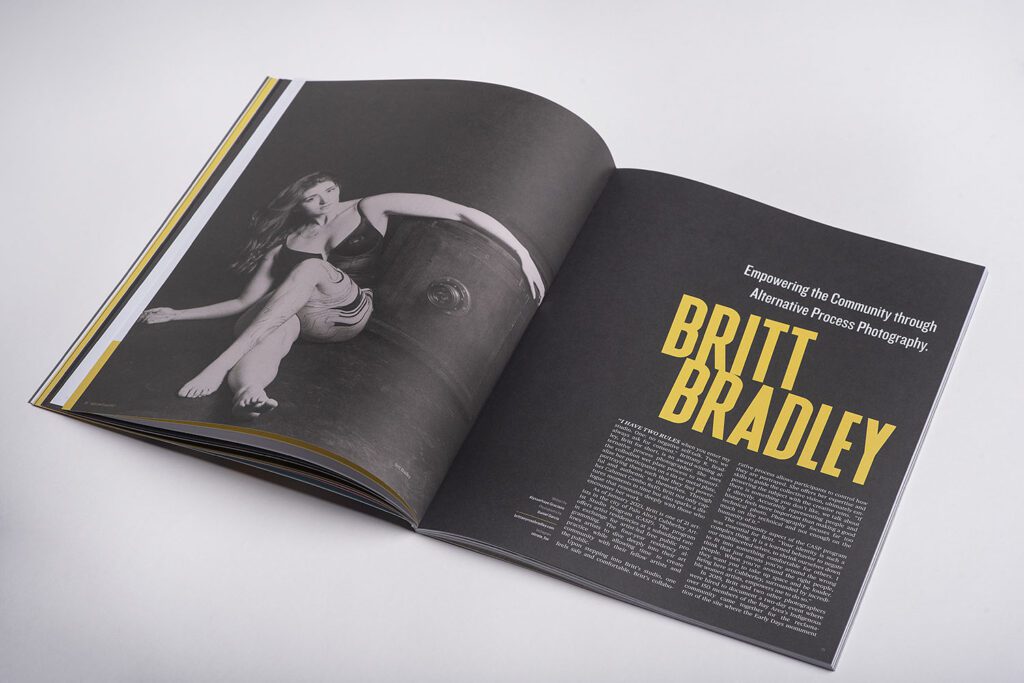
“I HAVE TWO RULES when you enter my studio. One: no negative self-talk. Two: we always ask for consent.” Brittany R. Bradley, Britt for short, is an award-winning alternative process photographer. She uses the collodion wet plate process to memorialize her participants on a tin or metal plate, portraying them such that they feel powerful and authentic to themselves. Through her Calumet Cambo 8×10, Britt not only captures moments in time but also sparks a dialogue that resonates deeply with those who encounter her work.
As of January 2023, Britt is one of 21 artists in the city of Palo Alto’s Cubberley Artist Studio Program (CASP). The program offers artist residencies at a subsidized rate in exchange for artist-led free public programming. The four-year residency allows artists to dive deeply into their art practice while allowing time to create community with their fellow artists and the public.
Upon stepping into Britt’s studio, one feels safe and comfortable. Britt’s collaborative process allows participants to control how they are portrayed. She offers her expertise and skills to guide the collective vision, ultimately empowering the subject with the creative reins. “If there is something you don’t like, we talk about it directly. Accurately representing people and history feels more important than making a good technical photo. Photography focuses far too much on the technical and not enough on the humanity of it.”
The community aspect of the CASP program was essential for Britt. “Your identity is such a complex thing. It is a learned behavior to negate our multifaceted selves, to shrink ourselves down to fit into something comfortable for others. I think that just means you’re around the wrong people. When you’re around the right people, they want you to take up space and be louder. Being here at Cubberley, surrounded by incredible women artists, empowers me to do so.”
In 2019, Britt and two other photographers were hired to document a two-day event where over 150 members of the Bay Area’s Indigenous community came together for the reclamation of the site where the Early Days monument once stood. The project emboldened the local Indigenous community to redefine their public perception. Britt feels it is important for her to use her seat at the table to demand there be one for the Indigenous community, allowing for a more accurate representation of our collective histories. “Photography has a history of not accurately representing communities of color, the queer community, women. I want to do my part in changing that narrative, giving those communities the power to represent themselves.”
Since the collodion process requires several steps to capture a single shot, access to a permanent studio allows Britt to have a round-the-clock space to shoot and develop photos in her darkroom at her own pace. When out in the field, Britt utilizes her custom-built mobile darkroom, Ruby. This allows her to transport all the necessary materials needed to process wet plate photographs on the go. Britt typically uses Ruby at protests and rallies but also to provide interactive public demonstrations and collaborative group sessions.
Britt grew up in Groveland, located in Gold Rush Country near Yosemite. Both of her parents were educators and encouraged Britt and her three brothers to spend time outdoors. “When I was eight, my father taught me to develop film.” Today, both Britt’s day job and art practice focus on photography and its related practices. “While my mom never discouraged me from pursuing the arts, she was worried I wouldn’t be able to make a living. But she isn’t as conventional as she thinks. She is strong, outspoken, does everything her own way, and has an unwavering moral compass.” One might describe Britt similarly, noting her alternative photography process and fight for uncovering historical and modern-day truths.
When not capturing people on a metal plate or tin, Britt is the collections care specialist at the Hoover Institution at Stanford University. This work allows Britt to use her technical skills in a different way. She currently lives in San Jose and is part of Silicon Valley Roller Derby. In an upcoming project, Britt will use the alternative photography process to document the eightwheeled sport, noting how it challenges athleticism and how it is presented in society.
Britt’s work goes beyond the visual, becoming a captivating narrative delving into history’s obscured corners. With a discerning eye and a genuine commitment to authenticity, Britt’s lens captures more than just images but also the essence of forgotten stories, inviting viewers to explore the complexities of our shared human journey.
“None of it is easy; it’s all slow,” Britt shares, referencing not only her art practice but life itself. “It’s a challenge to love and be in love in this day and age. All we can do is try. Try to be good to ourselves, and to our communities. In little ways, every day, we undermine ourselves. I think what is so important about being an artist is surrounding yourself with enough people who give you permission to stop doing that. Being able to be in a community that speaks your name in a room when you’re not in it—that’s the only way we get to push forward.”
Britt’s intentionality and care allow her to view problems not as problems but as indicators for deeper issues. “The truth exists somewhere between your experience and someone else’s. Perspective is a form of truth, but it doesn’t mean your perspective is the only truth.”
Alex was down on his luck after high school, when his best friend, a graphic designer, financed a camera for him. “I was kinda lost, and he put a tool in my hand,” Alex explains. “Ever since, it was hard to let go of the camera.” Following Bobby Kim and Ben Shenassafar of the Hundreds, he adopted his streetwear blog title, The Knowbody, as a pseudonymous last name.
He launched the Knowbody clothing brand, and along with “little random photography gigs,” that sufficed until he became a father, which requires more income. He and some friends opened a clothing boutique, Pesos Bodega, but it didn’t last long because they were too inexperienced. Alex then worked in apartment maintenance.
“I was kinda lost, and he put a tool in my hand. Ever since, it was hard to let go of the camera.” -Alex Knowbody
One day, when he was scrolling Instagram, he noticed that Iguanas Burritozilla, a San Jose–based restaurant, wasn’t getting the attention their “deliciousness” deserved. So, he called and became their unofficial creative director. He doesn’t even remember if he got paid, but it paid off, because he picked up more clients, and his supplemental income grew enough for him to quit his job.
Alex started the creative agency Better Than Good Enough LLC. “I was just tired of doing half-ass shit. I want to do better than that,” he shares. His LLC gave him the opportunity to work with the metal band Maya at Google on a Día de los Muertos collage project and to shoot for the Earthquakes—including photos of Wondo (number 8), who is retiring this season.
After having grown up in East San Jose, Alex moved to Portland for two years with his wife and daughter. In Portland, shooting a bike for Nike’s BIKETOWN PDX Latino Heritage Month boosted his confidence in himself and his developing style as he homed in on his Mexican culture and Latino heritage. San Jose had many Hispanic locations and models, but Portland was a foreign city. “Where the majority of the city’s white, there’s not a lot of [Latino] inspiration…I had to look for it,” Alex says.
During COVID-19, work dried up, from closed restaurants to cancelled events—including his planned art show. So, Alex, his wife, daughter, cat, and fish moved back to San Jose—to all live in one room in his mother-inlaw’s house. Private family photo sessions, along with becoming the creative director for Purple Lotus cannabis dispensary, got him through COVID-19 and helped bring back his belief in himself.
Alex’s dad is from Mexico and his mom is first-generation San Josean, which makes him a “first-and-a-half-generation” San Josean. Growing up, Alex felt like an outcast. “I couldn’t choose one [parent] to identify with, because I identified with both,” he says, regarding the Americanized Chicano side and the Mexican-rooted paisano side. “There is a lot of that here, but maybe the people don’t have the outlet to express it,” he continues. One outlet he attended was the Día de los Muertos Aztec dancing at the Mexican Heritage Plaza, where he took his daughter to water her cultural “seeds.”
Alex’s family is a family of creatives. His daughter is bold enough at nine years old to cut her hair and dye it bright green, and his wife paints and just launched her lifestyle brand, the Madre Life. For Alex, fatherhood is an inspiring change. “I feel like a lot of things could be cleared up if you just have clear communication. And I’m learning that through experiencing putting myself in my daughter’s shoes.”
After being featured on The FIRM podcast this year, Alex was asked to participate in the documentary San Jose Is Not for Sale. The squad, all from East San Jose, are working pro bono. “Everybody is doing it for the love for the city, because we give a shit…we have a story to tell,” he shares. “We feel like everybody tries to tell the story of San Jose in a way that maybe a lot of us don’t understand, and now it’s our turn.” They’re photographing things like local coffee shops, artists, and flea market vendors who face displacement to showcase the change that the city’s going through. Alex elaborates, “That shit’s gonna be dope. Like, the images, the stories, the people we get to interview…if it doesn’t mean shit to anybody else, it’s gonna mean something to us. This is a project that we are all gonna be super proud of.”
When asked about times he felt like giving up, he shares, “That’s every day, honestly… there’s good days and there’s bad days, and those bad days feel like forever…not only you feel it, but your family feels it.” Alex wants to inspire other people: “If that fool could do it, I could do it…I’m just an average-ass dude who, like, put in the time and effort into creating.”
“I’m always learning,” quips Jacque Rupp, a lifelong photographer who has deepened her craft over the past several years. With a robust career as an executive in Silicon Valley, including working for Apple, photography has been her through-line to navigate life, death, grief, aging, and womanhood. Jacque recalls, “Photography has always brought me so much joy. Particularly when I’ve gone through a tough time in my life, such as people dying, I find that photography is a great escape.”
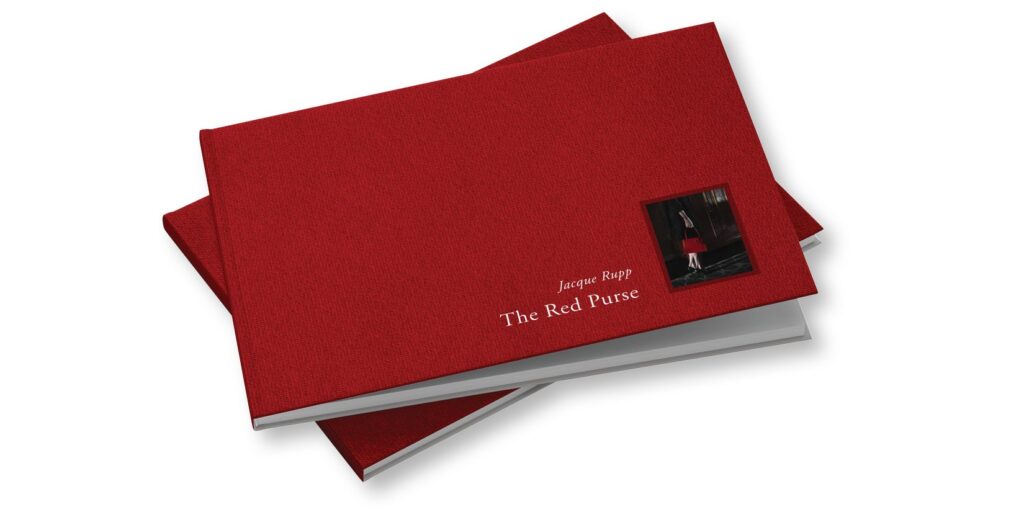
Growing up, Jacque moved around the country, which channeled her ability to change, grow, and connect with people. “I’ve had to rebuild many, many times in my life, and I hope I’ve gotten better over time. But I also realize that’s also a gift, because I can connect with people easily,” she shares. Always in a new situation—whether leading recruitment teams, partaking in photography expeditions around the world, or continuing to grow her photography practice by attending lectures, workshops, and residencies—Jacque strives to build deep connections with the people she encounters. This search for depth is omnipresent in Jacque’s work. Whether as a photojournalist, capturing migrant workers along the central coast or exploring grief, aging, and femininity through her fine art project, The Red Purse: A Story of Grief and Desire—Jacque’s ultimate goal is to build an emotional connection through the lens of her camera.
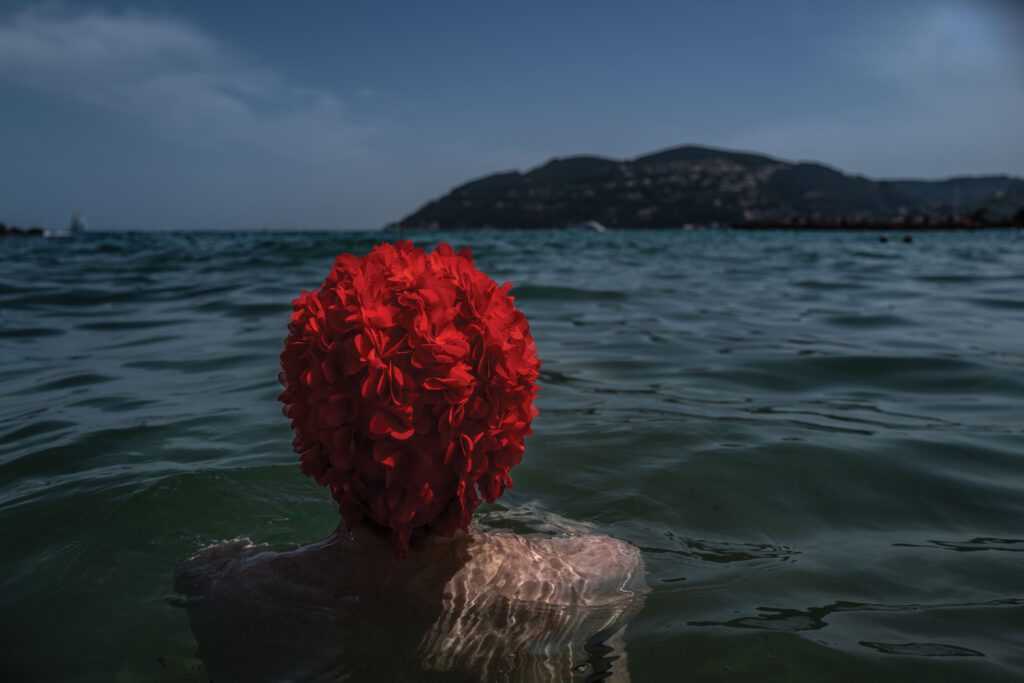
Red Petals, image from The Red Purse: A Story of Grief and Desire
Intention, purpose, and curiosity drive Jacque’s creativity: “I’ve always looked for purpose in photography. I want to do it for a reason; it’s not just to be pretty. And through traveling, I want to tell stories about people. It’s always about the people. I’m incredibly curious, and it’s a way for me to share what I see, how I see it, and tell that story.” This depth is palpable in her photographs—the intense contrast, moody, noir aesthetic, and affinity for night photography are all evidence of Jacque’s intention to build an emotional connection with the viewer. Her commitment to using the photographer’s eye to build that connection creates magic.
Her creative inspiration often comes from film, particularly the late David Lynch and Alfred Hitchcock: “What motivates and inspires me as a photographer is film. I refer to a lot of David Lynch films in my work. I love noir, Hitchcock. I think I’m definitely more inspired by movies than photographers.” Jacque sees herself as a visual storyteller, and film inspires her to add depth and meaning to her photography, “Film is just a moving image and I’m a storyteller. Film is a stream of moving images and the emotion that comes with it. Often when I’m watching a film, I’ll freeze a moment and take a picture of it as inspiration. It’s the storytelling factor, the cinematography that I love.”
Jacque’s quest for depth is heavily influenced by loss. In her thirties, her first experience of deep grief was the loss of her father, which shifted the way she saw the world. Shortly thereafter, she lost her sister, and then her husband, an insurmountable loss that completely shifted the ground from under her. Grief—a universal emotion we all must face sooner or later in life—shaped the way Jacque sees, interacts, and engages with the world. “Once you lose someone you love, how you engage with the world around you is forever changed,” Jacque proclaims, adding, “Death definitely takes you to a place, which I think is a gift in a way, because you appreciate and see things on such a deeper level. And you find that you need to be around people who have that greater depth. I don’t have the patience for surface level anymore.”
“Once you lose someone you love, how you engage with the world around you is forever changed.”
Through grief, photography remained a constant. As a widow with two young boys, Jacque’s hunger to connect with others and to share her experiences of grief, continued. Losing her husband forced her to shift her identity—but succumbing to despair wasn’t an option. She recalls, “I remember I was hungry to be normal again. You didn’t want to be pitied, you didn’t want to be treated differently, you don’t know what you’re supposed to do—do I have to wait a year to be happy?”
At the time of her husband’s death, there were limited resources for Jacque and her children to navigate their loss. Jacque was in her forties, her prime of life, and although her husband was gone, she still wanted what she lost. Insignificant at the time, purchasing a red purse gave Jacque permission to seek connection, feel desirable, and embrace her new identity. Reminiscing, “At that time I was reclaiming my own space, changing the house, making things more feminine and everything was different. I wanted to embrace that it was different. I realized later that the purse embodied everything I needed as a woman, and it gave me permission to be feminine, sexual. I was in my forties so I still wanted what I lost.” In addition, the purse gave Jacque the permission to explore life beyond the identity she built. “The purse became this reminder that it was okay to do all of these things—try on different persona, and at the time, there weren’t any resources, nothing that I found that resonated with my age group.”
Although the purse remained in Jacque’s possession for years, it wasn’t until the pandemic—twenty years after her husband’s passing—that Jacque began to use it as a prop to explore grief through her photography. Culminating in a small, red velvet book that emulates the purse she purchased, The Red Purse depicts a visual story exploring grief, aging, femininity, and sexuality. The Red Purse is Jacque’s way of embracing the loss she’s experienced and how she grew, lived, and honored herself in the process: “The Red Purse is about grief, and what I want [from the viewer] is for them to get comfortable opening up a conversation that we normally don’t talk about.” Through the lens of self-portraiture, The Red Purse permits Jacque to navigate her own desire and grasp on aging—aging in a society that seeks eternal youth by any means necessary. She proclaims, “I wasn’t going to do ‘widowhood’ like other people were going to do it. I don’t want to do ‘aging’ the way other people do it. I don’t want to succumb to what we think we have to do. I wanted to find a more authentic experience.”
Jacque’s quest for deeper meaning, to explore her own femininity and emotions, and how society perceives women, aging, and widowhood, is held through the lens of her camera. Always searching for deeper meaning, to emotionally connect with those around her, and to deepen her understanding of her own emotions, Jacque has shaped loss into art—a story that connects the viewer to their own emotional journey. Jacque hopes her photography shows the viewer that embracing grief and aging is a part of life, and in turn, beautiful. “I’m getting older, and to be able to embrace it I think comes from within. I think having the wisdom to embrace aging, just like embracing grief, is real. And aging is real, but it is beautiful too.”
“In a sense, that’s my mission: to hold onto what’s transient, even as it fades, leaving traces behind.”
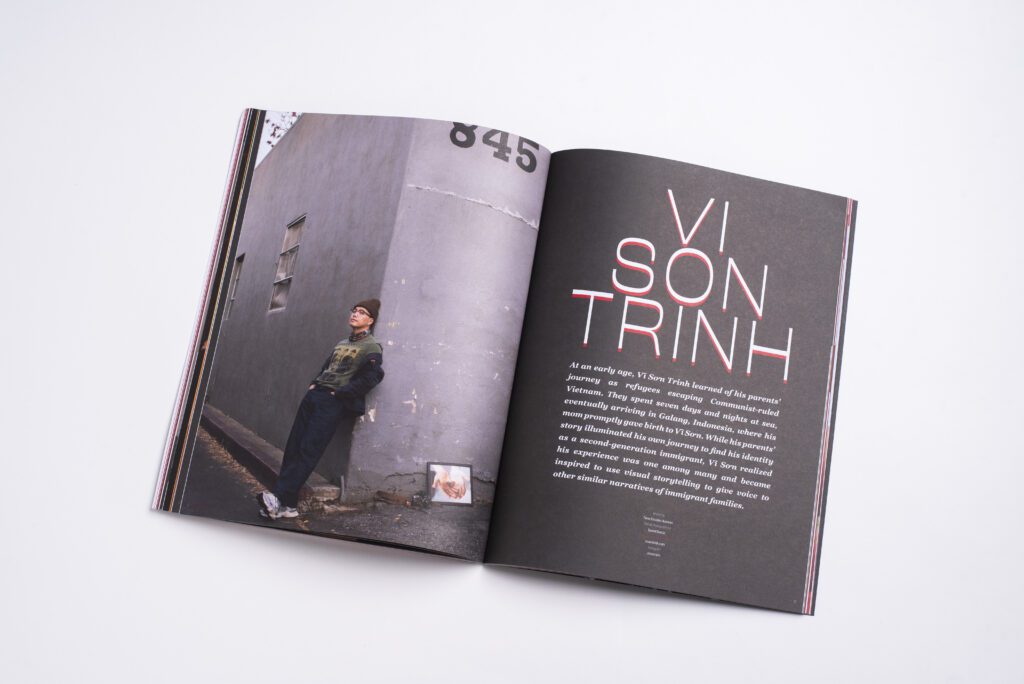
At an early age, Vĩ Sơn Trinh learned of his parents’ journey as refugees escaping Communist-ruled Vietnam. They spent seven days and nights at sea, eventually arriving in Galang, Indonesia, where his mom promptly gave birth to Vĩ Sơn. While his parents’ story illuminated his own journey to find his identity as a second-generation immigrant, Vĩ Sơn realized his experience was one among many and became inspired to use visual storytelling to give voice to other similar narratives of immigrant families.
Vĩ Sơn’s different projects, such as Silk Rise, Chinatown, and The Stories We Carry, aim to preserve everyday moments that explore cultural identity among second and third-generation immigrants. His photography immediately draws you into small, nuanced moments that carry a weightless glow of compassion and gratitude. The soft, faded, dream-like tone of his images feels like long-forgotten memories that unexpectedly visit you, almost like déjà vu. His images are comforting in their reassurance, giving order to the disorder that arises from intergenerational trauma.
As a visual journalist, photographer, and full-time cardiac nurse, Vĩ Sơn Trịnh uses his photography and filmmaking to uncover stories of resilience, the perseverance of familial bonds, and identity among refugees and immigrants.
Your images communicate a quiet, emotional depth, even out of context. Are there other elements in your life that influence your work? My influences are like waves—each one carrying fragments of memory, connecting the past to the present in ways that feel both vivid and elusive. Some inspirations are simple moments, like the hum of tires on the road when I drive alone. It reminds me of family road trips, my dad guiding us to visit relatives in Los Angeles, those long hours becoming my first experience of quiet spaces, where my thoughts could wander freely. There’s a kind of longing to capture those fleeting moments, to preserve the simplicity of what once was. This is why I’m drawn to photographers like Rinko Kawauchi; her work feels like visual haikus that honor small, often overlooked details. Her images remind me to pause, to see the truth in the subtleties, to find beauty in what others might overlook.
Do other art forms inspire you as well? Music also plays a crucial role in my creative process, adapting with my environment and mood. When I’m out on the streets, blending into the rhythm of city life, I listen to Shigeto. The intensity of his beats fuels my energy, pushing me to navigate crowds, cars, and alleyways with purpose. In contrast, when I’m seeking something introspective, I turn to the calming compositions of Olafur Arnalds or Ryuichi Sakamoto. Their music has a way of evoking nostalgia, allowing me to connect with fragments of memory that need space to breathe and take form.
Grief, too, influences my work. Creating has become a way to process loss and transform pain into something tangible. It’s an attempt to find beauty in absence, to honor what’s slipping away by capturing it.
In a sense, that’s my mission: to hold onto what’s transient, even as it fades, leaving traces behind.
There is a quiet tenderness to your photos with an emphasis on small moments, often up close. When you shoot, do you have a vision of what you want already in mind or are you simply paying attention to those moments as they unfold naturally? When I first began, there was no map, no destination—just the pull to capture everything under the sun, as if each moment could somehow fill an emptiness I hadn’t yet named. I was chasing a high, really, capturing whatever caught my eye, drawn to the sheer wonder of it. The camera became a net for everything fleeting, everything that seemed to slip away as soon as I looked at it. These days, when I work on a project, I carry that same innocence, that same sense of wonder, but there’s a steadiness to it now, a direction. I still find myself searching for that pure feeling, that unfiltered connection. I might start with a goal, an idea of where I’m headed, but once I’m in it, once the subject and I begin to share a kind of quiet understanding, that’s when things start to bloom on their own. The moments become softer, truer. It’s as if the image decides to reveal itself, layered and deep, only once we’ve learned to be still enough to listen.
I recently came across a wonderful explanation of how poetry, in particular, can be this improbable portal, or backdoor, into the cosmos by sneaking ideas into our subconscious, ultimately changing the way we perceive the external world. I realized how photography, likewise, can do the same thing…a visual poem, if you will. With that said, how did The Stories We Carry project change your perspective and the way you relate to the world? That’s such a beautiful way to put it, Taran—“poetry as a portal,” a doorway into other lives and experiences, ways of seeing we might never have considered. The Stories We Carry project felt like stepping into that portal, and through it, I was able to witness the inner worlds of first- and second-generation immigrant families, each one carrying their own histories and memories, held in everyday objects and stories. While I’m part of this community through my own family’s journey, the project gave me something rare: a deeper, more intimate sense of what it means to walk in someone else’s shoes, to feel their joys, their struggles, their resilience. Photography, for me, became a way to bridge that space, to capture glimpses of lives that are both familiar and vastly different. Each person I photographed gave me a doorway into their reality—a chance to see not just the visible details but the weight of their histories, the layers of their identities. The project reshaped my own understanding of belonging and displacement; it reminded me how nuanced these experiences are, even within a community I thought I knew well. It’s one thing to know that each immigrant story is unique, but it’s another to witness it, to be invited into those spaces, and to come away changed, with a broader compassion and a new way of seeing the lives around me.
Your journey to become a nurse, and the job itself, seems to play a big part in your identity and, likewise, your approach to your projects. Would you say there are any relative parallels to your visual journalist work and your day-to-day profession? Nursing and visual journalism share a surprising intimacy—both are grounded in careful observation, empathy, and the power of listening. My work as a nurse has shaped me into a more attentive photographer, just as my background in photojournalism has helped me to see my patients in greater depth. Nursing calls for a sensitivity to detail, a watchfulness that allows me to notice the smallest changes in a patient’s health or demeanor, knowing that these subtle shifts can mean everything. It’s a skill rooted in close observation, much like photography, where one frame can hold a world of unspoken truths.
In both fields, there’s an art to asking the right questions. As a nurse, I ask patients about their symptoms, their medications, their financial and emotional well-being, their homes and support systems—each answer adding another layer to their story, much like a journalist drawing out a narrative. It’s not just about gathering information; it’s about understanding how each piece of their life impacts their health, their journey. And when I’m photographing, that same curiosity shapes how I approach people. I’m attuned to the layers beneath their expressions, their gestures, the environment they inhabit.
Perhaps the deepest similarity is the sense of compassion each role demands. Nursing has taught me to look beyond the immediate—to see my patients not as cases, but as individuals with stories, histories, and vulnerabilities. That awareness has changed how I approach photography, too, infusing my images with a tenderness and empathy that only comes from bearing witness to both the fragility and resilience of others. In both nursing and photography, I’m reminded that what I capture or care for is not just a single moment or person, but a piece of a much larger, intricate story.
Do you have any projects on the horizon or ideas ruminating? Some days, the weight of picking up the camera feels heavier than I remember, like the lens has grown distant, more elusive. The everyday currents of work, the quiet exhaustion of life—it all leaves me feeling like creating is both a refuge and a labor. But I often find myself drifting into a daydream, imagining a project I haven’t yet begun: an archive of my father’s old Hi-8 footage and old photos from his visits to Vietnam in the ’90s, woven with scenes of our family’s early days here in the States. I want to tell our story, to trace our family’s path, the way memory lingers in old tapes, how it shapes us in ways we’re still learning to name.
Recently, I’ve felt a pull from others in my generation, other creatives using art to reach into their own histories, to confront the weight of intergenerational trauma and shape it into something tangible, something that heals. There’s a kind of solace in that, a shared language. I hope to make space for this work, to find my own way of piecing together fragments of that story, connecting with others who carry a similar thread of resilience and memory. Maybe, in time, these fragments will take form—a new project, a way to honor what’s been both lost and found.
A wheat-pasted poster on a San Francisco sidewalk may be commonplace for 99 percent of passersby. For photographer Dan Fenstermacher, the details caught his eye from across the street: an ambiguous lower body clothed in shorts and walking shoes—leg tattoos exposed—standing on a trail with marketing copy that read “on the path to zero impact.” Dan also noticed a burly, shirtless man thirty feet away walking towards the poster; he had patchy body hair on his chest that shared an uncanny resemblance to a smiley face. Dan hurried across the street to catch the convergence of the two. The photo he captured juxtaposes a hipster on a hike with a shirtless man on a city street—both of whom are uniquely getting in touch with nature—and puts a humorous spin on the sustainability marketing technique of showing people experiencing the outdoors. The composition plays with body level, placing the lower body on the poster in line with the man’s upper half. While any similarity between those two figures could be viewed as an abstract coincidence, Dan sees potential in layering and capturing dissimilar details with eye-catching composition to create something new, authentic, and often funny.
Dan Fenstermacher is a burgeoning photographer with internationally recognized work. He’s also a professor and chair of the West Valley College photography program, a contributor to The San Francisco Standard, and a volunteer photographer for the Make-A-Wish Foundation. Dan’s projects blend street photography and photojournalism with clever juxtaposition; his photos are most known for their vibrant colors, use of flash, and humorous composition.
Originally from Seattle, Washington, Dan obtained a bachelor’s degree in advertising from the University of Idaho before moving to Los Angeles to pursue a career in marketing. While there, he realized that advertising has less to do with creative ad concepts and more with market research, data analysis, and spreadsheets. Dan recalls, “I hated it. I started taking photography classes at night through a local community college while doing those advertising jobs. I had a roommate at the time who went off to Korea to teach English, so I figured I could do the same thing.” Dan went on to use his community college photo credits to teach fine art in China, aided by student translators. Later, he enrolled in a graduate photography program at San Jose State University.
“Traveling makes me feel alive. When you experience a new culture, it’s like getting to experience life again for the first time.”
Dan’s photography is rooted in detail and captures reality at the core of often misunderstood situations. “I have always been an observer,” he says. “I tend to notice things that most people wouldn’t consider. I like to combine street photography with journalistic documentary themes.” Each of Dan’s projects captures a range of topics and manages to juxtapose conception with reality. His project documenting seniors in Costa Rica contrasts American society’s fear of aging with the joy and experience seen on the faces of the elderly. His “Streets to the Dirt” project documents Black cowboys in Richmond, California, and shows that cowboys are not just White men in movies. Dan continues to broaden his photo expeditions, explaining that “traveling makes me feel alive. When you experience a new culture, it’s like getting to experience life again for the first time.” Dan’s career as a photography professor allows him to embrace his passion while surrounded by inspiring up-and-coming student artists. Dan aligns his trips with his school schedule and plans to travel to Guadalajara, Mexico, to document mariachi culture. His next goal is to produce his first self-published photo book.
Robert Ragazza finds inspiration on the tough streets of SanJose, and through his photographs, exposes the city’s heart.
Robertino Ragazza seems to know everyone. He greets every patron and server at the small coffee shop downtown with a smile, perhaps a carry-over from his full-time position as the award-winning concierge at the Hotel Sainte Claire in San Jose. He does know everyone, certainly in the city’s small but incredibly self-reliant art scene. He rattles off a who’s who of artists and patrons, proud to be a part of this pool of talent and vision.
But Robertino Ragazza really knows everyone. He knows the guy sitting outside with his dogs, hoping for spare change. He knows the man wrapped in blankets who stands on the corner of Santa Clara and First Street. He knows the woman camped out not far from his work, who always flashes him a mega-watt smile. These are all people he encounters regularly, and while others bustle past, Ragazza captures them in striking black-and-white photographs.
As he browses through his portfolio of portraits, he tells the stories of his subjects, how he managed to convince them to pose for him, or whether they were eager to volunteer. It took two years of friendship for the man wrapped in blankets to agree to pose. The relationship was based on trust and whether he believed Ragazza would look through the viewfinder and see his dignity. Ragazza knows precisely where each photo was taken, the exact street corner or bus, mapping out the city’s humanity through his compassionate artistic eye. The portraits are deep, almost textured and layered, as the richness of the black, white, and shades of grey and light reveal stories of sorrow, pain, hope, and life.
While Ragazza himself is young and stylish, he is a traditional, even old-fashioned, photographer. With the exception of a few iPhone photos, he shoots exclusively on film and shudders at the thought of using Photoshop. Averse to cropping, he lines up each shot in the viewfinder so that when he develops the photos, they come out exactly as he had seen them in the moment. He is patient, limiting himself to only a few frames per subject, knowing that more than five frames feels invasive. His compositional eye is practiced, as he finds the most interesting lighting and sharp contrasts. “You have to wait for the right moment,” he explains. “It’s how you know you’re in sync with the world.” He describes a magical moment in a natural setting when everything falls into place. The results are a testament to his method and skill, each photo meticulous yet with the feel of spontaneity.
He sees his photos as part of a larger series and story. While every shot carries its own weight, he arranges them so that each one plays a role in a larger context. His street portraits could almost be viewed as social documentation, recording everyday scenes and the humanity that makes them exceptional. His photos reflect the souls of those who make up the fabric of the city: weary on the bus, joyful with a grandchild, proud, compassionate, serious with a threatening tattoo, often hopeful but sometimes hopeless. Ragazza captures these moments that become timeless representations of the people he comes to know.
Ragazza would have every reason not to seek out those wearing “death” tattooed across their necks, or subjects on the bus who later join gangs and disappear from his radar. While a student in Los Angeles, Ragazza was the innocent victim of a gang-initiation drive-by shooting, an event that forever changed the course of his life. The bullet wound healed, but it seems to have given him a deep sensitivity to the desperate side of life. His experience with senseless brutality makes the human images reflected in his viewfinder all the more poignant. While he still jumps when he hears fireworks, he took the incident in stride, finding the positive, and moving forward with a new perspective. “That’s what life is,” he says with a thoughtful smile.
Today, he and his close-knit community of artists and supporters work together to be the city’s cultural heartbeat. Ragazza is a collector himself, identifying and fostering young talent, purchasing pieces when he can. When his resources are stretched, his own patrons step in, bartering the special printing paper he needs in exchange for a photograph. Ragazza’s works can go for top dollar, but they are an investment, not only in his talent and skill, but in his deep, complex portrait of life in San Jose. As he says, his work “is all about dignity and civility,” which is a real gift to this city and all who know him.