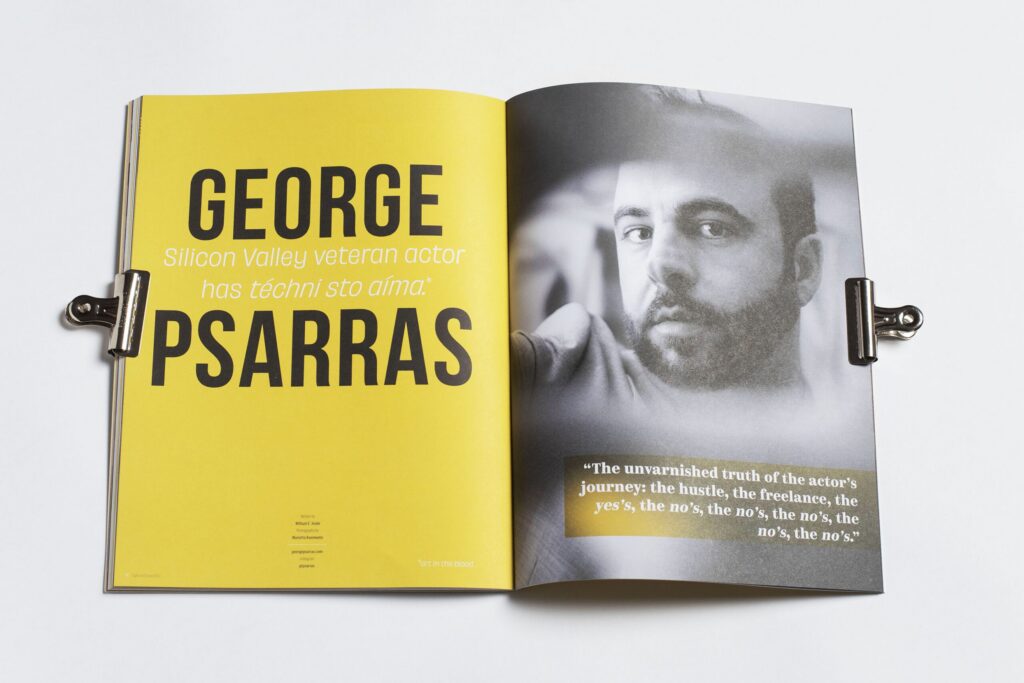
All the world’s a stage and everyone merely a player, and local actor George Psarras has nurtured a career with inestimable exits and entrances. The 43-year-old has played dozens of roles for stage and a few for the screen. He lent his voice to a police elf in an animated urban fantasy and accompanies his twin brother playing traditional Greek music. Now, he’s determined to manifest his rendition of a Sherlock Holmes story into a one-man touring show. With a professional musician for a twin brother and a supportive father who encouraged his alacrity for theater, George echoes Holmes’s quip, “Art in the blood is liable to take the strangest forms.”
The strange forms of George’s first act opened after studying theater at Foothill College and College of San Mateo. He then studied music at San Francisco State. With credentials and experience secured, George could have pursued showbiz in Hollywood but instead entrenched himself in Bay Area theater because “[his] family’s here.” He’s composed music professionally since 1998 and played stage roles since 2006. In 2011, he became the resident sound designer for City Lights Theater Company of San Jose.
“The unvarnished truth of the actor’s journey: the hustle, the freelance, the yes’s, the no’s, the no’s, the no’s, the no’s, the no’s.” -George Psarras
That’s how his second act began—with the classic dilemma of a midlife crisis.
“I sort of had an identity crisis on whether I wanted to be a musician or an actor, and sound design was a way to bridge that,” George says. “So I sort of fell into it. I went to the Foothill Theater Conservatory, studied there, and did some sound for some plays, and I’m like, ‘Oh, this could be a thing.’ Then, I got involved with the City Lights Theater Company, and they were looking for a sound designer. I was a first-time sound designer right out of the gate, and I was not good the first time out,” George admits humbly. “But I learned; I got better.”
“It was another creative outlet, a way to stay working between acting gigs, creating soundscapes and sometimes writing and curating new music, and crafting elements along with a lighting designer and a director…I’ve been able to do it consistently.” He accomplishes all of this from only a Macintosh running Pro Tools and Qlab. “I would love to have a studio like Hans Zimmer in a bungalow in the hills and record to my heart’s content, but it’s all remote,” he says.
George has designed sound and composed music for more than 60 productions with City Lights Theater Company. “I try to never recycle cues or music unless it’s been five or ten years in between stuff. I try to never repeat myself. That’s the goal.”
Experienced playing fictional characters, he’s also adept at speaking before student actors at his former schools when invited to talk shop. “[I’m compelled to tell them] the unvarnished truth of the actor’s journey: the hustle, the freelance, the yes’s, the no’s, the no’s, the no’s, the no’s, the no’s.”
His third act has seen screen credits in television and movies.
He recorded some “scratch tracks” in 2016 for dialogue that would ultimately go to Chris Pratt’s character in Pixar’s animated urban fantasy Onward. The producers called George back to record an hour’s worth of lines, some of which made the cut for the character Officer Avel. This year he starred in two movies, both featuring Billy Zane and Jon Heder: Waltzing with Brando and Tapawingo, in which his twin brother, Paul, also co-starred. “It’s sort of a spiritual successor to Napoleon Dynamite,” he explains.
George, fluent in Greek, admits he hasn’t had a dream role. His ultimate dream is to produce a full-cast adaptation of Sir Arthur Conan Doyle’s “The Adventure of the Greek Interpreter,” then tour a one-man version of the show. “We did a reading of it—a workshop—at City Lights a couple years ago. We just had a closed reading with these wonderful actors and friends who gave me some really valuable feedback,” George says.
Though Holmes is timeless, George is very aware of time’s passage. “When you have so many irons in the fire, you’re trying to stay in the art, which I feel very fortunate to do. The plant only grows when you water it. I can either spend time pushing my original music, or trying more sound design, or being a theater actor or film actor, which is what I’m focusing on now. There’s a certain biological clock ticking.”
In high school, ballet dancer Naomi Thien Kim Le’s father, Chinh Le, told her something pivotal: “If you can’t live without it, don’t live without it.” She took his words to heart.
Naomi has now danced professionally with San Jose’s New Ballet Company since 2020. At 23, she feels she still has more to accomplish. “Every year, there’s a new side of myself that unlocks into ballet. I’m achieving more and more despite getting older.”
Chinh Le instructs by example. Both he and Naomi’s mother, Anatasia, are from Vietnam and immigrated to the US in 1980. Their journeys to America, however, were quite different. “In short, she came on the airplane, I came on the boat,” Chinh explains. He attempted to leave Vietnam multiple times before he was successful. The only thing he took with him was his violin. Without a standard American education or fluency in English, he struggled to find musical education opportunities. Despite this, he was determined to become a professional musician. He eventually earned a scholarship at Indiana University. He’s now a violin teacher and a violinist with the San Jose Symphony, which accompanies New Ballet productions.
Chinh passed his passion for music and the arts on to his children. Naomi and her siblings all play instruments and dance with New Ballet. The family even formed a string quartet during the lockdown phase of the COVID-19 pandemic. “We need the normal things to sustain a life. But art gives people a reason to live,” Naomi says. Her mother echoed this importance in her approach to parenting. “What we were taught as [children] is that art is one of the rare gifts that one can possess. We want our children to explore their gifts.”
Naomi is grateful for her family’s support of her ballet career. “They always made sure I could have food on the table, no matter what,” she remembers, “so that I could comfortably choose and put a strong foot forward with what I wanted to do with my life.” Her connection with her heritage is strong. “My work ethic is from my family and my Vietnamese culture,” she explains. “The food that I eat to have the energy to go throughout my day, to dance, and to teach is really influenced by my culture.”
“Every year, there’s a new side of myself that unlocks into ballet. I’m achieving more and more despite getting older.”
Naomi originally began studying ballet at five years old to help with her coordination. Her parents homeschooled Naomi and her siblings and had them try out many different physical activities. Naomi began dancing as a student with New Ballet’s founder, artistic director, and executive director Dalia Rawson. She’s mentored Naomi’s development from a young student to a professional dancer. Naomi always took her classes seriously, but it took time for her to hone her skills as a true performer. “She was almost a little introverted,” Rawson remembers. “She has been a series of little revelations over the years.” When Naomi was 10, Rawson told her she had the discipline and the body to dance at a higher level. She’s now danced in hundreds of professional New Ballet shows.
Naomi’s approach to ballet is a joyful one. “It’s a human experience. I want to get into that kind of carnal state where, truly, I’m dancing because I’m enjoying life, I’m enjoying what I do,” she explains. “I don’t want to spend my career in dancing stressed all the time.” This approach runs parallel to Rawson’s mission with New Ballet, which prioritizes dancers’ mental health.
Naomi herself majored in psychology at Santa Clara State University. She attributes this partially to her mother, who got her master’s in psychology after working as a pharmacist. She says that New Ballet’s emphasis on mental health was also an influence on her decision. “I think I was just surrounded by a lot of people who cared about other people’s well-being and success, and I just wanted to carry that on.”
According to Rawson, there are two things a ballet dancer needs to elevate their practice: a solid control of classical technique and the ability to embody different roles with that technique. Naomi has both. “She brings moments out of choreography that I’ve seen her dance many, many times,” Rawson shares. “She is on the path to becoming San Jose’s first home-grown, home-trained, and hometeam ‘Ballerina.’ ” “Ballerina” as a title has a specific meaning within the dancing world. The dancer needs to have had at least three main ballerina roles, and one of them must be Giselle, which New Ballet will be doing a production of in 2025. Naomi has already danced main roles in Swan Lake and Sleeping Beauty. “It’s like Hamlet for a female ballet dancer,” Rawson explains. “There’s a very good chance that she will dance that role.”