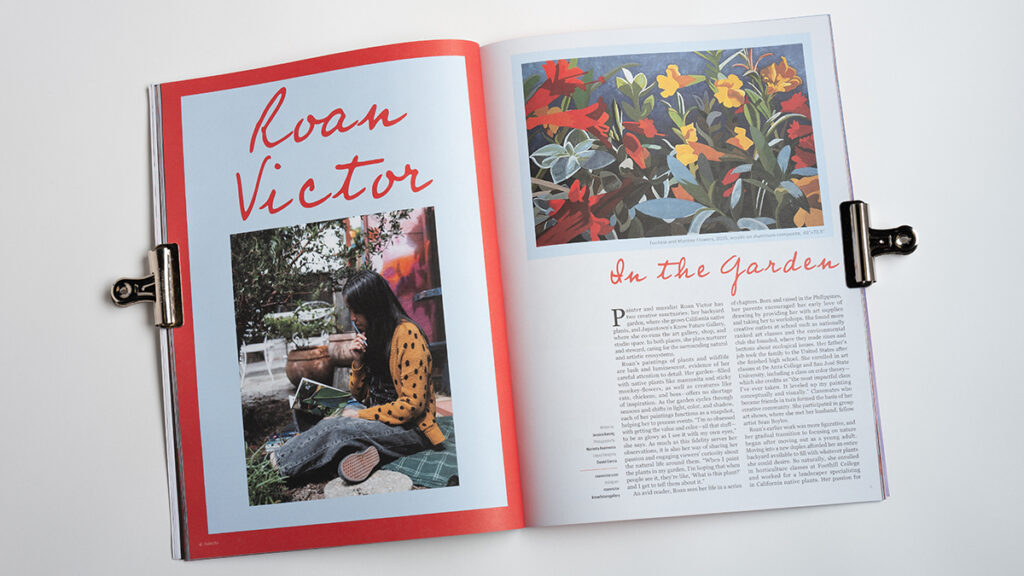
Painter and muralist Roan Victor has two creative sanctuaries: her backyard garden, where she grows California native plants, and Japantown’s Know Future Gallery, where she co-runs the art gallery, shop, and studio space. In both places, she plays nurturer and steward, caring for the surrounding natural and artistic ecosystems.
Roan’s paintings of plants and wildlife are lush and luminescent, evidence of her careful attention to detail. Her garden—filled with native plants like manzanita and sticky monkey-flowers, as well as creatures like cats, chickens, and bees—offers no shortage of inspiration. As the garden cycles through seasons and shifts in light, color, and shadow, each of her paintings functions as a snapshot, helping her to process events. “I’m so obsessed with getting the value and color—all that stuff— to be as glowy as I see it with my own eyes,” she says. As much as this fidelity serves her observations, it is also her way of sharing her passion and engaging viewers’ curiosity about the natural life around them. “When I paint the plants in my garden, I’m hoping that when people see it, they’re like, ‘What is this plant?’ and I get to tell them about it.”
An avid reader, Roan sees her life in a series of chapters. Born and raised in the Philippines, her parents encouraged her early love of drawing by providing her with art supplies and taking her to workshops. She found more creative outlets at school such as nationally ranked art classes and the environmental club she founded, where they made zines and buttons about ecological issues. Her father’s job took the family to the United States after she finished high school. She enrolled in art classes at De Anza College and San José State University, including a class on color theory— which she credits as “the most impactful class I’ve ever taken. It leveled up my painting conceptually and visually.” Classmates who became friends in turn formed the basis of her creative community. She participated in group art shows, where she met her husband, fellow artist Sean Boyles.
Roan’s earlier work was more figurative, and her gradual transition to focusing on nature began after moving out as a young adult. Moving into a new duplex afforded her an entire backyard available to fill with whatever plants she could desire. So naturally, she enrolled in horticulture classes at Foothill College and worked for a landscaper specializing in California native plants. Her passion for gardening and horticulture grew such that, as she recounts, “I was going to give up painting and art—I can’t multitask. I [must] put my whole brainpower into one thing.”
To meld her passions, she incorporated flora and fauna into her work. She made a series of drawings and paintings in 2012 that showcased figures with California native plants erupting from their heads—an effort to express the fullness of her new preoccupation. As she took on more commissions, various clients suggested removing the figures. She describes her solution: “I would focus more on, ‘I really like this plant,’ or ‘I really like these birds.’ I would put all those things—minus a figure.” Using her garden as a never-ending source of material, she developed a proposal for San José Mineta International Airport while watching creatures flying in and out of her garden. The resulting work, Frequent Flyers (2025), acquaints travelers with our region’s hummingbirds, bees, and butterflies.
While Roan has consistently participated in art shows and created commissioned work throughout her career, her primary focus for a long time was not her own studio practice. From 2011 to 2022, Roan and Sean owned and operated the Arsenal, which had snowballed from an initial T-shirt printing business to a full-blown art supply store where they also taught art classes and exhibited artists. Roan marvels, “the Arsenal was so crazy. It was, like, how many businesses in one? And, like, how many jobs?” Eleven years and a global pandemic later, the end of the store’s Japantown lease brought an opportunity to reassess priorities. The couple decided to close the Arsenal and dedicate more time to their own art. By a stroke of serendipity, an artist studio space a few blocks away was available for rent.
In the spirit of commitment to San Jose’s arts community, Know Future shares certain elements with the Arsenal, including an art gallery and a store in the front. Studio space in the back is dedicated for the four co-operators and resident artists—Roan, Sean, Fernando Quinones (aka Nandoid), and Jessica Mendez— who take turns curating each month’s gallery exhibition. The arrangement maintains a space for other local artists to show their work and host events, while allowing each co-operator the time and flexibility to focus on creating their own work.
Now with the freedom to pursue more personal projects, Roan is in an introspective period. In October 2026, her first solo exhibition since 2019 opens at Obelisk Gallery in Santa Clara. Titled Review, the show will look back on the past year, both in Roan’s life and the world at large, with each month paired with a distinct painting and a “tabloid” publication with commentary from the artist.
For Roan, the last few autumns have come with losing loved ones, including the death last year of her 19-year-old cat Amelie, who was a beloved part of Roan’s transition into adulthood. Her paintings of falling leaves convey mourning and processing the end of a chapter. The exhibition balances moments of grief with growth and rebirth, such as pink manzanita blossoms glowing in the sun to represent the month of January.
Roan’s paintings allow a glimpse into her world while also reflecting our collective experiences. “The only way I can tell a story is through my own eyes,” Roan says. “A lot of my work needs to be from my experience, from what I know, because when I’m painting, I need to put my whole brain, my whole self in it. No matter what it is, no matter how small, it needs to be something that’s really treating me.”
Born and raised in east-side San Jose, Sam Rodriguez was attracted to art from a young age. His first real foray into the art world came with adolescent graffiti adventures, but even then, Rodriguez knew he wanted more. At age 25, holding down two jobs while finishing college and with a baby on the way, Rodriguez didn’t have the time or energy to further his art. Luckily, a few years later, artist and friend Aaron De La Cruz invited him to be part of a small art show, reigniting his purpose. Now, Rodriguez has garnered the world’s attention with his symbolism-heavy, typographically jumbled portraits and his unique way of capturing the human form. His work graces the surfaces of international brands such as Puma, Under Armour, and Google. Recently, Rodriguez has taken to putting his work on T-shirts, both to make his work more financially accessible and to honor the cultural forms that first inspired him to make art.
“A lot of my work explores identity in general. It depends on each piece; some pieces are about identity in relation to language or fashion or anything really. It’s not a specific meaning; it’s more like I’m mixing different ingredients to create a new portrait. Sometimes, my work is my interpretation of what’s popular in culture. As a parent, I’m consuming more pop culture than ever, so a lot of my work is my take on what’s happening in the world. But, simultaneously, I don’t really have conclusions in the work I make. It’s more like I’m documenting information around me. In a way, my art is note-taking.”
“Five, four, three, two…” Standing in his living room, where bright teal couches and dark walnut cabinets complement cerulean walls, Paul counts down to his own interview: “Are you ready for launch? Let’s go!”
In the world of artist and designer Paul J. Gonzalez, possibility is as limitless as outer space. No conversation is ordinary, and no day is without surprise. So, one should always dress for—and anticipate—the possibility of splendor. Even to buy groceries, he’ll sport a one-off steel bracelet or flat top sunglasses or a metallic jacket.
But if a blur of futuristic inventions and astrological predictions is what you’re envisioning of his world, you might be surprised to learn that all his clothing and accessories come out of a color-coordinated, space-optimizing closet. In fact, he may be one of the most organized and self-analytical creatives you’ll meet.
Inside his home office, a small but well-lit room boasting groovy shelves he built himself and wide dual monitors—one of which he places sideways like a long scroll—he regularly takes stock of his life: body, mind, and soul are assessed as though they are pillars of a business (and arguably so for a full-time artist).
Here, Paul files away his receipts, categorizes his spending, and tracks personal data. The daily work certainly serves financial accountability, but he aims to cultivate improvement. “There are three Pauls: past, present, and future,” he declares. “All Pauls have to relate to each other.” Present Paul tallies interpersonal interactions and inventory alike: “Maybe, I got a little too drunk at the Cure concert,” he ruminates. “But it was Robert Smith!” he weighs. “But still,” he concludes, “I’ve got to check myself. I spent a little too much on alcohol, and I can put this money towards a new tablet.” Then the emotional check-in: “Did I have any breakdowns? Did I have any arguments? Why did I have arguments?”
Few may manage their daily lives so closely, but these routines feed his artistry. Health fuels work and rest, feeding not only into great ideas and the execution of them but, ultimately, more time for his family.
“By handling different mediums, you’re able to overlap the multiple skills and sometimes create something new that you never thought would happen.”
-Paul J. Gonzales
“Appreciating what you have,” he stresses, “is key.” Rather than crediting knack or discipline, he pinpoints gratitude as the primary engine of his self-managed, independent lifestyle. He recalls one low period of his life when he had just lost his job: “All I’d been doing was working and coming home with no time to create. I was depressed for years.” But inertia struck while watching a PBS documentary about a survivor. “I’m watching the show in my room, depressed, probably drinking a beer,” he recalls. “This guy climbed mountains and had to hunt his own food. I was sitting at home thinking, ‘I have nothing to complain about.’ It’s all in my mind.”
So, he began to move. He ran and rode his bike. He packed himself lunch. He went to work, and repainted vandalized buildings with San Jose’s Graffiti Removal program. He did push-ups in between lifting cans of paint. “I started figuring out ways to work out my time,” he recounts. “So then I had time to draw.”
As a kid, he knew he wanted to become an artist. For that very reason he fought to get into art school and then didn’t complete the degree. His program was setting him up to become a teacher or professor even though he signed up with the expectation of being an artist, completing projects, and learning from each piece along the way. So he sought education elsewhere.
“I needed to learn about business, marketing, finances, and management.” He found mentors and picked the brains of those he calls his “elders.” “If you want to really learn more about yourself,” he recommends, “talk to these elders who are already done with their work—anyone who’s willing to share the honest truth, because they’ve lived it.”
About to turn fifty next year, he’s ready to offer the same—such as how writing down experiences to look forward to can alchemize stale energy. “I’m looking forward to my mom, the calls, her visits. I’m always looking forward to adventures with my wife: Burning Man, Machu Picchu in the fall,” Paul shares. “I’m looking forward to cleaning my house and the yard. I’m looking forward to building the fence.”
Before the list is exhausted, he’s on his feet. There are many projects, murals, and presentations that he’s in the midst of at this very moment—but the process of each one, ironically, keeps him from succumbing to overwhelm. They will all be completed “so that I can either move on with it or critique it,” he says.
It sounds far-fetched, but it’s working. Over two hundred murals deep, he’s still excited for what he hasn’t yet done. “By handling different mediums, you’re able to overlap the multiple skills and sometimes create something new that you never thought would happen,” Paul remarks. From designing costumes to creating games for events, from woodworking to ceramics, he finds joy in both the start and the finish.
Whether someone wants to purchase a piece or he has to move out of his home, he sees it all as a chance to “start all over.” He can leave behind the custom fence, the teal walls, and the toolshed floor he laid down brick by brick in exchange for a whole new experience. After all, who’s to say that any part of his past didn’t have his future in mind? His life today is the dream of a shy kid who hardly spoke up but could definitely dress up.
As a child, Paul remembers being picked on for his soft-spoken nature. But in fifth grade, he discovered the Cure, and in sixth grade, he heard the Sex Pistols, and by middle school, he had found his voice through the sounds and fashions of punk rock. Standing out with bleached hair and leather jacket in the ’80s, “I was picked on even more then,” he recalls. “They’d call me gay, this and that. But the LGBTQ kids would hang out with me, and we’d have a blast.” Paul followed his crew to the gay bars and clubs, where all hues and textures of hair and fabric flourished, and he did too.
He is the only son of a young mother who raised him along with his grandmother and aunt. Her handy resourcefulness crafted a home that was eclectic and wondrous, with sculptures like King Tut’s head and his uncle’s live piranhas in the living room. “It was a small house on 25th Street near San Jose High,” he shares. “We were a low-income family, but I didn’t feel like I was without. She was always designing from a thrift store perspective and fixing things. So she would also help me with my costumes, too.”
He mentions breezily, “We’ve been winning costume [contests] in my family since the ’50s.”
These days, he likes to have his mother climb on the scaffold and paint with him. “She’s on her fifth mural,” he says proudly. As for his vast collection of art in every medium, “I don’t want to be a master,” he says, “but I definitely want to have a good time playing.”