“People will always want to talk about [my past] because it’s exciting. They focus on who you were, not who you are, or who you’re trying to become.” -Steven Free
Steven Free spends a lot of time with animals, whether it be the dogs he walks to pay the bills, the kittens he and his wife live with, or the giraffe that lives in his heart.
A radio plays to the hum of an overhead projector in a suburban backyard studio. A shelf stuffed with toy giraffes looks down on a tidy workspace. There are sketch boxes, a sink surrounded by binders filled with paint swatches, and a table topped with replica shipping containers that exhibit pieces by an (in)famous Bay Area graffiti artist. Hunched over the desk, standing in the spotlight of the projector’s halogen bulb, or tagging paint mixture instructions on index cards is Steven Free, better known as “Girafa,” a painter with a past that keeps his hands hard at work and his head in the clouds.
Steven’s artwork centers on a character that he developed as a teen. He was adopted as a toddler after his birth mother left him in a Bay Area motel room. That experience, subconscious in specificity, set him on a path of self-actualization. Stimulated by the response he got from recreating comic panels as a child, he gravitated toward creativity. Always doodling and looking for ways to express himself, Steven enrolled in capoeira, a martial art and dance form originating among enslaved Brazilians. He practiced capoeira for 18 years but gained an identity that would last a lifetime. As a rule, the Mestre, or instructor, would give his students nicknames. He landed on “Girafa,” the Brazilian Portuguese word for giraffe, for Steven, in reference to his lean and towering frame. “Since I have always been interested in comics, superheroes, and their alternate identity, I ran with the nickname and developed a character,” he says. By the early 2000s, the character most commonly associated with Girafa was painted on over a thousand walls, trucks, and pieces of property that did not belong to Steven. That version of radical self-expression resulted in arrest and restitution but began a new life for the giraffe that was once Steven Free. While not initially inspired by his inherited alter ego, giraffes have grown on him over the years. “When my Mestre gave me the nickname,” he explains, “I thought it was dumb, but I started to realize its potential. The long neck. The pattern. The environments I could include.” The versatility of the giraffe, combined with his appreciation for animals, stemming from his mother’s passion for bringing home pets, fostered themes of interspecies communication. “Animals can’t tell you what they need,” he says, “but if you pay attention, you know. It is a weird dialogue we have with our pets. I don’t draw people; I’m not interested.” Transposing elements of pop culture and human expression on the characters he illustrates has drawn audiences to his work. “I like giving animals human qualities when expressing sorrow, anger, or excitement.”
When asked how he feels when stumbling across pieces of his past life in the wild, Steven shares, “It’s the paint; it’s the sun that has eaten it away. It’s trippy because I know that was me, but I’m not carrying that same feeling.” His time creating graffiti will always trail him, “People will always want to talk about it because it’s exciting,” he claims. “They focus on who you were, not who you are, or who you’re trying to become.”
Today, Steven splits his time between walking dogs and creating art under his Girafa moniker. He shifted his focus from producing art to designing products after his 2019 solo exhibition at the late Arsenal SJ. Having difficulty selling artwork, Steven wanted to make his brand more accessible to those who followed his graffiti. He produced T-shirts, totes, keychains, and air fresheners, his latest push being a collection of replica trucks and shipping containers bearing iconic Girafa pieces. “After wrapping that show, I was burnt out with painting. I jumped into product design, but that took on a life of its own. That’s pretty par for the course,” he claims. “Every artist lives in the process of gradually evolving their work. I am excited to jump back into art and see if I can make a living being a full-time artist.”
Searching for greener pastures can be challenging, especially for a giraffe accustomed to the city streets. Steven’s shift to studio practice has been a change of pace. “Projects can take a long time. I didn’t have weeks to complete work in the street. I had to learn to be okay with not finishing a piece within an hour.” That extra time allows Steven to mix paint colors and meticulously document the shade and mixing process on index cards he catalogs in binders. While working fast is no longer a requirement, he always looks for ways to optimize his processes. “How can I work smarter, not harder? Sometimes, my process is very rigid, and I do things until they burn me out,” Steven says.
Steven’s contemporary work is still inspired by and attributed to the Girafa character he imagined as a teen, but he now distinguishes between foreign and familiar imagery. “I have a bad habit of trying to reinvent the wheel. I try things and start to lose the core of my work. It is a balance. I want to maintain what I am known for.” Pieces displayed in his studio depict a classic Girafa spot pattern composed in multi-color abstractions, a process formed by creating templates, masking lines, and inverting colors; his interests in color theory and intricate detail are on full display. “I can get into these pattern paintings with multiple color overlays until the process takes it out of me, and I need to scale back. I want to continue doing Girafa; it is what I am known for and enjoy doing, but I want to see where that can evolve.”
The next step for Steven is branching outside of the South Bay. He is working on a catalog that he hopes to display in galleries nationwide. This ambitious next step is one of evolution and self-determination. “Having work shown outside the Bay Area would give me much more confidence. There’s fear, because you don’t have hometown support, but you must be comfortable with things not working out, pieces not selling, or not being invited back. That’s the artist’s journey; even when things aren’t working out, you still have this drive. It’s who you are. It would be like telling somebody they can’t breathe anymore. You can’t help yourself.”
In addition to enduring the growing pains that come with forging a new path, Steven is a newlywed and lives a simple life with his wife and cats. When asked why folks should care about Steven Free, he counters, “I don’t think people should care about me. They should care that there are people like me willing to express themselves through art. I am not where I would like to be, but maybe somebody out there looks up to me. If they could see what I went through, the struggle, and how I continued to do work and want to progress as an artist, and that gives them hope? Being an artist is hard. We need people doing that hard work to prove it is possible.”
CONTENT MAGAZINE: How has San Jose influenced the artistic endeavors in your life and career?
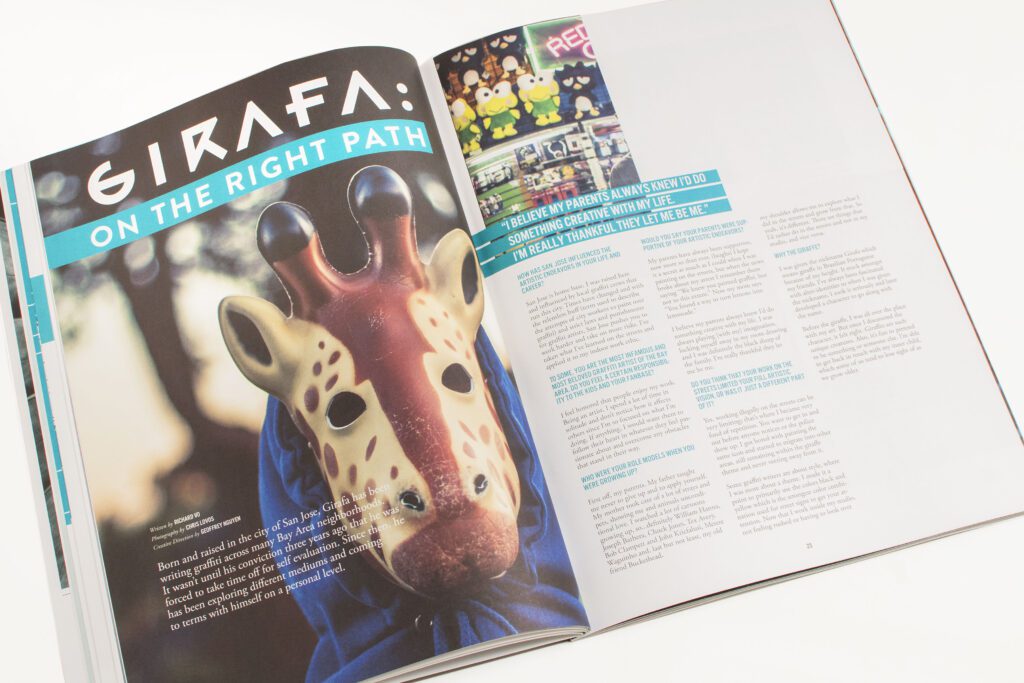
GIRAFA: Born and raised in the city of San Jose, Girafa has been writing graffiti across many Bay Area neighborhoods. It wasn’t until his conviction three years ago that he was forced to take time off for self-evaluation. Since then, he has been exploring different mediums and coming to terms with himself on a personal level. Born and raised in the city of San Jose, Girafa has been writing graffiti across many Bay Area neighborhoods. It wasn’t until his conviction three years ago that he was forced to take time off for self-evaluation. Since then, he has been exploring different mediums and coming to terms with himself on a personal level.
CM: How has San Jose influenced the artistic endeavors in your life and career?
G: an Jose is home base. I was raised here and influenced by local graffiti crews that run this city. Times have changed and with the relentless buff (term used to describe the attempts of city workers to paint over graffiti) and strict laws and punishments for graffiti artists, San Jose pushes you to work harder and take on more risks. I’ve taken what I’ve learned on the streets and applied it to my indoor work ethic.
CM: To some, you are the most infamous and most beloved graffiti artist in the Bay Area. Do you feel a certain responsibility to the kids and your fanbase?
I feel honored that people enjoy my work. Being an artist, I spend a lot of time in solitude and don’t notice how it affects others since I’m so focused on what I’m doing. If anything, I would want them to follow their heart in whatever they feel passionate about and overcome any obstacles that stand in their way.
CM: Who were your role models when you were growing up?
G: First off, my parents. My father taught me never to give up and to apply yourself. My mother took care of a lot of strays and pets, showing me and animals unconditional love. I watched a lot of cartoons growing up, so…definitely William Hanna, Joseph Barbera, Chuck Jones, Tex Avery, Bob Clampett and John Kricfalusi, Mestre Waguinho and, last but not least, my old friend Buckethead.
CM : Would you say your parents were supportive of your artistic endeavors?
G: My parents have always been supportive, now more so than ever. (laughs) I kept it a secret as much as I could when I was painting on the streets, but when the news broke about my arrest I remember them saying “We knew you painted graffiti, but not to this extent.” Now my mom says “You found a way to turn lemons into lemonade.”
G: I believe my parents always knew I’d do something creative with my life. I was always playing [with my] imagination, locking myself away in my room drawing and I was definitely the black sheep of the family. I’m really thankful they let me be me.
CM: Do you think that your work on the streets limited your full artistic vision, or was it just a different part of it?
G: Yes, working illegally on the streets can be very limiting; that’s where I became very fond of repetition. You want to get in and out before anyone notices or the police show up. I got bored with painting the same icon and started to migrate into other areas, still remaining within the giraffe theme and never veering away from it.
Some graffiti writers are about style, where I was more about a theme. I made it a point to primarily use the colors black and yellow which is the strongest color combination used for street signs to get your attention. Now that I work inside my studio, not feeling rushed or having to look over my shoulder allows me to explore what I did in the streets and grow from that. So yeah, it’s different. There are things that I’d rather do in the streets and not in my studio, and vice versa.
CM: Why the giraffe?
I was given the nickname Girafa which means giraffe in Brazilian Portuguese because of my height. It stuck amongst my friends. I’ve always been fascinated with alter-identities so when I was given the nickname, I took it seriously and later developed a character to go along with the name.
Before the giraffe, I was all over the place with my art. But once I discovered the character, it felt right. Giraffes are such unique creatures. Also, it’s fun to pretend to be something or someone else. I’m able to get back in touch with my inner child, which some of us tend to lose sight of as we grow older.
CM: On a deeper level, what do you think it is about alter-identities that fascinates you so much?
G: I was adopted at a very early age, which leaves a lot of questions about who I am and where I came from unanswered. I needed a way to fill in the blanks so creating alter-identities gave me the ability to create my own story—which became my personal way of dealing with my past. The thing that fascinates me the most is the mystery that surrounds the person. Graffiti is all about that, which is part of why I was attracted to it.
CM: Do you think you’ve learned more about who you are with your experiences and through art?
G: Yes, but I’m always a work in progress. I don’t regret any of my choices. I’d say in the last few years, especially my time spent on house arrest, I did a lot of reflecting, searching, and reading as to what’s my purpose for being here. I strongly feel each of us has a purpose to fulfill whatever it may be.
I don’t believe in bad circumstances, only lessons to learn and grow from. It’s crazy how you can trace all the steps that led you to where you are today, and the signs the universe will present to you so know you’re on the right path. When I’m in my studio alone creating work, it’s definitely therapy. Even though my work is fun and colorful on the surface, I spend the whole time working shit out in my head.
CM: Ultimately, how do you want to be remembered?
G: What an awkward question for me to answer. Honestly, it’s really not up to me. I’m only responsible for myself, and I have my own expectations to live up to. It’s hard to already come up with how I want to be remembered when I’ve just begun.
Originally Appeared in Issue 5.0 Underground – SOLD OUT