“I HAVE TWO RULES when you enter my studio. One: no negative self-talk. Two: we always ask for consent.” Brittany R. Bradley, Britt for short, is an award-winning alternative process photographer. She uses the collodion wet plate process to memorialize her participants on a tin or metal plate, portraying them such that they feel powerful and authentic to themselves. Through her Calumet Cambo 8×10, Britt not only captures moments in time but also sparks a dialogue that resonates deeply with those who encounter her work.
As of January 2023, Britt is one of 21 artists in the city of Palo Alto’s Cubberley Artist Studio Program (CASP). The program offers artist residencies at a subsidized rate in exchange for artist-led free public programming. The four-year residency allows artists to dive deeply into their art practice while allowing time to create community with their fellow artists and the public.
Upon stepping into Britt’s studio, one feels safe and comfortable. Britt’s collaborative process allows participants to control how they are portrayed. She offers her expertise and skills to guide the collective vision, ultimately empowering the subject with the creative reins. “If there is something you don’t like, we talk about it directly. Accurately representing people and history feels more important than making a good technical photo. Photography focuses far too much on the technical and not enough on the humanity of it.”
The community aspect of the CASP program was essential for Britt. “Your identity is such a complex thing. It is a learned behavior to negate our multifaceted selves, to shrink ourselves down to fit into something comfortable for others. I think that just means you’re around the wrong people. When you’re around the right people, they want you to take up space and be louder. Being here at Cubberley, surrounded by incredible women artists, empowers me to do so.”
In 2019, Britt and two other photographers were hired to document a two-day event where over 150 members of the Bay Area’s Indigenous community came together for the reclamation of the site where the Early Days monument once stood. The project emboldened the local Indigenous community to redefine their public perception. Britt feels it is important for her to use her seat at the table to demand there be one for the Indigenous community, allowing for a more accurate representation of our collective histories. “Photography has a history of not accurately representing communities of color, the queer community, women. I want to do my part in changing that narrative, giving those communities the power to represent themselves.”
Since the collodion process requires several steps to capture a single shot, access to a permanent studio allows Britt to have a round-the-clock space to shoot and develop photos in her darkroom at her own pace. When out in the field, Britt utilizes her custom-built mobile darkroom, Ruby. This allows her to transport all the necessary materials needed to process wet plate photographs on the go. Britt typically uses Ruby at protests and rallies but also to provide interactive public demonstrations and collaborative group sessions.
Britt grew up in Groveland, located in Gold Rush Country near Yosemite. Both of her parents were educators and encouraged Britt and her three brothers to spend time outdoors. “When I was eight, my father taught me to develop film.” Today, both Britt’s day job and art practice focus on photography and its related practices. “While my mom never discouraged me from pursuing the arts, she was worried I wouldn’t be able to make a living. But she isn’t as conventional as she thinks. She is strong, outspoken, does everything her own way, and has an unwavering moral compass.” One might describe Britt similarly, noting her alternative photography process and fight for uncovering historical and modern-day truths.
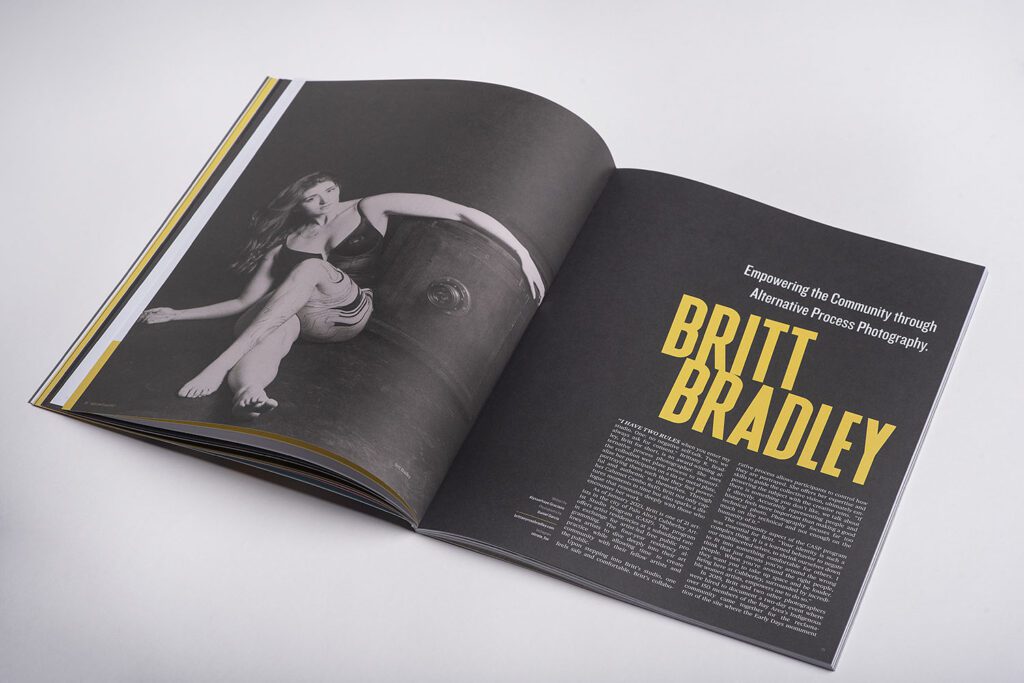
When not capturing people on a metal plate or tin, Britt is the collections care specialist at the Hoover Institution at Stanford University. This work allows Britt to use her technical skills in a different way. She currently lives in San Jose and is part of Silicon Valley Roller Derby. In an upcoming project, Britt will use the alternative photography process to document the eightwheeled sport, noting how it challenges athleticism and how it is presented in society.
Britt’s work goes beyond the visual, becoming a captivating narrative delving into history’s obscured corners. With a discerning eye and a genuine commitment to authenticity, Britt’s lens captures more than just images but also the essence of forgotten stories, inviting viewers to explore the complexities of our shared human journey.
“None of it is easy; it’s all slow,” Britt shares, referencing not only her art practice but life itself. “It’s a challenge to love and be in love in this day and age. All we can do is try. Try to be good to ourselves, and to our communities. In little ways, every day, we undermine ourselves. I think what is so important about being an artist is surrounding yourself with enough people who give you permission to stop doing that. Being able to be in a community that speaks your name in a room when you’re not in it—that’s the only way we get to push forward.”
Britt’s intentionality and care allow her to view problems not as problems but as indicators for deeper issues. “The truth exists somewhere between your experience and someone else’s. Perspective is a form of truth, but it doesn’t mean your perspective is the only truth.”
Instagram: nitrate_fox