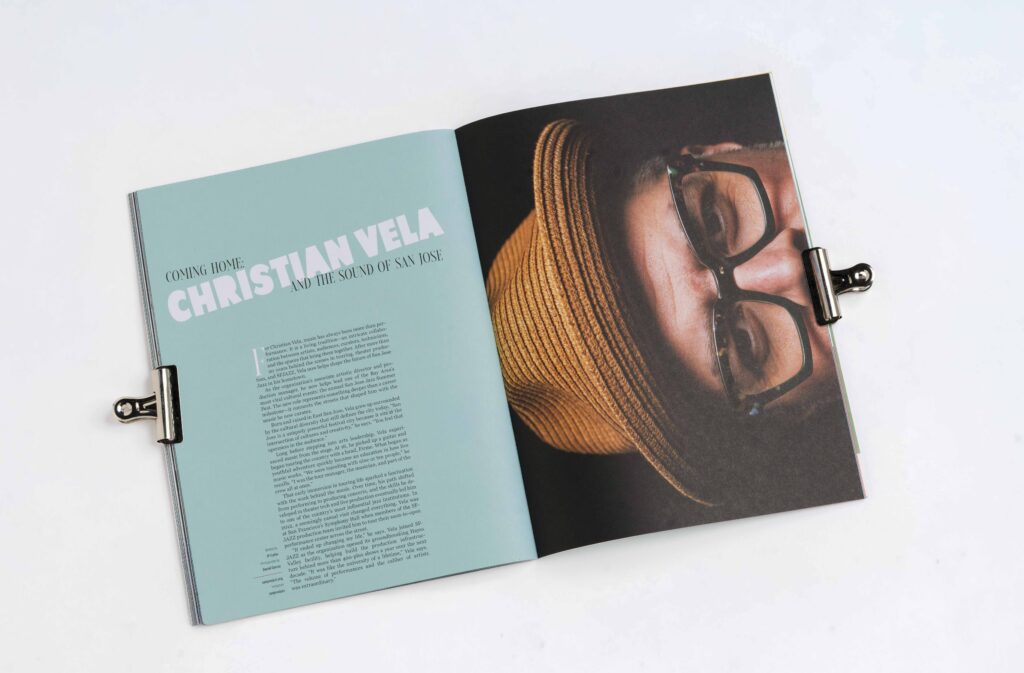
For Christian Vela, music has always been more than performance. It is a living tradition—an intricate collaboration between artists, audiences, curators, technicians, and the spaces that bring them together. After more than 20 years behind the scenes in touring, theater production, and SFJAZZ, Vela now helps shape the future of San Jose Jazz in his hometown.
As the organization’s associate artistic director and production manager, he now helps lead one of the Bay Area’s most vital cultural events: the annual San Jose Jazz Summer Fest. The new role represents something deeper than a career milestone—it connects the streets that shaped him with the music he now curates.
Born and raised in East San Jose, Vela grew up surrounded by the cultural diversity that still defines the city today. “San Jose is a uniquely powerful festival city because it sits at the intersection of cultures and creativity,” he says. “You feel that openness in the audience.”
Long before stepping into arts leadership, Vela experienced music from the stage. At 16, he picked up a guitar and began touring the country with a band, Firme. What began as youthful adventure quickly became an education in how live music works. “We were traveling with nine or ten people,” he recalls. “I was the tour manager, the musician, and part of the crew all at once.”
That early immersion in touring life sparked a fascination with the work behind the music. Over time, his path shifted from performing to producing concerts, and the skills he developed in theater tech and live production eventually led him to one of the country’s most influential jazz institutions. In 2012, a seemingly casual visit changed everything. Vela was at San Francisco’s Symphony Hall when members of the SFJAZZ production team invited him to tour their soon-to-open performance center across the street.
“It ended up changing my life,” he says. Vela joined SFJAZZ as the organization opened its groundbreaking Hayes Valley facility, helping build the production infrastructure behind more than 400-plus shows a year over the next decade. “It was like the university of a lifetime,” Vela says. “The volume of performances and the caliber of artists was extraordinary.”
The residency format at SFJAZZ created an environment where artists stayed for multiple nights. “You’re spending a week with each artist—rehearsals, sound checks, performances,” he explains. “You get to know the musicians, their families, their kids. Those relationships become incredibly meaningful.” During those years, Vela worked with artists across the global spectrum of jazz and soul—from acclaimed Cuban piano master Chucho Valdés and Mexican singer Lila Downs to funk and soul icons Lee Fields, Chicano Batman, and Fishbone.
He also helped produce large-scale institutional events, including the SFJAZZ Gala. “I love big production values,” Vela says. “I thrive with the challenge of bringing ambitious artistic ideas to life on stage.” Even as his career expanded across the Bay Area’s cultural landscape, including a stint as COO of Presidio Theatre, San Jose Jazz remained a familiar presence in his heart.
For the past four years, Vela has come to serve as production manager for San Jose Jazz Summer Fest, coordinating technical operations across the festival’s many stages. Summer Fest itself reflects the cultural rhythm of the city. Audiences can take in a Latin tropical dance set plus a show in the SJZ Break Room before witnessing an A-list headliner on the main stage. “That range mirrors the way people here live and listen,” Vela says. “Globally influenced, locally grounded, and very community oriented.”
Now stepping into a larger leadership role, Vela is helping guide the artistic vision of the festival while continuing to oversee the technical precision that makes it possible. His curatorial philosophy embraces jazz as both heritage and evolution. Vela often points to saxophonist Joshua Redman’s description of music as “tradition in transition.”
“That idea really resonates with me,” he says. “Jazz is a gift that America gave to the world. And now the world is giving us the next evolution of jazz.” As he enters his expanded role, Vela remains deeply mindful of the legacy built by longtime Artistic and Festival Director Bruce Labadie and the San Jose Jazz team. “I’m standing on the shoulders of giants,” he says. “Bruce built something really special here.”
But if Vela’s career has taught him anything, it is that the magic of music rarely happens in isolation. It is built through collaboration—between artists, crews, curators, and communities who gather around a shared experience. “This isn’t a festival people just attend,” Vela says. “It’s one they feel incredibly connected to.”
For a musician who has long called San Jose home, returning now feels natural. The stages may be bigger, but the mission remains the same: bringing people together through music.
Jon Dryden is a pianist, composer, professor of Jazz Studies at SJSU, and one of the 2025 Jazz Aid Fund grantees, performing at the San Jose Jazz New Works Fest on March 7 in the SJZ Break Room. We had the chance to pick his artistic brain on topics from what inspires him, how he balances the demands of teaching with composing while still earning enough to live, and his hopes and dreams for the Bay Area jazz scene.
Producer Jesse Harris describes Dryden’s playing as “somewhere between Vince Guaraldi and Paul Bley.” Others have called it “melancholy with a touch of hope,” says Jon Dryden. We think it’s dreamy, emotional, and layered–like crying while sitting under a grand piano when you’re a kid but still feeling comforted by it.
Dryden says for the Break Room show, “I’m bringing in a few amazing musicians whom I love to work with from New York and Los Angeles. The performance will open with a new piece called “Circada” and will include the SJZ grant-commissioned piece, “That Would Be Telling,”
The ensemble features Dryden on piano, Ben Flocks on tenor saxophone, Scott Colberg on bass, and Benjamin Ring on drums.
Dryden says the title, ”That Would Be Telling,” is “from a key phrase in the British Classic Spy-Fi seriesThe Prisoner, a show I watched with my students. It’s one of the most amazing and influential TV shows ever made. The music in the show is excellent too.”
When describing his inspiration and process, he shares, “I love metaphors, especially when they are used in subtle ways that cross artistic and psychological disciplines. Concepts like these give me an unwritten emotional framework I can draw from musically.”
The television show presents an argument between the individual and the collective. “It asks, how much of each mode of thinking–collectivity and individuality– should exist in a society? Does a collective society lead to homogenization and surveillance states?”
Whether collective societies lead to homogenization remains to be seen. However, Dryden acknowledges that it’s nearly impossible to have a thriving jazz scene without one strong type of collective: community.
”I love what the SJZ Break Room isdoing, which is establishing a place to play, listen and mingle, he says.”
However, he admits that it can be tough to maintain the sense of community he experienced in New York, where most venues are located in a smaller geographic area.
“The Bay Area Jazz scene has many amazing musicians, but is so spread out that there’s no center where people can congregate.”
Community means so much, says Dryden, because “we need each other, and we need to be around people who are better musicians than us. What I would like to see much more of is more friendly competition–people kindly challenging one another to grow musically and to share ideas.” Without friendly competition, he says, creativity can falter.
A robust community not only provides a center of gravity where jazz-lovers and performers can congregate, commune, and compete, but it creates a place to network and radically imagine new possibilities. New possibilities inspire not only new works of art but also new music students, new venues, and new job opportunities–something sorely needed to sustain Bay Area musicians.
“The hyphenated life is a common career for most musicians,” says Dryden, referring to the multiple streams of income that he depends on in order to afford the cost of living in Aptos, to which he returned in 2010 to care for his dad after living and working for 19 years in New York City.
The way Dryden describes the New York City Jazz scene conjures up complex feelings, much like his compositions do. His words bring up feelings and images, like the melancholy yet intensely alive takes he gives to popular songs he covers, like Nirvana’s All Apologies. He mentions venues, all close to one another, in a relatively condensed space. Images of happy, dreamy couples and groups of people weaving their way into and out of vibrant jazz clubs all close together–“that’s hard to beat, even when you have small hubs like those in San Francisco and the East Bay,” Dryden explains.
Prior to returning to his native California, Dryden was “solely making a living as a performing musician/composer/arranger/producer. Since I moved back home to Aptos, I’ve added instructor and lecturer to those skills.”
Some working musicians, says Dryden, have their hands in a lot of pots because “many of us love a lot of different kinds of music.” No exception, he cites musical influences as diverse as Shostakovich, Scriabin, and Smith–Elliot Smith, that is. He also loves Prince. Dryden himself has collaborated with an impressive group of musicians–Michael Urbaniak, Patrice Rushen, and the Brecker Brothers, to name a few. He has recorded with several stratospheric megastars–Questlove, Norah Jones, David Byrne, Dave Chappelle, and John Mayer. And if those accomplishments weren’t remarkable enough, he has also composed for both Michael Moore and David Byrne–both heroes’ heroes.
He finds inspiration both in the incredible musicians he loves playing with and in his students. “They know a lot of things I don’t, and they have new music they’re listening to that I’m not aware of. I like to hear what they are into musically. Some of my students write pieces that aren’t anything like what I would come up with. I love to see that. Semi-consciously, I pick up their concepts and sometimes I work bits–no stealing, mind you. Just bits–into my compositions.“
While he wishes he could devote more time to composing, “teaching earns me more than half my income and consumes less time.” And still, he admits that he could not afford living in Santa Cruz County without his family house, where he lives. So, the multi-hyphenate grindlife continues, and while he doesn’t know the answer to the economic woes that drives musicians out of urban areas they can no longer afford, he does hope that “scenes will start to percolate in unexpected places.”
Dryden started piano lessons at five and began composing not long after. ”The compositions weren’t very good then, of course; but I have always associated performing and composing as one thing,” he says.
While he has strong ideas about composition and excellence, his view on interpreting music is more open-ended: “I like music to be whatever the listener wants it to be. One role a composer/songwriter can take on is making the personal universal.”
Check out the Jon Dryden Quartet at SJZ Break Room for New Works Fest, Friday, March 7 at 8p (Doors open at 7:30p). Tickets. Livestream.
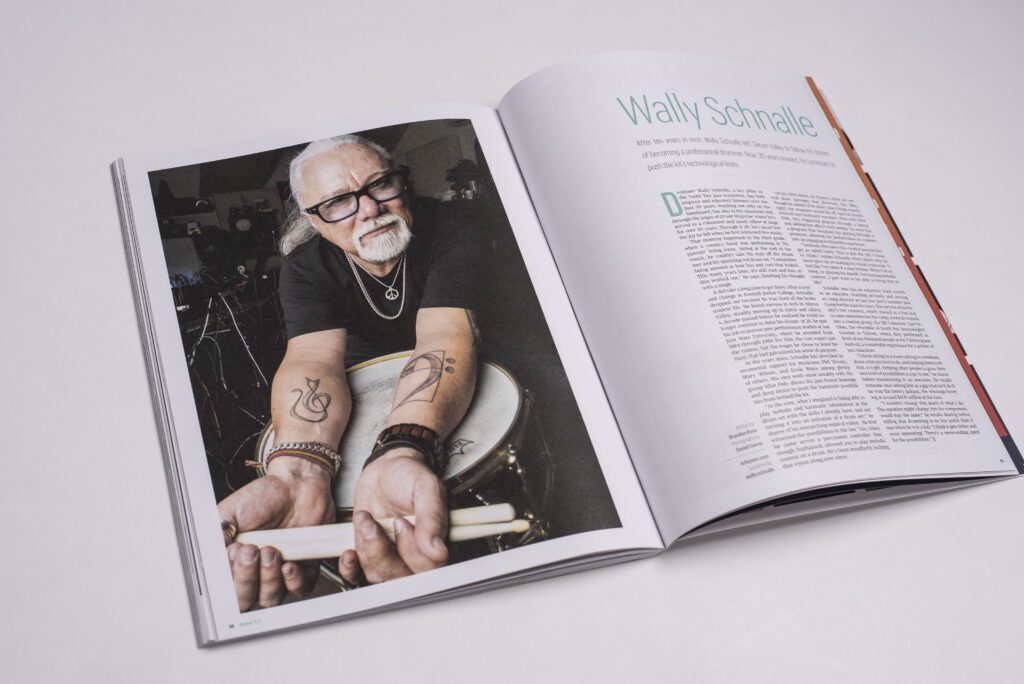
Drummer Wally Schnalle, a key pillar in the South Bay jazz ecosystem, has both inspired and educated listeners over the past 30 years, teaching not only on the bandstand but in the classroom and through the pages of Drum! Magazine, where he’s served as a columnist and music editor at large for over 20 years. Through it all, he’s never lost the joy he felt when he first witnessed live music.
That moment happened in the third grade, when a country band was performing in his parents’ living room. Sitting at the end of the couch, he couldn’t take his eyes off the drummer and his sparkling red drum set. “I remember being amazed at how fun and cool that looked. This many years later, it’s still cool and fun, so that worked out,” he says, finishing his thought with a laugh.
However, it did take a long time to get there. After a year and change at Foothill Junior College, Schnalle dropped out because he was tired of the broke student life. He found success in tech in Silicon Valley, steadily moving up in status and salary. A decade passed before he realized he could no longer continue to defer his dream—at 28, he quit his job to pursue jazz performance studies at San Jose State University, where he attended from 1984 through 1989. For him, the cost wasn’t just the tuition, but the wages he chose to leave behind, galvanizing his sense of purpose.
In the years since, Schnalle has provided instrumental support for Phil Woods, Mary Wilson, and Ernie Watts, among plenty of others. His own work—most notably with the group Idiot Fish—shows his jazz fusion leanings and deep desire to push the harmonic possibilities from behind the kit.
“At the core, what I imagined is being able to play melodic and harmonic information at the drum set with the skills I already have, and not turning it into an imitation of a drum set,” he shares of his overarching musical vision. He first witnessed the possibilities in the late ’70s, when he came across a percussion controller that, though haphazard, allowed you to play melodic content on a drum. He’s been steadfastly inching that vision along ever since.
On his 1994 debut, (it rhymes), there are several short passages that showcase this idea, though he admits if he didn’t play things exactly right, the sequence would be off. Special drums evolved into keyboard vocoders. Now with Idiot Fish, he’s triggering plug-ins through a laptop and adding live effects with pedals. He even has a program that visualizes his playing through a projector, allowing the performance to coalesce into an engaging multimedia experience.
“Anybody who takes this creative journey has got an uphill battle. This is just the hill I chose to climb,” replies Schnalle when asked why he never gave up on making his vision come true. “I feel like I’ve taken it a step further. When I’m soloing, or playing by myself, I’m hearing melodic content…I just want to be able to bring that to life.”
“I think sitting in a room talking to somebody about what you love to do, and helping them to do that, is a gift. Helping other people to grow their own level of possibilities is a joy to me.”
Schnalle also has an extensive track record as an educator, teaching privately and serving as camp director at San Jose Jazz’s Summer Jazz Camp for the past six years. The success of his faculty’s live concerts, which started as a fun way to raise awareness for the camp, has evolved recently into a touring group, the SJZ Collective. Last October, the ensemble of South Bay heavyweights traveled to Taiwan, where they performed in front of ten thousand people at the Taichung Jazz Festival, a remarkable experience for a quintet of jazz educators.
“I think sitting in a room talking to somebody about what you love to do, and helping them to do that, is a gift. Helping other people to grow their own level of possibilities is a joy to me,” he shares before transitioning to an anecdote. He recalls someone once asking him at a gig what he’d do if he won the lottery jackpot, the winnings hovering at around $400 million at the time.
“I wouldn’t change that much of what I do. The equation might change, but the components would stay the same,” he recalls sharing before adding that drumming is no less joyful than it was when he was a kid. “I think it gets richer and more interesting. There’s a never-ending quest for the possibilities.”