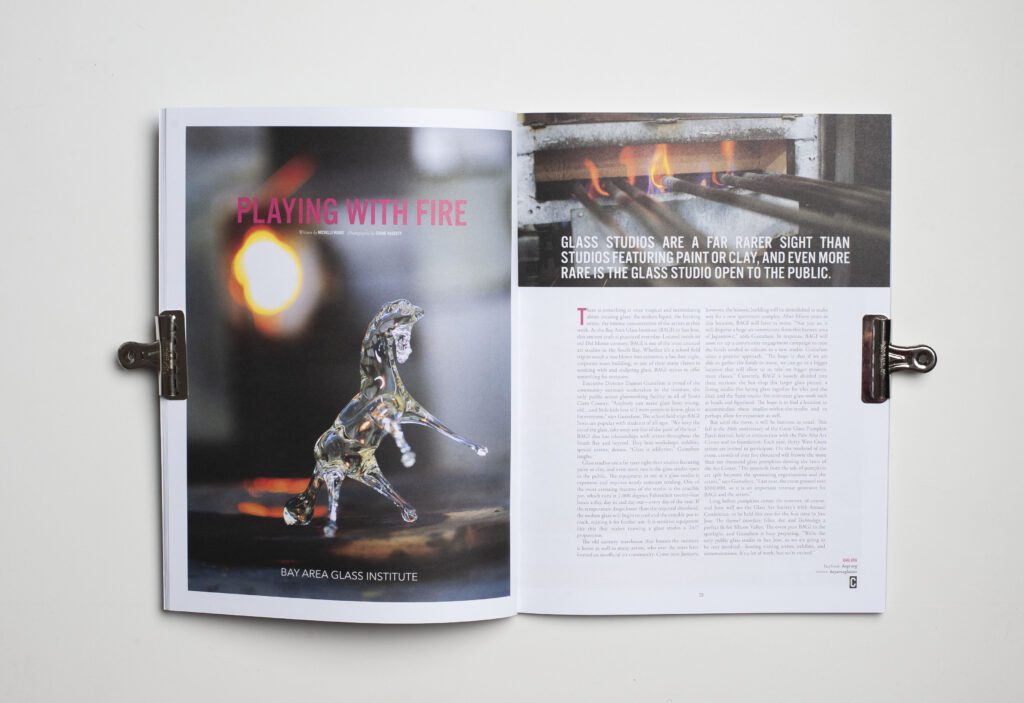
There is something at once magical and intimidating about creating glass: the molten liquid, the burning ovens, the intense concentration of the artists as they work. At the Bay Area Glass Institute (BAGI) in San Jose, this ancient craft is practiced everyday. Located inside an old Del Monte cannery, BAGI is one of the most unusual art studios in the South Bay. Whether it’s a school field trip to watch a vase blown into existence, a fun date night, corporate team building, or one of their many classes in working with and sculpting glass, BAGI strives to offer something for everyone.
Executive Director Damon Gustafson is proud of the community outreach undertaken by the institute, the only public access glassworking facility in all of Santa Clara County. “Anybody can make glass here: young, old…and little kids love it! I want people to know, glass is for everyone,” says Gustafson. The school field trips BAGI hosts are popular with students of all ages. “We keep the joy of the glass, take away any fear of the ‘pain’ of the heat.” BAGI also has relationships with artists throughout the South Bay and beyond. They host workshops, exhibits, special events, demos. “Glass is addictive,” Gustafson laughs.
GLASS STUDIOS ARE A FAR RARER SIGHT THAN STUDIOS FEATURING PAINT OR CLAY, AND EVEN MORE RARE IS THE GLASS STUDIO OPEN TO THE PUBLIC.
Glass studios are a far rarer sight than studios featuring paint or clay, and even more rare is the glass studio open to the public. The equipment in use at a glass studio is expensive and requires nearly constant tending. One of the most arresting features of the studio is the crucible pot, which runs at 2,000 degrees Fahrenheit twenty-four hours a day, day in and day out—every day of the year. If the temperature drops lower than the required threshold, the molten glass will begin to cool and the crucible pot to crack, ruining it for further use. It is sensitive equipment like this that makes running a glass studio a 24/7 proposition.
The old cannery warehouse that houses the institute is home as well to many artists, who over the years have formed an unofficial art community. Come next January, however, the historic building will be demolished to make way for a new apartment complex. After fifteen years in this location, BAGI will have to move. “Not just us, it will disperse a huge art community from this historic area of Japantown,” adds Gustafson. In response, BAGI will soon rev up a community engagement campaign to raise the funds needed to relocate to a new studio. Gustafson takes a positive approach, “The hope is that if we are able to gather the funds to move, we can go to a bigger location that will allow us to take on bigger projects, more classes.” Currently, BAGI is loosely divided into three sections: the hot shop (for larger glass pieces), a fusing studio (for laying glass together for tiles and the like), and the flame studio (for miniature glass work such as beads and figurines). The hope is to find a location to accommodate these studios-within-the-studio and to perhaps allow for expansion as well.
But until the move, it will be business as usual. This fall is the 20th anniversary of the Great Glass Pumpkin Patch festival, held in conjunction with the Palo Alto Art Center and its foundation. Each year, thirty West Coast artists are invited to participate. On the weekend of the event, crowds of over five thousand will browse the more than ten thousand glass pumpkins dotting the lawn of the Art Center. “The proceeds from the sale of pumpkins are split between the sponsoring organizations and the artists,” says Gustafson. “Last year, the event grossed over $300,000, so it is an important revenue generator for BAGI and the artists.”
Long before pumpkins comes the summer, of course, and June will see the Glass Art Society’s 44th Annual Conference, to be held this year for the first time in San Jose. The theme? Interface: Glass, Art, and Technology, a perfect fit for Silicon Valley. The event puts BAGI in the spotlight, and Gustafson is busy preparing. “We’re the only public glass studio in San Jose, so we are going to be very involved—hosting visiting artists, exhibits, and demonstrations. It’s a lot of work, but we’re excited.”
Instagram: bayareaglassinstitute
635 Phelan Ave, San Jose, California 95112