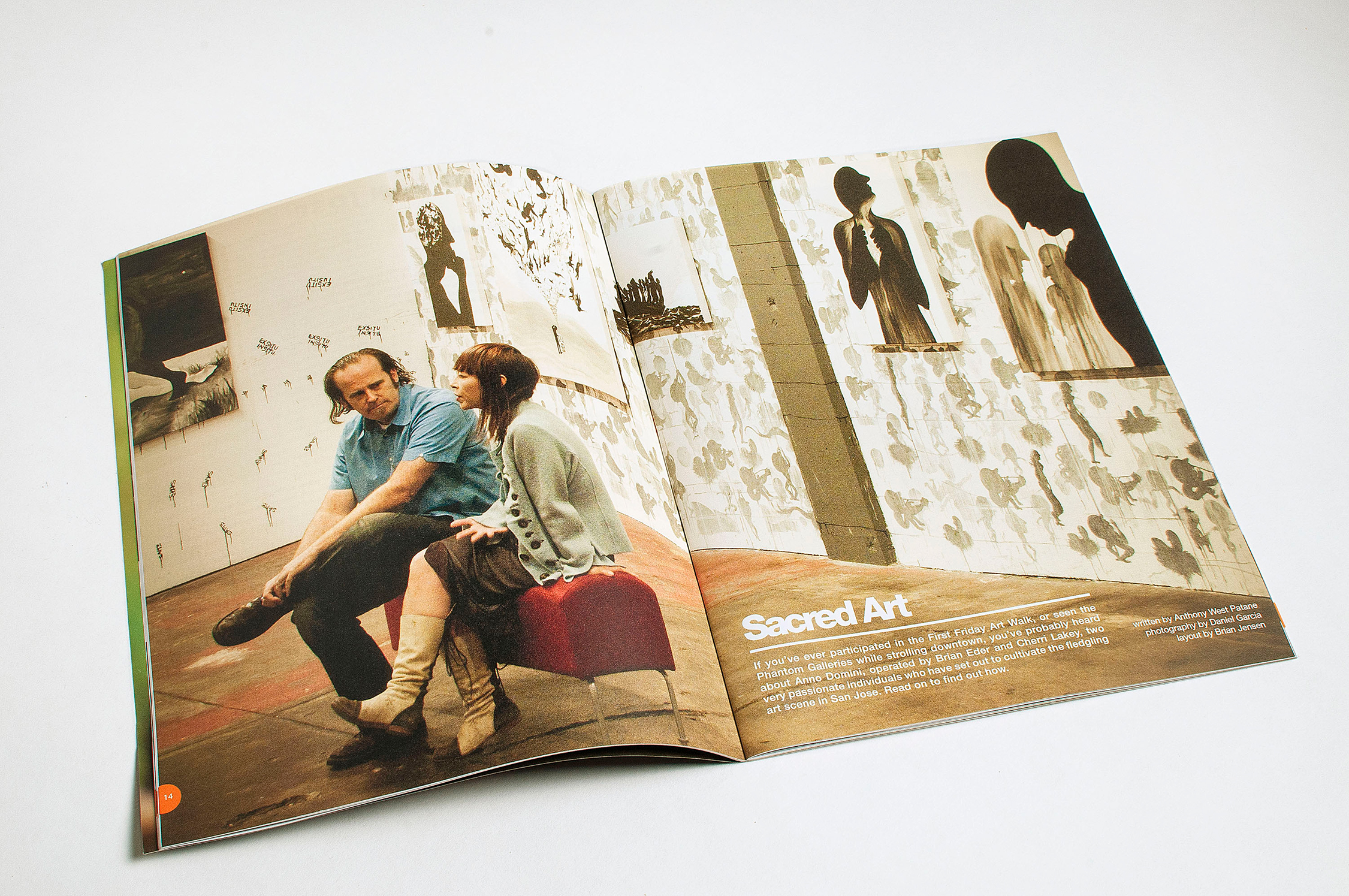
If you’ve ever participated in the First Friday Art Walk, or seen the Phantom Galleries while strolling downtown, or been in to Kaleid Gallery, you’ve probably heard about Anno Domini, operated by Brian Eder and Cherri Lakey, two very passionate individuals who have set out to cultivate the fledgling art scene in San Jose.
How did Anno Domini come to fruition and what are you guys all about?
CHERRI: In 2000, graffiti actually became a felony instead of a misdemeanor, so that was jail time. We really loved the street art that was happening in San Francisco in 98-99, the time when you’d see something really beautiful every day, and then 3,4, or 5 months later it was just gone, and it was just heartbreaking. So we really took an interest in the artists. There were maybe 2 galleries at the time showing street art. We really wanted to be involved in that and Brian had somewhat of an art background already, so we just had to find our place. We knew we wanted to start our own graphic design company. And then it was a matter of, do we go to San Francisco where we already feel like it’s a scene and has support, or do we go to a place like San Jose where it’s zero tolerance, it’s much harder, and there is less of a scene? Don’t they need it more? And couldn’t we build something of our own? We chose San Jose.
BRIAN: I lived here before, and I think the campaign back in the mid-eighties was “San Jose is growing up.” And I remember “San Jose is throwing up” would always go through my mind because there was nothing happening. It was so devoid of life in a lot of ways, at least it seemed like it at the time. And the things that would start up, the cool kinds of places, they would disappear so quickly. Where was the culture? Only New York, San Francisco, Los Angeles? We wanted a place kind of like where Warhol and his friends would have hung out back in the 70’s, where people talked about everything from politics and religion to street art. And that’s the whole reason we started the gallery. In the beginning it was just wanting to get together with other like-minded people.
CHERRI: It was during the dotcom boom. There was a vibe down here; startups all the time, crazy creative people with two guys sleeping under a desk. We really thrived off that.
How do you think the scene here in San Jose differs from that of LA and SF?
BRIAN: For someone here to get attention on any level they really have to work a lot harder and we think that just makes for stronger artists. But at the same time, what’s happening in San Jose, especially in the past, was that artists would get to a certain age and they would leave, they would move to another city. So right when you got artists to a place where they could start creating here, they were taking off because they didn’t see being able to survive in San Jose doing their art.
CHERRI: It becomes a portal. The city and the artist invests so much into going to school here or trying for awhile. San Francisco is 45 minutes away. You can live really cheap and there are hundreds of galleries to plug into right away in terms of an art scene. And LA is not that far either, so every city has to say, what are we doing to really support them so they can live and work here? When we started 10 years ago, nobody was talking about artists. It was all about the tech industry, biogenetics, all this crazy stuff, and we would stand up at the end of a meeting and just go, “what about artists?” And they would sort of look at us like they had no idea what we were talking about. It was a real battle and we tried to find a bridge where we could work with artists, but also be a city liaison too because if you know anything about the digital culture and what’s coming, these are the bright minds that are starting these companies or being hired, mainly because these companies need musicians, and artists and poets. They can teach anybody the rules of accounting, manufacturing rules, but who’s going to think of the next big thing? Who’s gonna say, well why can’t we do this? They start with a blank canvas and they create something no one has ever seen before. And that’s who the companies want. So there’s this thing going on where the MFA is the new MBA. We need to cultivate that if we want tech companies to stay here too. They need to have a creative pool to hire from. But we need artists that live and work and thrive being artists. Hopefully there is some harmony there and some opportunities.
Can you tell us about the Phantom galleries, what you’ve done with that, and how it’s a part of the San Jose Downtown project?
BRIAN: With the dotcom crash, we would be walking around downtown and the biggest thing that was standing out was people just walking the streets staring at the ground past empty businesses and dying restaurants. On the weekends, it was literally a ghost town. We put in the phantom galleries by arguing that the empty storefronts were public space. At first it wasn’t seen that way, but at the end we finally got the project in there and it’s one of only two projects since 2001 that is still running.
CHERRI: At our peak we had 15 spaces going. It was insane! Our contract was to do a dozen installations over the year and we ended up showing 150 artists the first year. And we went back with a binder and said, we have this many artists wanting to show. We’re in our 8th year now.
BRIAN: It was about artists being part of economic progress in a city. That entire area is rented out now.
Do you have any advice for upcoming artists that are trying to break through?
BRIAN: I’ll use David Choe as an example. He did a show in Los Angeles at an ice cream parlor and the next time we saw his work in San Jose, it was 18in a hair salon. He wasn’t afraid to do it and there was nothing really beneath him in the beginning. It was just about getting his work out there. And there are a lot of artists that start out where they’re already too good for places. It’s just about doing the work and being open to possibilities and not slamming the door on an opportunity because it could be a bigger deal than you imagined.
How about you, Cherri? Advice for the upcoming artist?
CHERRI: The most successful artists we’ve seen do their art every day because it’s who they are. There are artists, where it’s a hobby, it’s fun, it’s a relaxing thing for them, and that’s great. So put that into context too. But typically the artists who are like, there is no plan B, this is it, this is what keeps them sane and they do their work with or without anyone noticing.
BRIAN: Artists have to understand the gallery. If you’re a punk band, you don’t go to the opera house and ask for a gig.
CHERRI: And then be upset when you don’t get it.
What would you both like to see happen in San Jose in the future, specifically in the art scene?
CHERRI: Fifty more galleries, first of all.
BRIAN: More of an art buying culture. People would be really surprised about the kind of art that comes through San Jose. Besides having amazing local art, there is amazing international art being exhibited here. With all the wealth that’s in the Bay Area, it’s not romantic in their minds right now to buy their art in San Jose, so they think, I’ll just go to New York and buy this or that artist. There are artists being exhibited and blowing up in Europe and New York that have come through here.
CHERRI: More of an appreciation of the culture that thrives here. San Jose has a history of a more institutional and academic art scene. I think we are the only non nonprofit gallery downtown right now. But there are people doing amazing things in their basements and garages and down the street. San Jose has the same sort of habit of trying to bring artists in from fairs and stuff from outside, but I know a guy two blocks away who blows those artists away. So why are we not giving them more opportunities?
And it’s not San Jose’s fault; it’s a matter of people realizing it, being a part of the culture, and giving them opportunities. That’s sort of what we try to do with the street market and with Subzero. Let’s bring them out and bring them topside. We tend to gravitate to subculture and people under the radar. You know, a lot of them want to be there, they like flying under that radar.
BRIAN: It’s because mainstream doesn’t need anyone’s help. It’s already been embraced. And where’s the fun in that?
CHERRI: It’s fun for all of us in the underbelly to come up topside and get together and have one big party. It’s cool, because the mainstream comes and they feel safe. They are shocked a lot of times, especially when the artists are saying they’re from San Jose!
What is sacred for you about Anno Domini? What sets it apart?
CHERRI: Anno Domini is family. I grew up as an outcast, without friends, in a very small town in the Midwest and I never fit in. So when I found Brian, to find someone who is definitely my other half, that’s one huge life-changing thing. But then together, to create a place where we asked, where are the musicians and where are the poets, where are those people that we can debate with about all these amazing things? And then to suddenly have them in this box. Cause really that’s all Anno Domini is. It’s just a box. It’s just walls, a floor, and a roof. And to feel like you’ve found your people, your like-mindedness, you’ve found friends…the real definition of friends. People that step up every single time in the most amazing way. Consistently. That, for me, is the most sacred part of it. It’s interesting that you use the word “sacred” because we had a girl here and she was telling me how much she loved Anno Domini and I realized how much her eyes were starting to well up and starting to cry. She said Anno Domini was her church, where she gets her inspiration to keep doing that nine-to-five thing everyday, day after day. It’s amazing.
BRIAN: To us, it is a sacred space. It’s this place where ideas are born. We curate the artists, we don’t curate their work. A lot of places you go into, especially bigger institutions, they want to tell you why something is art and to us, the question is more important. If you come to it like you have all the answers, you’ll never get anything out of it. But we try to walk in here as if we don’t have the answers and keep looking at everything as if it were new.
How would you describe the artwork you feature?
BRIAN: We refer to it as urban contemporary, and that’s about as tight as we want to get. The idea is that it’s by someone who lives in a big city, who really lives in it. And that comes through their music or poetry, or the art that’s there.
CHERRI: Artists will sometimes say to us, I can be this or that. We just want you to be you. And whether or not it fits with us is fine, but that’s the only criteria. We give a lot of debut solos and it’s not smart business to give an artist their first solo show. But our thing is, we knew a long time ago that we were in this for moving the culture forward and for art history. We know that someday, somebody is going to look at our history and say, something happened here, something came out of here.
BRIAN: That’s more important than how much money is in our bank accounts.
CHERRI: We know there are still a lot of artists out there that don’t know about us and we don’t know about them, but we would love to! The biggest thing we always say about Anno Domini is the inspiration part. A lot of times, we bring art here because we want people to realize what’s going on in the world. If you come in and say, “I could do that,” great! Do it! The best thing we hear is when a kid says, “I’d love to stay, but I really want to go home and paint.” Cool, we have done our job for the night, you know? That’s it!